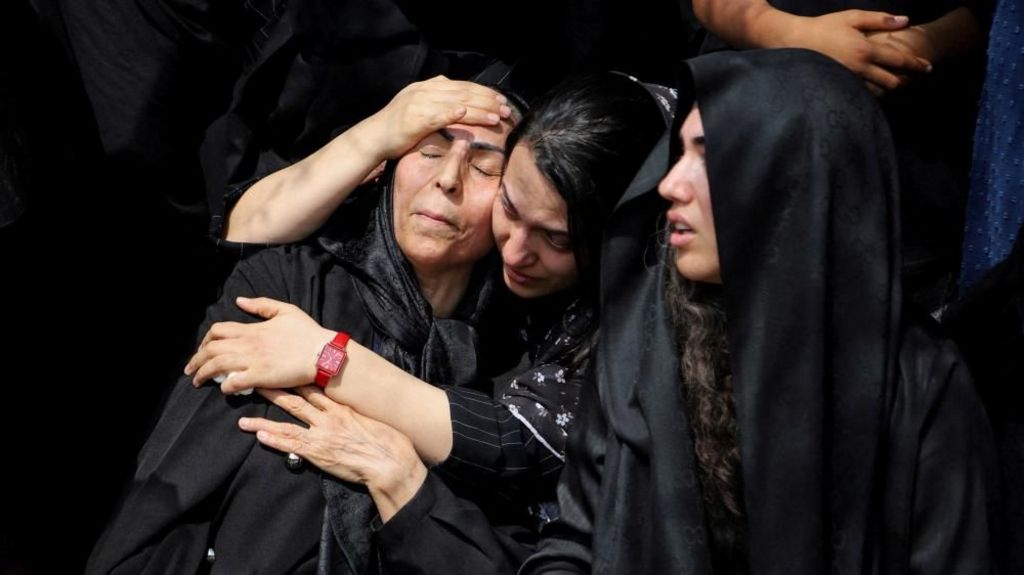
Two months after a deadly missile strike hit a primary school in Minab, Iran, during the opening phase of the US-Israeli military campaign on February 28, a group of five former senior US officials have publicly condemned the Pentagon for its prolonged refusal to acknowledge potential American responsibility for the incident, which killed 168 people including roughly 110 children per Iranian government figures.
The Pentagon has issued only one public update since the strike, stating that the incident remains under investigation. When the BBC submitted a series of detailed questions about the strike and allegations of institutional secrecy, a Pentagon spokesperson repeated only that the inquiry is ongoing, noting that additional information would be released once it becomes available. Independent US media reporting in early March, however, has cited unnamed military sources confirming that preliminary investigative work suggests American forces likely struck the school by accident, though no final formal conclusion has been released. Those same reports trace the error to outdated target coordinates provided by a US intelligence agency; the missile was intended for an adjacent Iranian Revolutionary Guard Corps (IRGC) military base, a target the Pentagon has repeatedly refused to confirm was on its list of pre-planned February 28 strikes, despite publicly disclosing details of dozens of other targets hit during the opening of the war.
The BBC has independently verified authentic video footage showing a US Tomahawk missile striking the IRGC base adjacent to the destroyed school, corroborating the core claims of the earlier anonymous media reports. In contrast to the Pentagon’s current two-month silence, a BBC analysis of three high-profile past cases of civilian fatalities from US military operations found that in every instance, the Pentagon released substantial, detailed information to the public in less than 30 days.
Retired US Air Force Lieutenant Colonel Rachel E. VanLandingham, a former top legal adviser at US Central Command (CENTCOM) during the Iraq and Afghanistan wars and one of the critics of the current response, called the Trump administration’s approach a “striking departure” from long-standing Pentagon standard operating procedures. VanLandingham noted that past US administrations, regardless of party, at least paid public lip service to upholding the laws of war and commitments to accountability. What is missing from the current administration’s statements, she argued, is any pledge to take responsibility and take steps to prevent similar civilian tragedies in the future.
Wes Bryant, a former senior advisor for precision warfare and civilian harm mitigation at the Pentagon’s Civilian Protection Center of Excellence who left the department last year after Defense Secretary Pete Hegseth drastically cut staffing for the civilian harm unit, told the BBC that the Pentagon’s current investigative process itself confirms officials already know US forces were responsible. Bryant explained that formal investigations are only launched after a preliminary inquiry confirms two key facts: that civilian harm occurred, and that US forces were operating in the area and could have caused the incident. “From a process standpoint… that just points even more to the fact that they know already that the US caused this or else they wouldn’t be doing this investigation, and they just don’t want to acknowledge it or speak to it,” Bryant said, adding that the complete refusal to comment on any details of the incident is “unacceptable.”
One anonymous former senior defense official agreed that while complex civilian harm investigations can take extended time, the level of secrecy in this case is entirely unwarranted. “But this is a case where… it’s unusually opaque in that I can tell from the situation it’s actually not that complicated,” the official told the BBC. “Normally the Pentagon would take immediate [or] relatively fast responsibility and then probably require a longer period of time to provide all the details, so to me it’s problematic.”
Top congressional Democrats have repeatedly pressed Hegseth for answers, starting with a basic confirmation of whether US forces carried out the strike. The BBC has reviewed two formal response letters sent by the Pentagon on Hegseth’s behalf, neither of which answers any of the Democrats’ core questions. A most recent April 2 letter only confirmed that an investigating officer outside the CENTCOM chain of command has been appointed, and that results would be shared after the inquiry concludes. When the BBC reached out to 15 Republican members of Congress, including top leaders of House and Senate national security committees, all declined to comment on the administration’s handling of the strike. Only one Republican senator, John Kennedy of Louisiana, has publicly broken rank, telling the *New York Times* in March that “I think we made a mistake. It was a terrible, terrible mistake.”
During closed-door congressional briefings on Iran war operations, Pentagon officials have repeatedly declined to answer questions about the Minab strike, citing the ongoing investigation. Adam Smith, the top Democrat on the House Armed Services Committee, called that response “pathetic and completely inadequate,” confirming that officials have refused to admit US responsibility even in private.
The pattern of silence from current administration officials lines up with public comments from President Donald Trump, who has repeatedly denied any knowledge of evidence linking US forces to the strike and without evidence blamed Iran for the deaths. On March 7, Trump claimed Iran was responsible for the strike. Days later, when asked about verified video of a US Tomahawk hitting the adjacent military base, he claimed he had not seen the footage and falsely asserted that Iran also possesses Tomahawk missiles. When pressed later about reports that a preliminary probe found US forces were responsible, he again said he had no knowledge of the incident. Hegseth similarly told the BBC in March that “All I can say is that we’re investigating that. We of course never target civilian targets.”
To contextualize the current response, the BBC compared the Minab incident to three prior high-profile cases of civilian deaths from US strikes across different administrations: the 2021 Kabul airport drone strike that killed 10 civilians including seven children, the 2015 MSF hospital bombing in Kunduz that killed 42 people, and the 1991 al-Amiriyah shelter bombing in Baghdad that killed 408 civilians. In all three cases, even when the US initially denied responsibility, senior officials acknowledged the strike and released substantial public details within a month at most, contrasting sharply with the two-month silence in the Minab case.
Annie Shiel, a former State Department official focused on civilian harm reduction who now serves as US Advocacy Director for the Center for Civilians in Conflict (CIVIC), noted that the appointment of an external investigator is at least a nominal step toward procedural independence, but argued that any US role should be acknowledged publicly even before the full investigation concludes. Shiel added that past US administrations have often been forced to reverse initial denials after independent reporting confirms US responsibility, a pattern the current administration seems intent on avoiding by saying nothing at all.
Independent corroboration of the strike’s details has been further complicated by the Iranian government’s refusal to grant independent investigators or journalists access to the blast site. The UN Fact Finding Mission on Iran announced March 17 that it had formally requested access to Minab but been denied permission to visit.
Charles O Blaha, a 32-year veteran of the US foreign service and former director of the State Department’s Office of Security and Human Rights, now a senior advisor to Democracy for the Arab World Now (DAWN), said the administration’s lack of transparency most likely stems from a reluctance to contradict President Trump, who already publicly and falsely blamed Iran for the strike. Blaha called Trump’s claim “really far-fetched and very clearly not true,” adding that the silence also reflects the administration’s broader pattern of dismissing any negative news about the Iran war as unpatriotic.