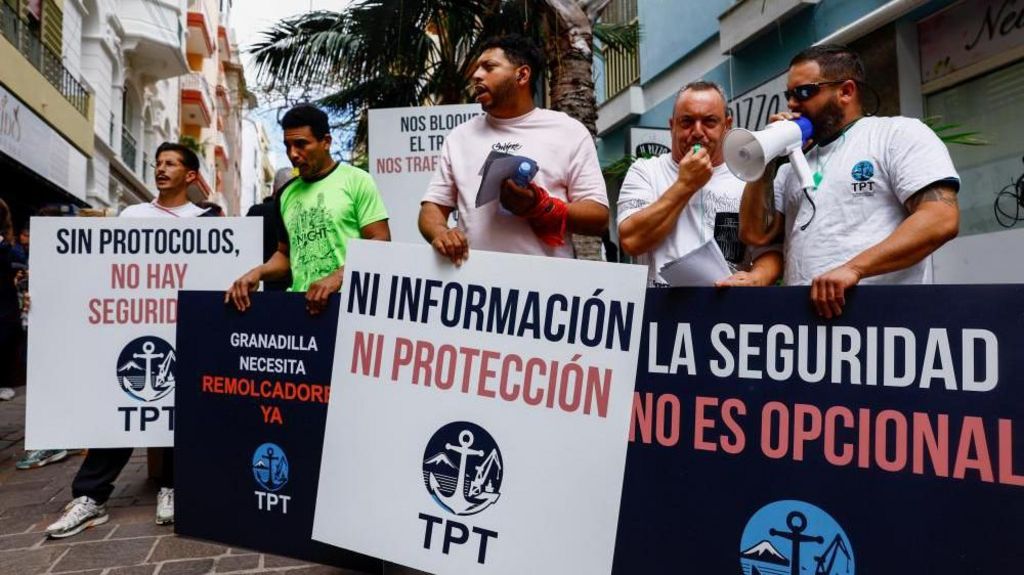
Tensions are running high on the Spanish island of Tenerife this week as local residents and port workers push back against a national government agreement to allow the hantavirus-exposed cruise vessel MV Hondius to disembark its passengers this weekend. The ship, which departed Cape Verde after three infected people were evacuated and local authorities refused it docking access, is heading for Canary Islands waters after the Spanish administration struck a deal with the World Health Organization (WHO) to accept the passengers. The plan has sparked widespread anger and anxiety across the archipelago, amplifying existing frustrations over ongoing migration pressures.\n\nOn Friday, dozens of port workers gathered outside the Canary Islands regional parliament in Santa Cruz de Tenerife to demonstrate against the docking arrangement. Blowing whistles, sounding vuvuzelas and holding signs highlighting their safety concerns, protesters said they have not been given adequate protection or clear information about the vessel’s arrival. Joana Batista, a representative of the local port workers’ union speaking at the rally, said workers were uncomfortable being assigned to the port without special safety protocols when an infected ship was approaching. Some union members have threatened to block the ship’s access to the island if their demands for full protection and transparency are not met. Batista added that while the ship may be allowed to dock, it must do so with all necessary public health safeguards in place, and local residents deserve full clarity on passenger movement and potential risks to the community.\n\nFor many local residents, the arrival of the cruise ship has compounded long-simmering frustration over the Canary Islands’ status as a primary entry point for thousands of undocumented migrants arriving from North and West Africa. Nutritionist María de la Luz Sedeño, who observed the protest, called the ship’s planned arrival the “last straw” for local residents tired of bearing the brunt of unaddressed international crises. While some Canary islanders take pride in welcoming migrant arrivals, others share Sedeño’s frustration, and the crisis has become a unifying point of discontent for many who feel the national government ignores local input. According to NGO Caminando Fronteras, more than 3,000 people died attempting to reach the Canary Islands in 2025, most traveling in unsafe makeshift dinghies. The ongoing migration situation will draw global attention next month when Pope Leo is scheduled to visit the islands to meet with migrants and aid organizations. Sedeño also criticized the central government for overriding clear opposition to the cruise ship’s arrival from Canary Islands regional president Fernando Clavijo, saying “the people here are not being listened to.”\n\nIn response to accusations of overreach and lack of transparency, the Socialist-led national government has released full details of its public health plan for the vessel’s arrival. Instead of docking directly at a populated Tenerife port, the MV Hondius will anchor offshore, and passengers will be transported via ferry to the remote Granadilla industrial port in the island’s southeast, far from residential neighborhoods. After disembarkation, all foreign passengers will be immediately repatriated, while the 14 Spanish nationals on board will be transferred to Madrid for quarantine. Virginia Barcones, head of Spain’s civil protection agency, emphasized that authorities have taken all steps to ensure no contact between passengers and local residents, guaranteeing that local communities will be “absolutely and completely protected.”\n\nThe government’s detailed plan has eased concerns for some Tenerife residents. Marialaina Retina Fernández, a local pensioner, said she feels calmer now that clear information has been released. Noting that the Canary Islands have access to high-quality local healthcare, she expressed cautious acceptance of the temporary presence of the ship’s passengers. “It’s not ideal that they all end up coming here, but if the authorities say they’ll do everything possible to make sure nobody gets infected, let’s hope that’s how it is,” she said.\n\nDespite the government’s public health safeguards, far-right party Vox has sought to politicalize the issue by drawing parallels between the cruise ship arrival and undocumented migrant arrivals. Meanwhile, many local residents say the arrival of a multi-national ship with a viral outbreak brings unwanted flashbacks to the early days of the COVID-19 pandemic, when the first confirmed COVID case in Spain was a German tourist on nearby La Gomera, followed by the quarantine of 1,000 hotel guests and staff on Tenerife. Both the WHO and the Spanish government have explicitly pushed back on comparisons to the COVID-19 pandemic, downplaying the epidemiological risks of the current hantavirus situation. Still, many residents remain on edge. Retina Fernández, for her part, framed the situation as just another crisis the Canary Islands have been forced to manage, noting “we’re used to all sorts of problems arriving here, and you can see that we’re good at managing these situations.”