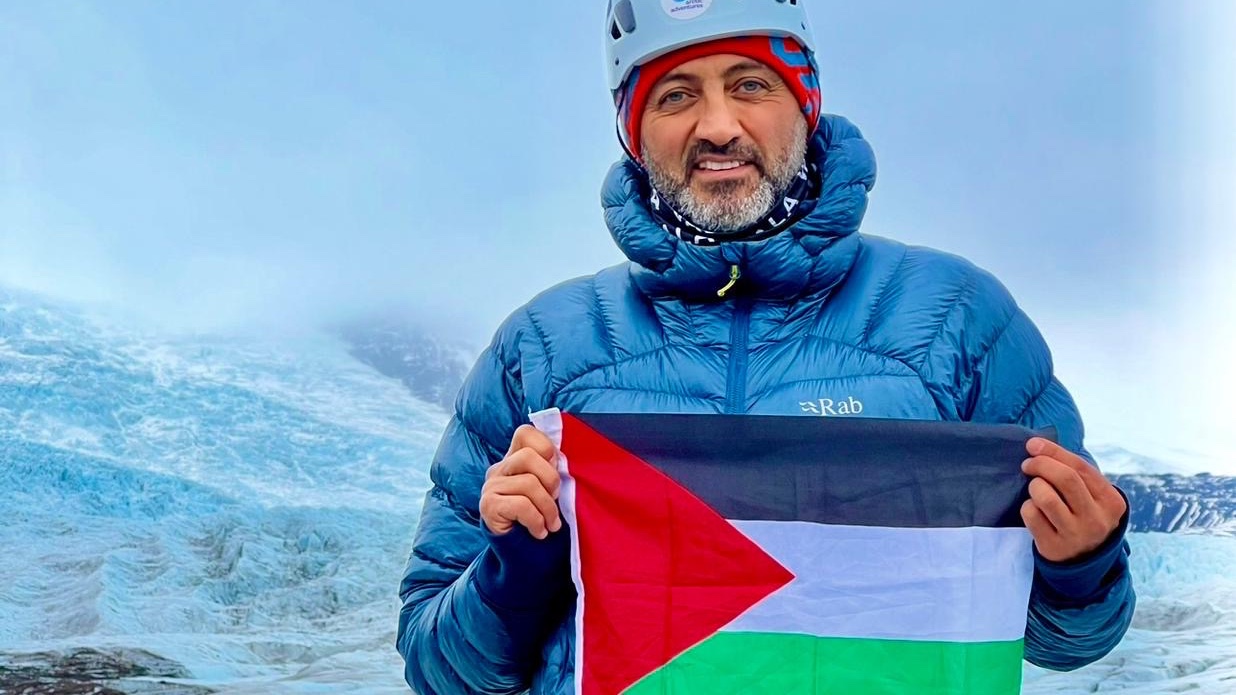
As darkness falls over Everest Base Camp, 17,500 feet above sea level on a Friday evening, Mostafa Salameh sits inside his tent speaking to Middle East Eye over the phone. His tone is bright as he describes the clear, crisp night sky, a welcome change after a full week of continuous snowfall that slowed climbing progress across the Himalayan peak.
This expedition marks Salameh’s sixth attempt to summit the world’s tallest mountain, which towers more than 29,000 feet above sea level. It is far from his first high-stakes journey to the top: he has successfully reached the summit on his last three consecutive climbs, and over the course of his mountaineering career he has raised more than $8 million for global charitable causes, ranging from life-saving cancer research to programs run by UNICEF, the United Nations’ children’s agency.
But this trip carries a uniquely personal meaning for the 56-year-old British-Jordanian-Palestinian climber. “For the children of Gaza, [to] make them believe in their dream. And to tell them, listen, I’m one of you. If I was able to do it this way, I think anybody can do it,” Salameh explained.
Dubbed the “Rising Dreams” mission, the expedition is staffed by Salameh, a videographer, a video editor, and five experienced Nepali Sherpa guides. The team’s goal is to raise $10 million for UK-based al-Khair charity, which has confirmed that 100 percent of all funds raised will go toward supporting children’s medical care, hygiene infrastructure, and mental health programs in war-torn Gaza. At the time of the interview, just over $5,300 had been raised toward the target.
This year’s Everest climbing season has been fraught with unusual challenges. The season started later than it typically does, and rapid glacial melt driven by climate change has created unstable, dangerous terrain for climbing teams moving up the mountain’s slopes.
For Salameh, a career as a professional mountaineer and motivational speaker was never a given. Born to parents expelled from Palestine in 1948 and 1976, he spent his childhood growing up in the al-Wehdat refugee camp in Jordan, with part of his youth spent in Kuwait. His first break came when he secured a cleaning job at the Jordanian ambassador’s official residence in London.
One year into the role, he struck out on his own, working long shifts washing dishes at city restaurants to save enough money to enroll at a Scottish university in the late 1990s. His goal at the time was far from climbing: he dreamed of becoming a hospitality manager at a luxury hotel. He achieved that goal, too, leading food and beverage teams at high-profile venues across England and Scotland.
Everything changed in 2004, when Salameh, who had never tried any extreme sport before, had a transformative dream that altered the course of his life. “I saw myself at the top of the world, making the Athan (Muslim call to prayer) and praying. I had no idea where this was,” he recalled.
Determined to turn the dream into reality, he leveraged every connection he had, eventually earning the support of King Abdullah of Jordan, who sponsored his climbing training and his first ever attempt to summit Everest in 2005. That first attempt fell short, as did a second try in 2007. It was not until 2008 that he finally stood at the peak of Everest – a milestone that marked the start of a remarkable series of achievements, from completing the Seven Summits (climbing the highest peak on every continent) to finishing the Explorers’ Grand Slam. Before that run of success, he was knighted by King Abdullah for his advocacy and achievements.
By 2016, Salameh had published a memoir titled *Dreams of a Refugee*, chronicling his journey from refugee camp to the top of the world. In 2022, he was awarded an honorary doctorate from his alma mater, Queen Margaret University in Edinburgh, in recognition of his humanitarian work and life achievements.
Today, resting at base camp ahead of his final push to the summit, Salameh says his latest expedition draws inspiration from the activists of the Global Sumud Flotilla, the grassroots initiative that set sail last year with donated medicine and critical humanitarian supplies to demand an end to the Israeli siege on Gaza. A second flotilla voyage was organized just last month.
Reflecting on his own mission, Salameh put it simply: “I thought, you know, if these guys [are] going through the sea, maybe I’ll go through the mountain.”