On Wednesday, a groundbreaking international conference focused on phasing out fossil fuels drew to a close in the Caribbean coastal city of Santa Marta, Colombia, marking a historic shift in global climate policy conversations. For the first time in three decades of formal climate negotiations, delegates from 56 countries gathered to directly address the question of how to wind down oil, gas, and coal production — the primary driver of anthropogenic global warming — rather than debating whether such a transition is necessary. What began as an exploratory dialogue has laid the foundation for ongoing global cooperation, with financing for developing nations emerging as the most pressing obstacle to a just, widespread transition.
The gathering brought together a diverse cross-section of stakeholders beyond national government negotiators, including climate advocates, financial experts, Indigenous community leaders, youth representatives, and subnational authorities. Unlike formal United Nations climate conferences (known as COPs), which are often rigid and marked by pre-negotiated positional stances, participants described the Santa Marta meeting as having an unusually open, collaborative atmosphere. Former Irish President Mary Robinson, a leading voice for climate justice, noted that the tone of dialogue set this gathering apart from traditional UN talks, with participants engaging in more human, cooperative problem-solving rather than sticking to inflexible official lines.
Prior global climate negotiations have long centered on cutting end-use emissions rather than targeting the root of the climate crisis: fossil fuel extraction and production itself. This landmark meeting reoriented the conversation to tackle the full scope of the transition, including coordination between fossil fuel producing and consuming nations, support for workers shifting out of fossil fuel sectors, and managing the broader economic impacts of winding down production. While the conference did not produce legally binding commitments, it delivered tangible initial outcomes: agreements for ongoing cross-country collaboration, the establishment of dedicated working groups focused on financing and just labor transitions, and renewed momentum for future global negotiations to coordinate a coordinated fossil fuel phaseout.
Discussions repeatedly centered on financing as the single most urgent barrier to progress. Many low- and middle-income nations in the Global South face unsustainable debt burdens, high global borrowing costs, and limited access to affordable capital for renewable energy development, even as renewables have become cheaper than fossil fuels in most parts of the world. Tzeporah Berman, founder and chair of the Fossil Fuel Non-Proliferation Treaty Initiative, explained that many developing countries are pushed to expand new fossil fuel projects solely to service their existing debt, trapping them in a cycle of dependency that is incompatible with climate action. Participants also highlighted how restrictive domestic fiscal policies and structural inequities in the global financial system slow transition progress, noting that traditional macroeconomic responses to inflation can inadvertently hamper investment in the clean energy transition. Ana Toni, CEO of the upcoming COP30 hosted by Brazil, called for greater engagement from finance ministers to develop targeted solutions to the fiscal challenges of the transition.
The conference also forged a new, inclusive alliance that brings together major economies and the world’s most climate-vulnerable nations, a dynamic that participants said has been missing from many prior climate efforts. While the U.S. federal government was not invited — organizers framed the gathering as a space for nations already aligned on the goal of phasing out fossil fuels — a senior official from California attended as an independent observer, noting that clear policy and regulatory certainty is critical to unlocking private sector investment for the transition.
Indigenous participants raised important questions about inclusive decision-making, noting that Indigenous communities have long been frontline stewards of forest ecosystems that absorb carbon, but their knowledge and voices are often sidelined in global climate processes. Patricia Suárez, an adviser to the National Organization of Indigenous Peoples of the Colombian Amazon, emphasized that any just transition must center Indigenous territorial rights and acknowledge the critical role these communities play in addressing the climate crisis, while calling for meaningful representation in all upcoming transition initiatives.
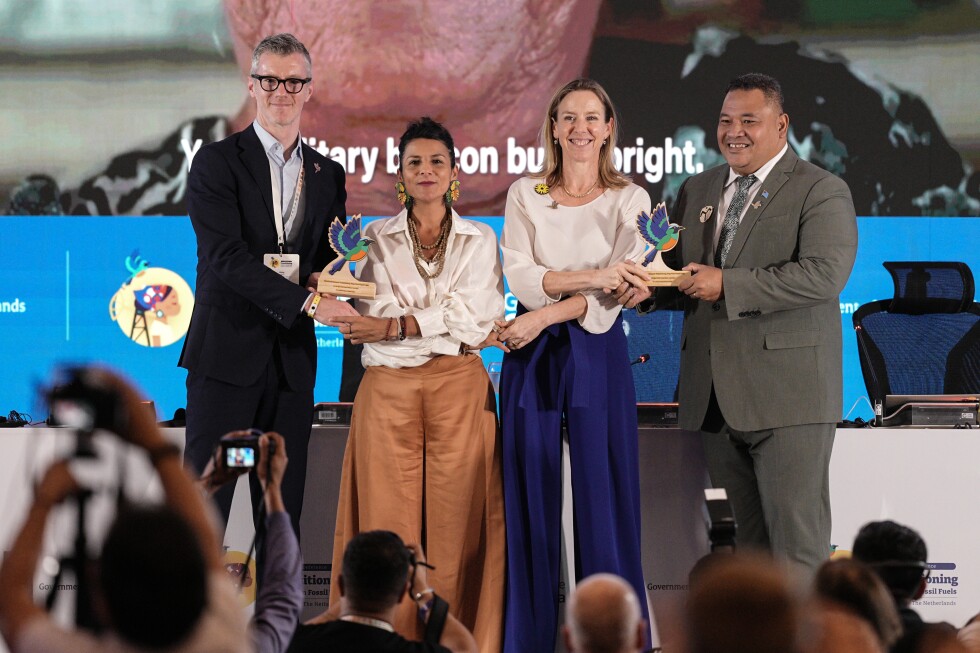
In a moment that drew resounding applause from delegates, attendees announced that the next fossil fuel transition conference will be co-hosted by Tuvalu, a low-lying Pacific island nation extremely vulnerable to sea-level rise, and Ireland. The pairing of a climate-vulnerable developing state and a wealthy developed European nation reflects a deliberate effort to bridge global divides in perspective and responsibility for the transition. Tuvalu’s Minister of Home Affairs, Climate Change and Environment Maina Vakafua Talia noted that hosting the conference will highlight the lived, on-the-ground impacts of fossil fuel emissions, and that future talks will prioritize delivering concrete, actionable outcomes rather than non-binding statements. “If we are to address the climate change issue, we have to address the root cause, and the root cause is the fossil fuel industry,” Talia said, adding that delegates are eager to put concrete solutions and actionable steps on the table at the next gathering.
Senior policy observers noted that the conference signals a growing global appetite for moving beyond broad climate pledges to targeted, practical action on the core driver of climate change. “Santa Marta has delivered something valuable: a genuine demonstration that climate action remains a priority, and real appetite for specific solutions,” said Vance Culbert, senior policy adviser at the International Institute for Sustainable Development, adding that the initiative will help give the global fossil fuel transition a more coherent, powerful foundation.