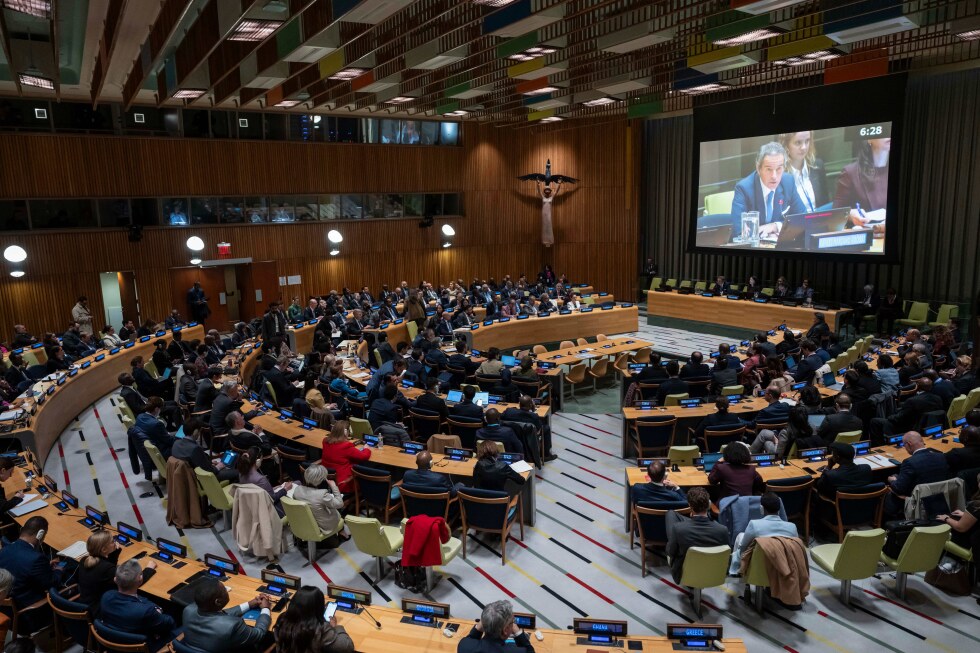
UNITED NATIONS — As the United Nations launches a high-stakes review of global nuclear non-proliferation efforts, the top leader of the body tasked with enforcing the global ban on nuclear testing has issued an urgent warning: any resumption of nuclear tests by major nuclear powers including the United States and Russia could trigger an unstoppable cascade of testing across the globe. Robert Floyd, executive secretary of the Comprehensive Nuclear Test Ban Treaty Organization (CTBTO), laid out this stark assessment during a press briefing with U.N. correspondents on Wednesday.
Floyd’s warning comes in the wake of mounting tensions that emerged late last year, when the world’s two largest nuclear-armed states — the U.S. and Russia — both openly floated the possibility of resuming nuclear testing, a move that sent shockwaves through the international non-proliferation community. “That is a spiral that we do not want to see start, because it may never be able to be stopped, Floyd emphasized, highlighting the irreversible risk of breaking the decades-long de facto moratorium on tests.
Three decades have passed since the CTBT first opened for global signatures back in 1996. Floyd noted that in the century prior to the treaty’s adoption, more than 2,000 nuclear tests had been conducted across the world. Since 1996, that number has dropped to fewer than a dozen, with six of those tests carried out by North Korea — a sharp decline that demonstrates the treaty’s quiet, ongoing impact on global security, even in its current provisional state.
Despite this progress, the CTBT has yet to formally enter into force. The treaty’s rules require ratification by 44 specific nuclear-capable states to take full legal effect, and nine of those countries have not completed this step. Among the holdouts, the United States, China, Iran, Egypt and Israel have signed the treaty but not ratified it; India, Pakistan and North Korea have neither signed nor ratified; Russia, which completed ratification years ago, took the unprecedented step of revoking its ratification in 2023.
Against this backdrop, the U.N.’s ongoing review of the separate Treaty on the Non-Proliferation of Nuclear Weapons (NPT) puts renewed focus on the fragility of the global nuclear order. This year’s review is already shaped by geopolitical tension, particularly over Iran’s nuclear program, which former U.S. President Donald Trump has cited as justification for past aggressive action against Tehran.
Floyd has been pushing for coordinated action from the world’s major powers to break the current deadlock. He told reporters that he recently traveled to Moscow for high-level talks, where he argued to Russian Foreign Minister Sergey Lavrov that an unconstrained return to nuclear testing runs counter to the national interest of every country on Earth. He has also held talks with U.S. State Department officials, and said he is eager to meet with U.S. Secretary of State Marco Rubio to advance the treaty’s goals. Floyd proposed that a joint ratification push by China, Russia and the United States would be a transformative, confidence-building step that could put the CTBT on track for full implementation.
Currently, both China and Russia have publicly reaffirmed their commitment to maintaining a voluntary moratorium on nuclear testing. However, since 2019, the U.S. State Department has repeatedly raised public concerns about what it says are suspicious nuclear-related activities in both countries. Late last year, Trump leveled accusations that Russia and China were already conducting covert tests, and announced he had ordered the U.S. Defense Department to prepare to resume U.S. testing to match what he claimed other powers were doing.
In response to Trump’s announcement, Russian Deputy Foreign Minister Sergei Ryabkov clarified Russia’s position: Moscow would only resume its own nuclear testing if Washington broke the moratorium first.
Floyd also pushed back against any claims that secret testing could go undetected, noting that the CTBT’s global monitoring network is a highly sophisticated system capable of picking up even very small nuclear detonations anywhere on the planet. For any state seeking to develop a functional nuclear weapon, testing is a mandatory step — and if any country moves forward with a test, “if they did it will be known to all, Floyd said.
The warning comes as global leaders grapple with growing nuclear risk, from rising great power competition to escalating regional tensions, making the preservation of the global testing moratorium a core priority for international security in the coming years.