In the tight-knit residential settlement of Owino Uhuru on Kenya’s Mombasa coast, the doors of a local lead-acid battery recycling plant closed more than a decade ago. But for thousands of residents who call this neighborhood home, the toxic legacy of that facility has never faded — a warning sign of the hidden public health risks emerging as Africa’s clean energy transition drives an unprecedented surge in battery demand across the continent.
Forty-year-old Faith Muthama, a mother of four, is one of hundreds of residents still living with chronic health damage linked to the site’s contamination. Decades after the plant first began operations, she still cannot complete routine household work without gasping for breath. A 2012 blood test confirmed what her body had already been signaling: dangerous, elevated levels of lead were circulating in her bloodstream. “Life has never been the same,” Muthama says.
The contamination that poisons this community traces back to 2007, when Kenya Metal Refineries EPZ — a local subsidiary of an Indian firm headquartered in Mumbai — opened the recycling plant in the middle of the residential area. For seven years, the facility processed spent lead-acid batteries to extract refined lead for export to India. Residents say toxic waste from operations leached untreated into the neighborhood’s soil and groundwater, sparking a public health disaster that has been linked to more than 20 deaths to date. Even after the Kenyan government shut the plant down in 2014, the embedded lead in local ecosystems continues to sicken generations of residents.
Medical research confirms lead exposure carries irreversible, life-altering health harms: permanent neurological damage, stunted cognitive development in children, and chronic organ damage that cuts life expectancy. Vulnerable groups including children, the elderly and pregnant people face the highest risk, as growing bodies absorb lead far more readily than adults.
In 2025, affected residents won a rare legal victory for environmental justice: Kenya’s Supreme Court upheld a class-action lawsuit against the smelting company, ordering roughly $12 million in damages to be distributed to nearly 3,000 impacted community members. But months after the landmark ruling, activists and residents say the Kenyan state has failed to move forward with timely disbursement of the awarded funds, leaving sick residents without financial support to cover ongoing medical care.
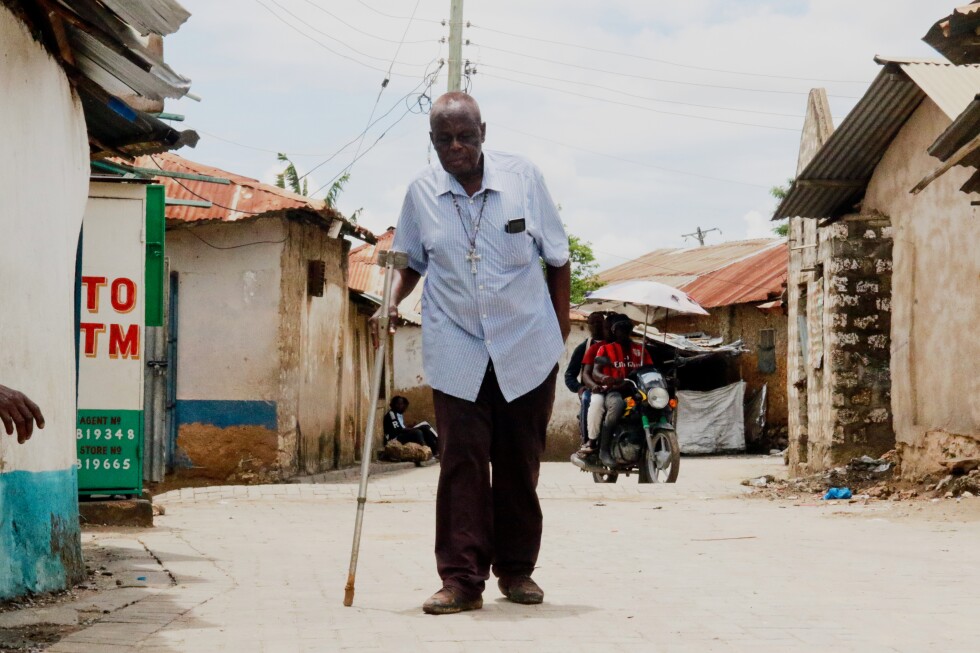
Seventy-year-old Alfred Ogulo, a village elder, has already spent all of his life savings on treatment for lead-related illness. Tests once showed critically high lead levels in his blood, leaving him with permanent nerve damage that leaves him unable to walk without a cane. He lives with persistent chest pain and a chronic cough, a leftover from breathing toxic fumes when the plant was active. “I am just waiting for help as I have exhausted all my resources treating myself,” Ogulo says.
The crisis in Owino Uhuru is far from an isolated case. Public health experts warn that similar lead contamination risks are emerging across the entire African continent, driven by the rapid expansion of renewable energy access that relies heavily on lead-acid battery storage. A February 2025 report from the Centre for Global Development, an independent think tank with offices in Washington and London, finds that the boom in off-grid solar systems — widely seen as a critical solution to closing Africa’s decades-long energy access gap — has caused a sharp spike in demand for affordable lead-acid batteries, and by extension, for battery recycling services.
Lead-acid batteries remain the dominant power storage option across low-income African markets because they cost a fraction of the price of newer alternatives such as lithium-ion batteries. But safe, environmentally sound recycling of these batteries requires expensive specialized infrastructure that most African countries lack. As a result, the majority of lead-acid battery recycling in the region falls to informal, unregulated operators who use low-cost, rudimentary methods that release massive amounts of lead particles into the surrounding air, soil and water.
“Off-grid solar could account for a substantial share of batteries entering the recycling stream in Africa,” explained Lee Crawford, a senior research fellow at the Centre for Global Development and one of the lead contributors to the report. “That’s on top of existing demand from vehicles like cars and motorbikes.”
Crawford notes that the high cost of safe recycling creates powerful economic incentives for operators to cut corners on environmental and public health protections. While banning lead-acid batteries entirely would address the risk, Crawford says such a ban is unfeasible given the current affordability gap with alternative technologies. The only viable path forward, he argues, is investing in scaling up safe, regulated recycling infrastructure across the continent.
The scale of the threat is staggering. Studies conducted across Africa and South Asia estimate that between one-third and half of all children living in these regions have elevated blood lead levels, making lead poisoning one of the most widespread underreported environmental health risks in the world. Weak regulatory enforcement across many African nations amplifies the problem: while most countries have environmental rules on paper that would limit toxic exposure from lead operations, inconsistent implementation and lack of funding for inspections allow unregulated recycling to continue unchecked.
“This is a silent threat,” Crawford said. “It’s often invisible, but it affects health, cognitive development and economic productivity for entire communities.”
The problem of accountability extends far beyond small informal recycling workshops, experts add. Even larger, formal recycling facilities often lack proper pollution control measures, while globalized supply chains for recycled lead make it easy for responsible parties to avoid accountability for contamination. “There needs to be accountability across the entire supply chain,” Crawford emphasized.
A small number of African countries have begun to implement policy solutions to address the gap. South Africa, for example, has introduced a formal producer responsibility framework that requires battery manufacturers to fund and manage end-of-life recycling for their products, creating a structured, regulated system for processing spent batteries. But across much of the continent, especially in countries that import most of their batteries rather than producing them domestically, assigning clear responsibility for safe recycling remains a major policy challenge.
International development donors have increasingly shifted funding toward lithium-ion battery technologies, which do not carry the same lead-related public health risks. But industry analysts project that lead-acid batteries will remain in widespread use across Africa for decades to come, particularly in low-cost off-grid solar systems that bring energy access to remote communities.
For the residents of Owino Uhuru, the crisis remains an immediate, daily reality. Phyllis Omido, who leads the Mombasa-based Centre for Justice Governance and Environmental Action and helped residents bring their class-action lawsuit, says the Kenyan government has failed to uphold the Supreme Court’s ruling, leaving vulnerable residents without the relief they were awarded.
“It is sad that the state has ignored prioritizing the compensation payment as ordered by the court,” Omido said. “These monies would have alleviated the current suffering these vulnerable residents are going through.”
Sixty-year-old Mejumaa Hassan Nyanje, who has lived in Owino Uhuru through the entire crisis, says residents feel abandoned by national leaders and the company that caused the contamination. “Is it fair that we are the ones still chasing justice while the company walks away?” Nyanje said, fighting back tears. “Will we all die before justice is served? It feels like we’ve been abandoned, like our lives and our health don’t matter.”
This climate and environmental reporting from The Associated Press receives financial support from multiple private foundations. AP maintains full editorial control over all content.