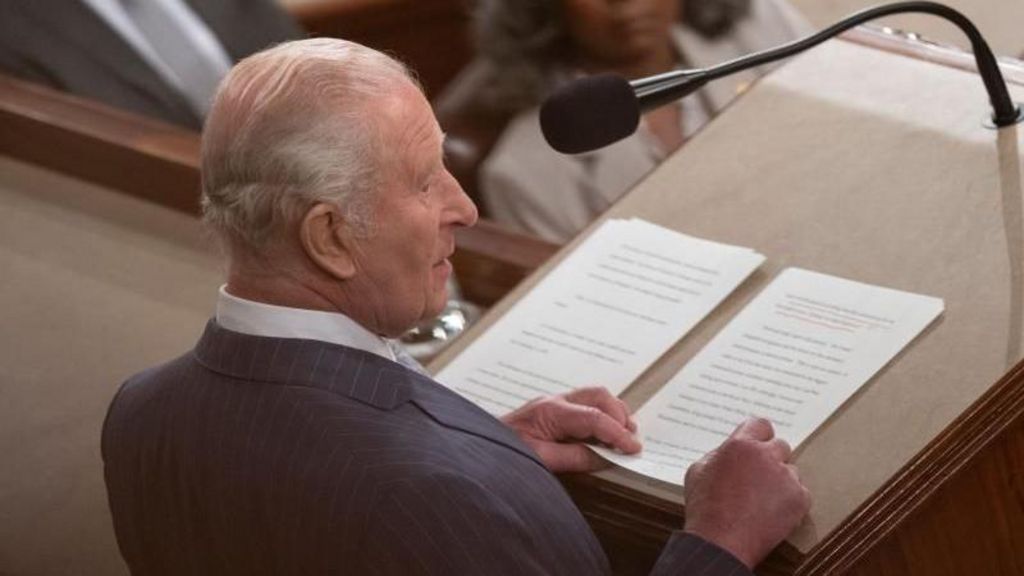
King Charles III’s long-awaited state visit to the United States was framed from the outset as a dual-purpose mission: a celebration of both America’s upcoming 250th anniversary and the decades-old “special relationship” that binds Washington and London, and a quiet diplomatic push to repair frayed bilateral relations. The core test of the King’s outreach came on Tuesday afternoon, when he delivered only the second royal address to a joint session of US Congress, the first since Queen Elizabeth II spoke at the Capitol in 1991.
Tensions between the two allies have risen sharply in recent months, rooted in Britain’s hesitation to fully back the joint US-Israeli military campaign against Iran. Against this backdrop, the King’s trip was widely viewed as a charm offensive designed to dial down friction, rather than resolve deep rifts outright. Analysts have noted that strained relations do not equal a full break in the alliance, a point the King himself emphasized in his closing remarks, where he highlighted that “reconciliation and renewal” have defined centuries of interaction between the two nations.
The unpredictable temperament of second-term President Donald Trump adds a layer of uncertainty to the outcome: warm ties can turn cold quickly, but former adversaries have also regained his favor just as fast. In brief remarks following a one-on-one meeting at the White House, Trump offered a warm assessment of the monarch, saying, “He’s a fantastic person. They’re incredible people and it’s a real honour.” That early signal offered a glimmer of hope that the King’s outreach had made headway.
But the speech also carried subtle political undertones that resonated differently across the US political aisle. Opening his remarks, the King did not shy away from the multiple crises facing both nations, acknowledging openly that the world is living through “times of great uncertainty”. He explicitly named ongoing conflicts in the Middle East and Europe — points of recent disagreement between the US and UK — and referenced the threat to democracy posed by political violence, a nod to the disruption that interrupted the previous weekend’s White House Correspondents’ Dinner.
“With the spirit of 1776 in our minds,” he joked, “we can perhaps agree that we do not always agree” — a lighthearted line that set up his core argument: when the US and UK align their efforts, they can deliver progress that benefits people across the globe.
One line drew early cheers that started on the Democratic side of the chamber before spreading across the room: the King’s reference to the British legal tradition of checks and balances on executive power, rooted in the Magna Carta. For left-leaning critics of President Trump, who have spent years decrying what they see as his abuse of executive authority, and who led hundreds of thousands in “no kings” rallies across the country over the past year, the line carried obvious implicit weight.
Another closing line, “America’s words carry weight and meaning, as they have since independence. The actions of this great nation matter even more,” sparked quiet muttering from Democratic lawmakers, many of whom have repeatedly criticized Trump’s rhetorical choices and policy actions. Whether the King intended it or not, many liberal attendees interpreted the remarks as a subtle nod to their concerns, giving them another opening to voice their long-held “no kings” sentiment.
Beyond diplomatic tensions, the King wove personal context and longstanding policy priorities into his address. A five-year veteran of the Royal Navy, he referenced his military service to highlight the deep security and intelligence cooperation between the two nations, and between the US and European allies. Notably, he echoed a common point among European NATO allies, recalling that the alliance only ever invoked its collective defense clause after the 9/11 terror attacks on the US, a subtle reminder of the bloc’s shared commitment. He also made space to reference his decades-long advocacy on climate change, noting the “disastrously melting ice-caps of the Arctic” as a shared threat requiring collective action. He even lightened the tone with well-received whimsy: opening with the famous (and often misquoted) Oscar Wilde quip that the US and UK share everything except a language, joking that he had not come to launch a “cunning rearguard action” to retake American rule, and quipping about the British parliamentary tradition of holding an MP hostage during the King’s speech at Westminster.
One highly anticipated topic was entirely absent from the address, however: the Jeffrey Epstein sex offender scandal. Last year, over the Trump administration’s objections, Congress passed a law mandating the release of previously sealed US government files tied to the Epstein investigation. Those releases exposed new details about Epstein’s deep connections to powerful figures on both sides of the Atlantic, including former UK ambassador to the US Peter Mandelson and King Charles’s younger brother, Prince Andrew. The closest the King came to addressing the issue was an oblique reference to the need to “support victims of some of the ills that, so tragically, exist in both our societies today” — a line widely viewed as insufficient for critics calling for a public acknowledgment. While the scandal has already triggered major political fallout in the UK, it has yet to significantly harm current officeholders in the US, and the issue remains far from fading from public discourse, with more details expected to emerge in coming months.
For all the underlying tensions and unaddressed controversies, the King’s address appears to have achieved its core immediate goal: breaking the ice between the two allies at a moment of strain. Whether his public remarks and private diplomatic discussions will be enough to solidify and strengthen the bilateral alliance in the long term remains an open question, but the first day of the state visit has already shifted the tone of the relationship.