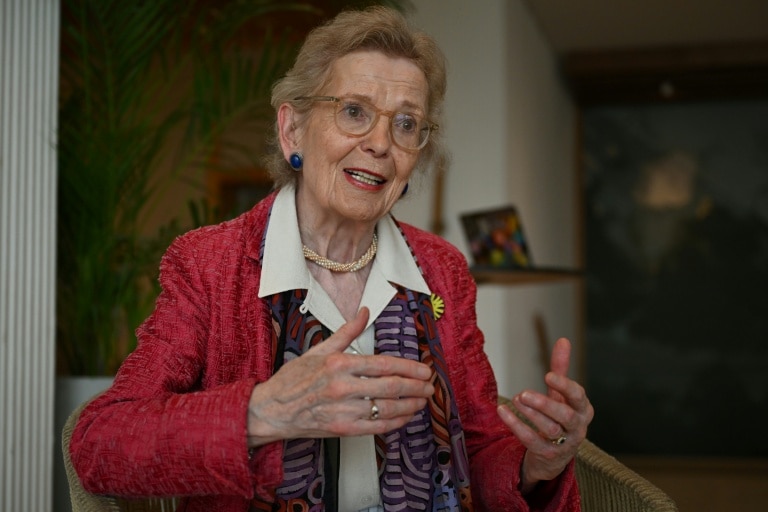
As a former Irish president who has witnessed decades of global political and environmental shifts, Mary Robinson is positioning the upcoming high-level fossil fuel phaseout conference in Santa Marta, Colombia, as an unprecedented turning point in the global fight against climate change. Speaking to Agence France-Presse ahead of the April 28-29 gathering, the veteran climate advocate says the summit comes at a uniquely opportune moment: amid ongoing global energy market chaos sparked by the Iran conflict, the meeting is throwing a stark spotlight on the steep dangers of continued reliance on coal, oil, and gas — a burden that falls heaviest on the low-income communities Robinson has spent her career championing.
Robinson, a member of The Elders, a collective of former global leaders founded by Nelson Mandela, served as the United Nations Special Envoy for Climate Change when the landmark Paris Agreement was signed in 2015. When asked whether the Santa Marta gathering, which emerged from widespread frustration with slow progress in the UN-led climate negotiation process, undermines the role of the annual Conference of the Parties (COP), Robinson pushed back on that framing. She emphasized that the COP process remains irreplaceable for global climate coordination, noting that the Colombia conference was never intended to replace UN talks — instead, it is designed to complement and accelerate the multilateral process.
She pointed to the failed outcome of COP30 in Belém, where fossil fuel lobbying blocked any official agreement to include explicit language referencing a phaseout of fossil fuels, as the core catalyst for organizing the Santa Marta summit. What was not foreseen when the conference was planned, Robinson noted, was the eruption of one of the most severe global oil and gas crises in modern history. This unexpected timing has only amplified the meeting’s urgency, she argued, making it the ideal moment to break through decades of entrenched “fossil fuel mindset” and accelerate the global transition to renewable, clean energy systems. “It’s the way we have to go, it’s the way we are going, but we need to go far much faster,” she said.
Unlike formal UN climate talks, the Santa Marta conference is not structured around binding, text-by-text negotiations, Robinson explained, which gives participants unprecedented space to collaborate on actionable action. Stakeholders from across sectors — national governments, sub-national governing bodies, private industry, civil society groups, and grassroots activists gathering for the concurrent People’s Summit — are attending ready to share concrete commitments they are prepared to implement, rather than haggling over negotiating language. This open, action-oriented dynamic, Robinson said, makes it likely the summit will spawn new coalitions of actors committed to moving rapidly away from fossil fuels, creating a new, results-first momentum that has been missing from global climate talks to date.
When addressing concerns that hundreds of millions of people around the world still depend on fossil fuels for basic energy access, Robinson tied that reliance directly to the current energy crisis: the ongoing conflict has cut off roughly 20 percent of global oil and gas supplies, sending prices soaring and leaving the world’s poorest communities facing the steepest costs. Farmers have been hit particularly hard by skyrocketing fertilizer prices tied to fossil fuel markets, highlighting that continued reliance on dirty energy offers no long-term path to energy security or stable livelihoods. This reality, she argued, makes the Santa Marta conference a uniquely critical moment to build momentum for change.
Robinson also addressed the growing pressure many governments face to expand fossil fuel production in response to the current energy crisis, arguing that far too many policy decisions around energy security are not grounded in the urgent warnings climate scientists have issued for decades. Drawing a parallel to the COVID-19 pandemic, where most nations relied on top chief medical officers to guide policy, Robinson called on all governments to appoint chief planetary scientists to provide authoritative, science-based guidance for climate and energy policy. “During COVID, lots of countries had chief medical officers, and we listened because we were scared. They had a lot of authority,” she noted. “We’re in the same position. We haven’t thought it through yet, but we are.”
While the latest climate science paints a deeply alarming picture, with the planet approaching irreversible tipping points faster than many researchers predicted, Robinson says she retains cautious optimism for the future. That optimism was crystallized during a scientific expedition to Greenland, where she had a transformative experience listening to a glacier calve — the process where large chunks of ice break off into the ocean as temperatures rise. She described hearing sounds like thunder as a large section of ice split off, followed by smaller cracks that echoed like rifle shots, and found herself crying as the reality of human-caused climate change hit home. That moment, she said, underscored both the urgency of the crisis and the need to seize every available opportunity to act. With the open, action-focused space provided by the Santa Marta conference, the global community finally has a chance to build the momentum needed to accelerate the transition away from fossil fuels, she argued, and leaders must not waste this opening.