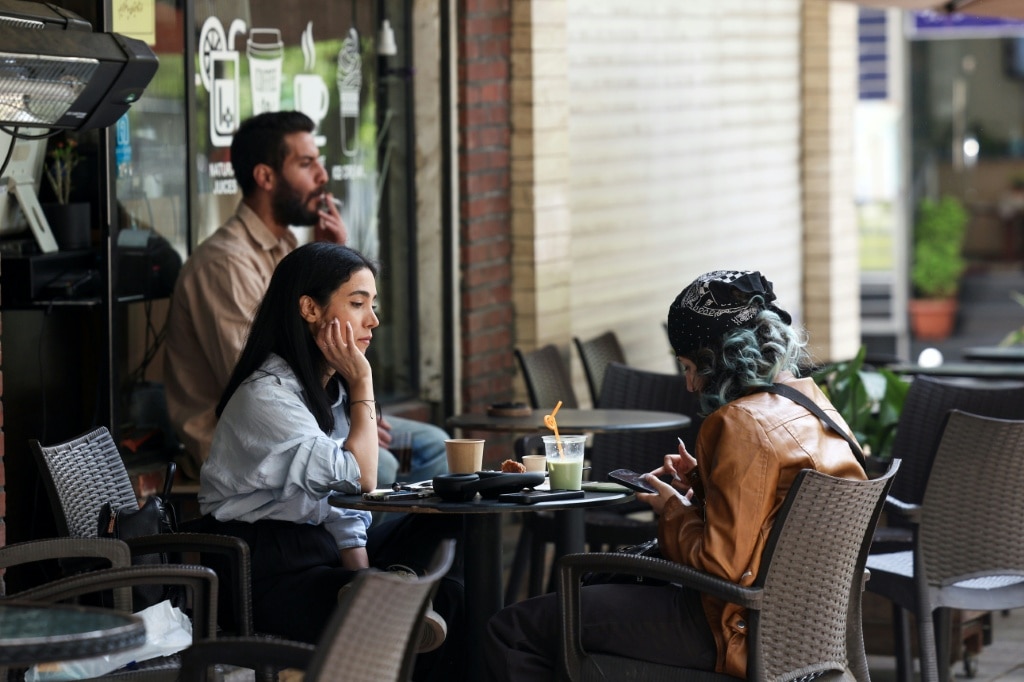
Viral images of Iranian women going without the mandatory hijab while socializing at Tehran cafes have captured global attention as a visible sign of pushback against the country’s long-standing dress rules. But for many women living across Iran, this small public shift has not translated to meaningful progress on gender rights or broader personal freedom.
Elnaz, a 32-year-old painter based in Tehran who requested anonymity for safety, told AFP she sees no sign of systemic change from the government. “There has been no real achievement when it comes to women’s rights,” she explained. “Under the surface, in reality, no tangible change has taken place for people’s freedom, especially regarding women’s basic rights.”
The mandate that all women wear a headscarf in public was implemented shortly after the 1979 Islamic Revolution and has long stood as a core ideological pillar of the ruling clerical establishment. Visible enforcement of the rule has softened in recent years, particularly in parts of Tehran and other major urban centers, a shift that traces its roots to the nationwide 2022-2023 protests that erupted after 22-year-old Mahsa Amini died in morality police custody. Amini had been arrested for allegedly violating the country’s dress code.
The trend of women ditching the hijab in public persisted through multiple subsequent crises: a 2025 war with Israel, January 2025 protests over soaring living costs, and the most recent ceasefire-halted conflict between Iran and a US-Israeli coalition. Today, the feared white patrol vans of the morality police, which once patrolled public squares and street corners to detain women violating the hijab rule, are rarely seen in many areas. It is now common to see women with and without headscarves walking side by side even in Tehran’s more liberal neighborhoods, leaving the choice of attire up to individual women for the first time in decades.
For some long-time advocates of personal choice, the change is dramatic, even stunning. Just five years ago, public displays of women going without a hijab were unthinkable. “I’m happy for all of them, because until just three years ago this was only a dream,” said 57-year-old Zahra, a housewife from the central city of Isfahan. “My youth has passed and I never got to have this experience; now I don’t wear hijab anymore, but I wish I could have experienced these days when I was young.”
Yet beneath this visible surface shift, harsh restrictions remain firmly in place. Women can still be summoned by law enforcement for refusing to wear a hijab, and cafes that allow bareheaded women on their premises are regularly shut down by authorities. Entry to banks, government buildings, and educational institutions still almost universally requires women to wear the head covering. Rights groups add that broader gender restrictions remain intact, with tens of thousands of protesters arrested following January’s demonstrations, and thousands more detainees including women detained during the most recent conflict.
Cafe owners in particular bear the brunt of ongoing enforcement, even as viral social media posts frame the relaxed street-level norms as newfound freedom. “Beautiful photos of cafes and girls are being shared everywhere, but as cafe owners, we’ve been paying a heavy price for that,” said 34-year-old Tehran cafe owner Negin. “We’ve been treated very harshly over these years, continuing until this day. We’ve been shut down multiple times, fined and forced to pay bribes… What makes me even angrier is when people call this ‘freedom’ and claim women are becoming freer.”
Amnesty International confirmed this mixed landscape in a statement released earlier this month, noting that widespread grassroots resistance to compulsory hijab had pushed authorities to back away from the large-scale violent arrests and assaults seen in earlier years. However, the human rights organization added that authorities continue to leverage existing laws to enforce mandatory veiling in workplaces, universities and all public sector institutions. Women who resist still face routine harassment, physical assault, arbitrary arrest, heavy fines, and expulsion from their jobs or academic programs.
One notable, politically charged shift has appeared on state-controlled television, which now occasionally airs footage of women without hijab — but only when those women publicly support the Islamic Republic and denounce its opponents, a move critics dismiss as a cynical public relations tactic.
“More women are putting their fear aside each day and trying out what it’s like to go out without hijab, and it’s gradually becoming more widespread,” noted 39-year-old Tehran housewife Shahrzad. “But I don’t see any change in the government system. It’s the same as before, aside from those videos of girls going in front of state news cameras without hijab and saying ‘my leader, my leader, I will sacrifice myself for him’.”
The level of relaxed enforcement also varies drastically across the country, with tighter restrictions remaining in place in more conservative and religiously significant regions. In Mashhad, a major eastern city that hosts one of Shia Islam’s holiest shrines, rules remain far stricter than in Tehran. “Before the 12-day war against Israel in June, in Mashhad they wouldn’t let us in anywhere without hijab,” said 32-year-old student Mahsa. “Now they do let people in, but unfortunately, we haven’t had the same level of change that people in Tehran have seen over the past three years.”
Even in Isfahan, a major city widely categorized as conservative, enforcement has ramped back up recently despite the public shift in the capital. Farnaz, a 41-year-old Isfahan resident, is scheduled to appear in court later this month over a charge of violating hijab rules. “In Isfahan, for the past few days they’ve started sealing cafes again over hijab issues. They didn’t even wait for the situation with the war to be clarified,” she said. “Here, you’re dealing both with the government and with conservative community members. Like before in some neighbourhoods, religious people sometimes warn you and harass you. It’s not just about the morality police. I don’t see any significant change.”
Fellow Isfahan resident Maryam, 35, added that women without hijabs are still turned away from service at some local banks, and all retail workers are required to adhere to the mandate. “If you are involved in social or economic activity, you are expected to observe hijab,” she explained.
Zahra, the Isfahan housewife, pointed out that the current softer street norms came at a devastating cost: human rights groups estimate hundreds of protesters were killed in the brutal government crackdown that followed the 2022 Mahsa Amini demonstrations. She warned that the current lull in harsh enforcement may only be temporary, as authorities are currently distracted by ongoing regional conflict. “Right now, they (the authorities) are just distracted by the war,” she said. “But after that, who knows what they will do about it.”