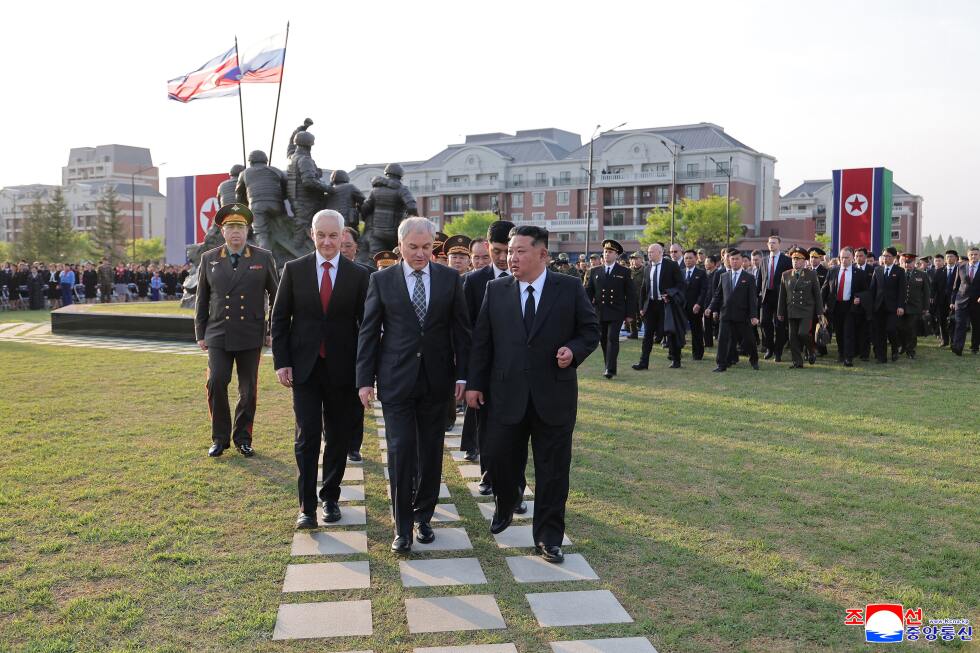
On Sunday, North Korea held a grand opening ceremony for a new memorial museum in its capital Pyongyang, honoring hundreds of North Korean service members killed while fighting alongside Russian forces against Ukraine in the Kursk border region. The event marked the one-year anniversary of the conclusion of operations to secure the Kursk area, and brought together top leadership from both North Korea and Russia to reaffirm their growing bilateral partnership.
The joint military deployment dates back to April 2025, when Pyongyang and Moscow confirmed that North Korean troops had fought alongside Russian units to repel a Ukrainian incursion into Russia’s Kursk region. Neither country has publicly released an official death toll or full deployment number, but South Korea’s national intelligence agency has estimated that roughly 15,000 North Korean troops were sent to the frontline, with approximately 2,000 of those personnel killed in combat.
North Korea’s state-run Korean Central News Agency (KCNA) confirmed that Supreme Leader Kim Jong Un led the inauguration ceremony, alongside a high-level Russian delegation including Vyacheslav Volodin, Speaker of the State Duma, and Russian Defense Minister Andrei Beloussov. During the event, Kim personally placed soil over the remains of one fallen soldier, laid floral tributes at a mortuary holding other recovered bodies, and joined the Russian officials in signing a commemorative guest book.
In his keynote address, Kim framed the fallen North Korean troops as eternal symbols of the North Korean people’s bravery, saying their legacy would forever fuel the shared victorious march forward for both the Korean and Russian peoples. He lauded the combined force for pushing back against what he described as a U.S.-led Western campaign of hegemonic ambition and military adventurism on the Ukrainian front. In separate talks with Beloussov, Kim reiterated that Pyongyang would offer unwavering support for Moscow’s policies to defend its sovereign rights and national security interests, KCNA reported.
Russia’s top leadership sent a clear message of solidarity through the event. In a letter read aloud by Volodin to attendees, Russian President Vladimir Putin said the new museum would stand as an enduring marker of the friendship and shared purpose binding the two nations. Putin added that he was confident the two countries would continue to deepen their comprehensive strategic partnership in the years ahead. Beloussov also confirmed Moscow’s plan to expand military cooperation, telling Kim that Russia is prepared to sign a formal bilateral military cooperation agreement covering the 2027 to 2031 period.
Since Russia launched its full-scale invasion of Ukraine, North Korea has positioned Moscow as the top priority of its foreign policy, providing both conventional weaponry and frontline troops to support Russia’s war effort. In exchange, defense and international relations analysts widely believe Pyongyang has received critical economic aid and other forms of support from Moscow. The growing alignment has sparked deep alarm in Seoul, Washington and their allied partners, who warn that Russia could share advanced high-tech military technologies that would allow North Korea to accelerate the development of its nuclear weapons and long-range missile programs.
Military analysts have noted that the North Korean troops deployed to Kursk faced early challenges, with many falling vulnerable to Ukrainian drone strikes and artillery fire due to limited modern combat experience and unfamiliarity with the local terrain. However, Ukrainian military and intelligence assessments have concluded that the deployment has delivered significant long-term benefits to Pyongyang: North Korean personnel have gained hands-on, modern frontline combat experience, and they have become a core component of Russia’s strategy to outlast Ukrainian defenses by deploying large ground forces to overwhelm Ukrainian positions in the Kursk campaign.