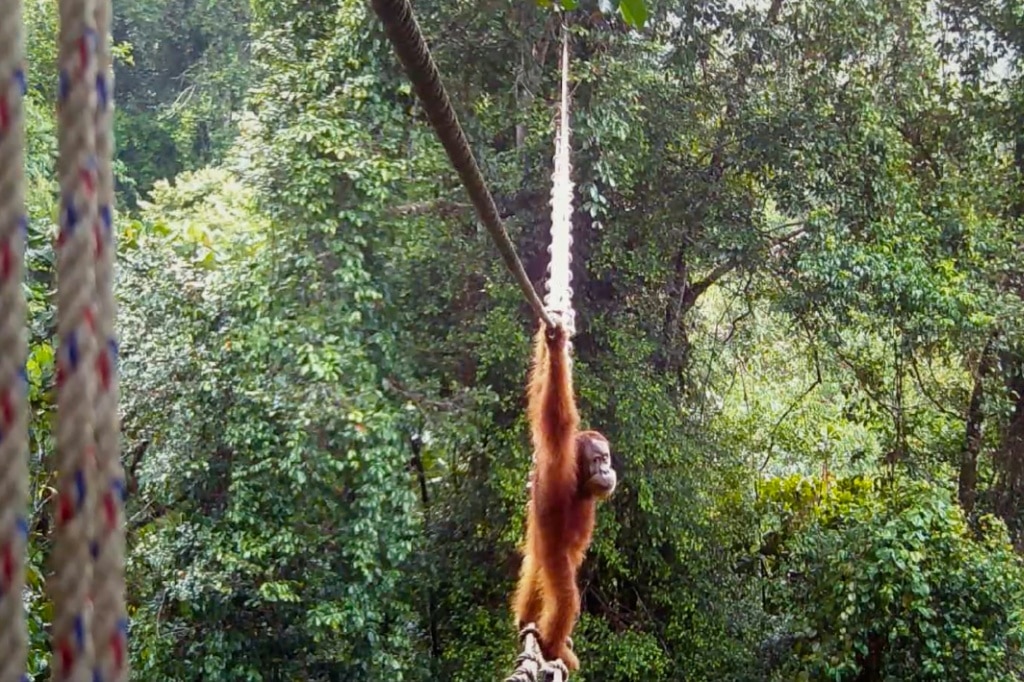
Critically endangered Sumatran orangutans have reached a landmark conservation milestone, after conservation groups captured the first ever recorded footage of one of the great apes crossing a purpose-built man-made canopy bridge in North Sumatra, Indonesia. This crossing marks the first confirmed use of such a structure by a wild Sumatran orangutan anywhere in the world, according to local and international conservation organizations working on the project.
Endemic exclusively to the Indonesian island of Sumatra, with their close Bornean orangutan relatives found across the shared island of Borneo, Sumatran orangutans are currently listed as Critically Endangered by the International Union for Conservation of Nature (IUCN). Latest population surveys count just over 13,500 individual orangutans remaining in the wild, with their steady population decline driven largely by widespread habitat loss and fragmentation, alongside the ongoing threat of illegal hunting.
The five canopy bridges at the center of this breakthrough were completed in 2024 through a collaborative partnership between Indonesian conservation NGO Tangguh Hutan Khatulistiwa, UK-based charity Sumatra Orangutan Society (SOS), and local Indonesian government authorities. The structures were installed after an existing rural road — a critical economic and social lifeline connecting isolated communities in Sumatra’s Pakpak Bharat district — was expanded, cutting directly through contiguous rainforest habitat and splitting a local orangutan population of roughly 350 individuals into isolated groups.
Prior to this historic sighting, other native forest species including gibbons and long-tailed macaques had already been documented using the hanging bridges to cross above the paved road safely. But the recent camera trap footage of an orangutan making the crossing confirms the bridges can successfully meet the unique needs of the region’s most high-profile endangered species.
Helen Buckland, chief executive of SOS, called the orangutan’s crossing a “huge milestone for global conservation efforts.” Buckland emphasized that the successful use of the simple canopy structure proves that human development and wildlife protection do not have to be mutually exclusive. “Sometimes, the simplest solutions are the most effective,” she noted.
Erwin Alamsyah Siregar, executive director of Tangguh Hutan Khatulistiwa, echoed Buckland’s optimism, framing habitat fragmentation as one of the most pressing challenges facing modern conservation work. Siregar expressed hope that the successful pilot of these canopy bridges will lead to their adoption as a standard feature of infrastructure planning across the Southeast Asian region, helping to reduce human-wildlife conflict and protect endangered species as development expands into remaining wild habitats.