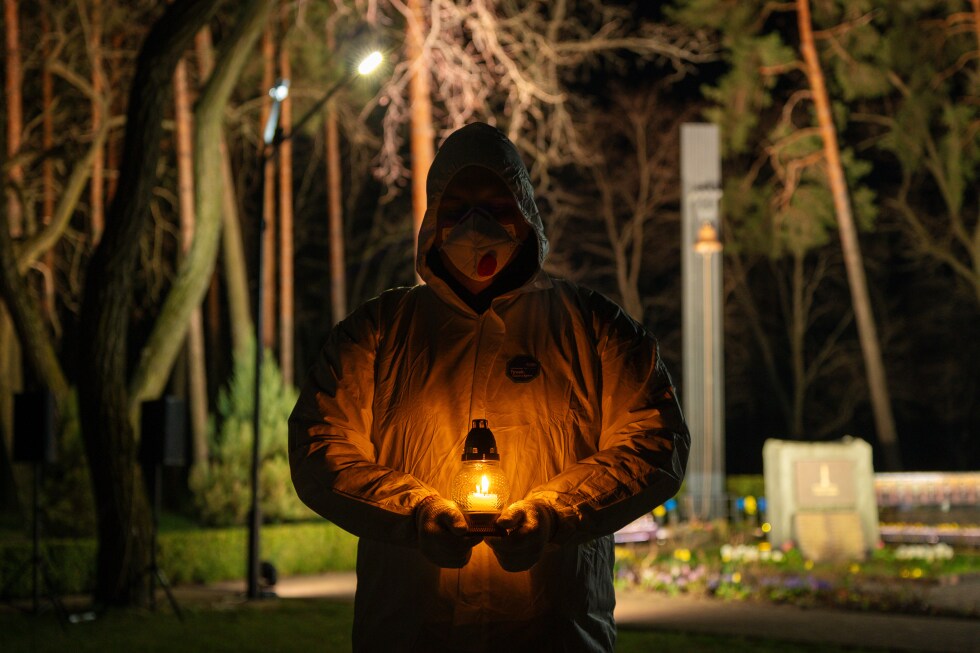
Four decades after the world’s worst nuclear disaster shattered communities across what is now northern Ukraine, residents of Slavutych defied wartime curfews and official warnings against large public gatherings to honor the dead and heroes of the 1986 Chernobyl catastrophe in a midnight commemoration held on the 25th of April, 2026.
Slavutych, the purpose-built city located roughly 50 kilometers from the shattered remains of the Chernobyl Nuclear Power Plant, is inextricably tied to the disaster’s legacy. Built in the aftermath of the April 26, 1986 explosion to house displaced plant workers and their families, the city welcomed its first permanent residents in 1988. Today, it holds the collective memory of a catastrophe that exposed decades of dangerous negligence and institutional secrecy under the former Soviet Union. For 48 hours after the reactor exploded, Soviet authorities hid the scale of the accident from the public, only acknowledging the disaster after radioactive fallout drifted across Northern Europe and Swedish scientists raised public alarm.
An estimated 600,000 emergency responders and cleanup workers, widely known as Chernobyl’s “liquidators,” were drafted into the deadly work of extinguishing the reactor fire and containing radioactive contamination. Thirty workers lost their lives within months of the accident, claimed by the blast or acute radiation sickness. Millions of people across Ukraine and neighboring Belarus were exposed to life-threatening radiation levels, and hundreds of towns and villages were permanently abandoned, forcing hundreds of thousands of residents into mass permanent evacuation.
Like much of northern Ukraine, Slavutych has faced new upheaval amid Russia’s full-scale invasion of Ukraine. The city was briefly occupied by Russian forces early in the war during Moscow’s failed push to capture Kyiv, and it has endured brutal winters marked by widespread power outages that left some residents cooking meals over open fires in city streets. Even with these risks and ongoing restrictions, the annual commemoration vigil has gone ahead without fail, drawing crowds of all ages to the city’s central square.
This year, attendees streamed into the plaza before midnight, many arriving as families carrying armfuls of spring tulips and daffodils. They arranged candles across the ground to form a giant radiation hazard symbol, a quiet tribute to those who lost their lives to the disaster. The gathering unfolded against a backdrop of Soviet-era apartment blocks, with a war memorial honoring local residents killed in the ongoing invasion standing a short distance away.
For many attendees, the vigil is a deeply personal ritual. Seventy-one-year-old Liudmyla Liubyva once attended the ceremony with her husband, a former Chernobyl plant worker who developed a radiation-linked disability that left him unable to walk. She told attendees that while honoring the sacrifices of liquidators remains a critical duty, Russia’s war has reignited long-dormant fears that the nuclear danger was never fully laid to rest. Referencing a 2025 Russian drone strike that damaged the New Safe Confinement — the massive steel dome constructed to seal radioactive contamination from the destroyed reactor — Liubyva said, “When the drone struck the arch, it felt like the world could return to 1986. We all — young and old alike — must protect our land, because it is so vulnerable.”
As soft instrumental music played, poetry about the disaster echoed across the square through loudspeakers. “Years pass, generations change, but the pain of Chernobyl does not fade,” a woman’s voice recited. At the front of the gathering, attendees dressed in white protective suits and face masks, symbolic of the gear liquidators were often forced to use during cleanup, stood in silent vigil holding lit candles.
Sixty-seven-year-old Larysa Panova, who was forced to abandon her native hometown of Chernobyl and resettle in Slavutych after the accident, said the new city has become her home, but she still longs for the forests and open land of the community she left behind. Before the full-scale invasion, Panova regularly traveled back to the Chernobyl Exclusion Zone to visit remaining relatives or revisit the places of her childhood. The war has cut off that access, leaving her with only memories. “I never stop thinking of Chernobyl as my homeland,” Panova said. “You remember your school, your childhood, your youth — everything happened there, in Chernobyl.”
This reporting was contributed by AP correspondents Vasilisa Stepanenko and Volodymyr Yurchuk based in Kyiv, with financial support for nuclear security coverage provided by the Outrider Foundation. The Associated Press retains full editorial control over all content.