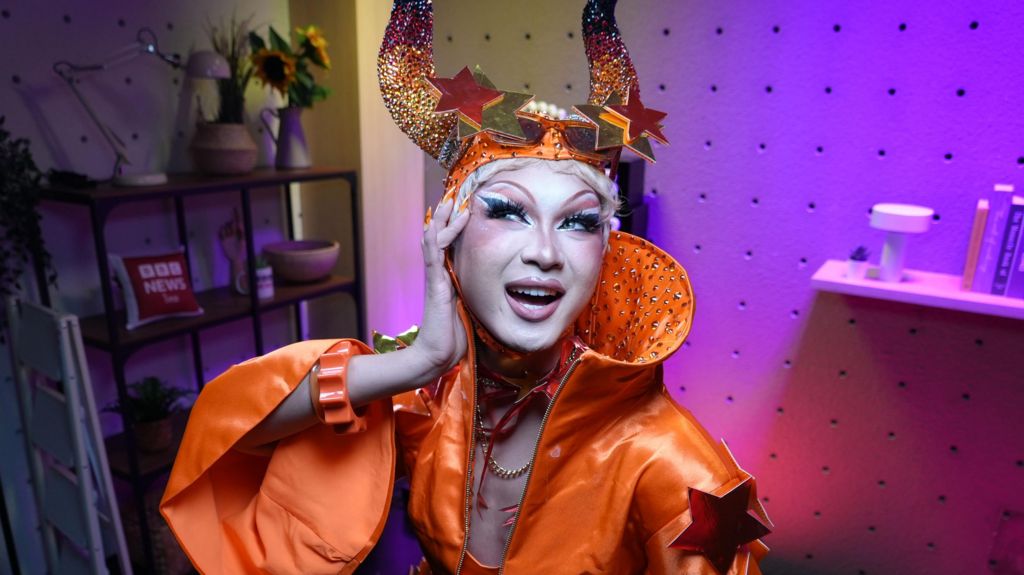
In a landmark moment for global drag culture, 24-year-old Thai performer Gawdland — born Tharathep Thaweephon — has etched her name into the history books as the first Southeast Asian to take home the crown in *RuPaul’s Drag Race UK vs the World*, breaking a long-running glass ceiling for regional performers on the world stage.
The victory, which caps off a hard-fought competition against fan-favorite queens from seven different countries including the U.S., UK, Canada, Mexico, Germany, Sweden, and the Philippines, fulfills a lifelong dream the drag artist nurtured growing up in the quiet northern Thai town of Lamphun. Long before her rise to international fame, Gawdland carried her regional identity as a core part of her art, a choice that ultimately became her greatest competitive advantage.
Gawdland, who entered the competition determined to avoid the early elimination fate that felled prominent Southeast Asian predecessors like Thailand’s Pangina Heals in 2022 and the Philippines’ Marina Summers in 2024, leaned fully into distinctly Thai aesthetics for every runway look. Her iconic designs drew inspiration from Lamphun’s ancient temples, and she brought iconic Thai cultural figures to life on stage: she sashayed as a Muay Thai warrior, embodied the vivid energy of a Siamese fighting fish, and reimagined the mythic half-bird, half-woman Kinnaree from Thai folklore. A consistent undercurrent of warrior strength ran through every one of her creations. Initially unsure how much of her Thai identity to center in the global competition, Gawdland credited her stylist and friend Art Arya for pushing her to embrace her roots unapologetically. “She told me that this Thai-ness is exactly what would make me stand out. Our culture, this difference that sets us apart from everyone else,” Gawdland shared. “Once you’re standing on that main stage next to the others, you will be outstanding.”
That unapologetic authenticity culminated in a viral standout performance of her original track *Firecracker*, during which she interacted with flames bursting from a fireworks prop in a bold, memorable routine. The performance resonated so deeply across Southeast Asia that a group of young Filipino jasmine garland sellers in Manila spontaneously broke into a dance to the track after recognizing Gawdland in public. The 24-year-old queen posted a joyful clip of the encounter, cheering the boys on using the Filipino queer slang term “nakshie” (meaning daughter), a moment that captured the outpouring of regional support that followed her historic win.
Speaking to BBC Thai after her victory, Gawdland framed the win as far more than a personal achievement. “For me to win this crown, to have this victory, it means the world. It means representation, it means taking up space. It means that we can dream big. We can dream an impossible dream,” she said. “I am the proof of Asian drag excellence. When we do drag in Asia, in South East Asia, we’re not here to play. We’re here to win.” Her greatest hope, she added, is that her victory will inspire marginalized young queer people across the region — like the three young flower sellers in Manila — to pursue their own dreams, no matter how out of reach they may seem.
While Gawdland’s victory marks a historic milestone for Southeast Asian drag, the community still faces significant structural and social challenges across the region. Home to nearly 700 million people, much of Southeast Asia remains socially conservative, with widespread legal and cultural discrimination against LGBTQ+ communities. Homosexuality is criminalized in Malaysia, and in Indonesia’s Aceh province, same-sex relations are punishable by public caning under Sharia law. Even in the comparatively progressive Philippines, same-sex couples lack formal legal recognition and protections. To date, Thailand is the only nation in the region that recognizes same-sex unions.
Drag performers across the region also face growing scrutiny as their profile rises. Gawdland herself faced online backlash for wearing an outfit featuring the colors of the Thai flag, while two years prior, Filipina drag artist Pura Luka Vega was arrested after a performance in which she wore a costume portraying Jesus Christ. Though charges were ultimately dropped, the incident sparked widespread conservative outrage in the predominantly Catholic nation. For Gawdland, this scrutiny underscores a core truth of the art form: “Drag is political. It has always been. It’s been that way for a long time. The origins of drag are protest, a refusal to submit to tradition. Society wants us to be men, but no, I’ll be a woman,” she said. “That question — ‘What is she doing? Why is she doing this?’ — that is the very core of drag. It leaves behind a conversation, dialogue, debate.”
Beyond social and political barriers, the Southeast Asian drag industry also faces systemic underfunding. Gawdland had to raise 1 million Thai baht (approximately $31,000) to cover the costs of competing on *UK vs the World*, pulling together savings from her own performances, support from producers, and contributions from senior drag queens in Thailand. Sakol Sopitachasak, an assistant professor at Bangkok’s Thammasat University who has published research on Thai drag, explained that while the Thai government supports traditional arts, drag rarely qualifies for public funding. “It’s a profession that requires you to put everything into one person. You have to do your makeup, your costumes, be creative, and you have to be able to act, be a good speaker, be funny, be sarcastic… You need so much,” Sakol noted.
Gawdland’s £50,000 prize for winning the competition, paired with her new title of “Queen of the Mothertucking World,” offers a lifeline not just for her, but for the broader Thai drag ecosystem. She emphasized that booking a single drag queen supports an entire network of behind-the-scenes workers, from costume designers and hair stylists to choreographers and dancers. “Hiring one drag queen goes on and on. Everyone gets paid because we’re essentially a money distributor,” she explained.
In the weeks since her victory, Gawdland has returned to Thailand for a triumphant homecoming, headlining this year’s Songkran (Thai New Year) celebrations in Bangkok — an event that has become a major draw for LGBTQ+ tourists from across the region. Carried on a throne through crowds of revelers under a central Bangkok train station, the newly crowned queen reflected on the journey that brought her from a small northern town to the global drag throne. Just months earlier, waiting for her flight to London at Bangkok’s Suvarnabhumi Airport, she said she had worried about how domestic audiences would receive her. But the outpouring of support from Thai fans after the show premiered has erased any doubt. “It’s beyond the word worth it. Every exhaustion, every effort, every tear and drop of blood, every pain, every heartbreak — it all vanished instantly. It is so, so worth it for everything I have now,” she said.