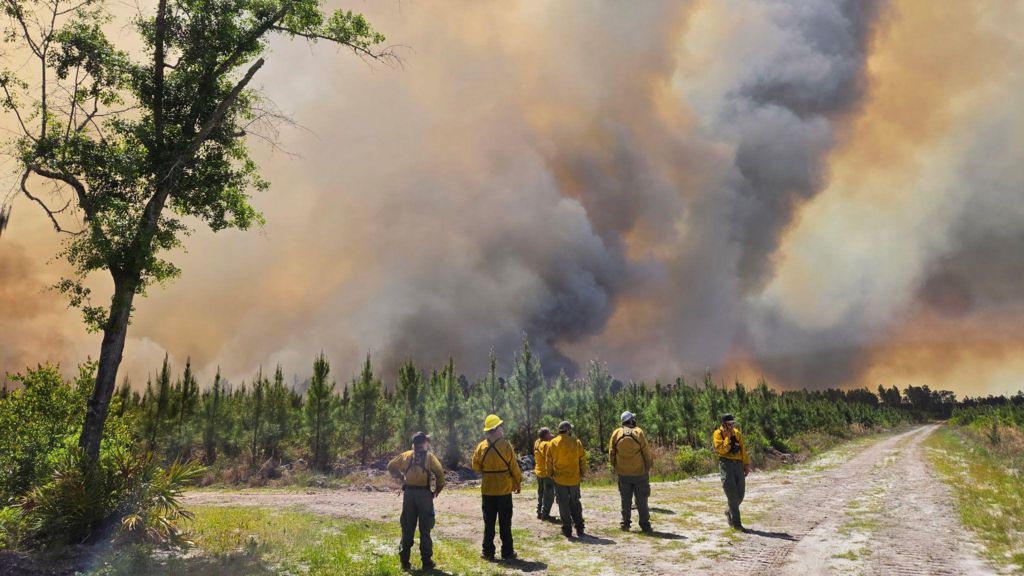
A devastating outbreak of wildfires across the U.S. state of Georgia has left a trail of widespread destruction, with official data confirming more than 39,500 acres of land scorched and over 120 residential properties reduced to ash. As blazes continue to spread amid historically dry conditions, state leaders have activated emergency response protocols to mobilize resources and protect at-risk communities.
The two largest and most destructive blazes, identified as the Pineland Road Fire and the Highway 82 Fire, are concentrated in the state’s southeastern region. Their rapid growth prompted Governor Brian Kemp to issue a 30-day state of emergency covering 91 of Georgia’s 159 counties, unlocking additional state funding and response assets to support local firefighting efforts.
Georgia Forestry Commission Director Johnny Sabo emphasized the extreme risk facing the state in a recent public video address, noting that parched vegetation has created tinder-dry conditions where even the smallest spark can escalate into a life-threatening inferno in minutes. “We are in extreme drought conditions, and wildfire activity has already surpassed our five-year average,” Sabo added, underscoring that the current outbreak is far beyond what response teams typically handle this time of year.
Beyond the two major blazes, emergency crews are simultaneously working to contain dozens of smaller fires across the state. On Saturday alone, officials documented 32 new wildfire ignitions that burned a combined 50 acres of land, stretching response resources thin across multiple regions. The outbreak first began on April 18, with Governor Kemp issuing the state of emergency declaration just four days later as blazes began to spread uncontrollably.
Investigators with the Georgia Forestry Commission (GFC) have already identified likely ignition sources for the two major fires. The Highway 82 Fire, which has burned roughly 7,500 acres to date, is believed to have started when a metallic foil balloon made contact with an overhead power line, generating a spark that ignited surrounding dry vegetation. As of the latest update, the blaze was only 10% contained, leaving nearby communities at continued risk. The far larger Pineland Road Fire, which has scorched 32,000 acres, has been traced to an accidental stray spark generated by a routine welding operation, GFC investigators confirmed.
In a Friday update posted to the GFC official website, response teams reported that at least 35 minor additional structures have been lost to the Pineland Road Fire, with 187 homes still under immediate threat from advancing flames. To reduce the risk of new ignitions, state officials have implemented a full outdoor burn ban across the 91 counties covered by the state of emergency. The ban prohibits all open burning of waste, agricultural debris, and other unregulated outdoor fires.
For local families who have already lost their homes, the disaster has brought unimaginable loss. Anna Dudek, a resident whose property was destroyed by the blazes, shared her harrowing experience with CBS News, the BBC’s U.S. media partner. As the Dudek family spotted flames reaching their property line and began packing belongings to evacuate, they quickly moved their children and pets to safety before fleeing. From a distance, Anna monitored her home through a security camera feed connected to her phone, watching in real time as flames engulfed the structure. “When both of my devices went offline, and the screen went black and I couldn’t see anything more, it was so gut-wrenching because then I knew that what I call home was gone,” she told reporters.
The current wildfire outbreak is not isolated to Georgia, with hundreds of concurrent blazes also burning across neighboring Florida, straining regional firefighting resources across the U.S. Southeast as the region grapples with ongoing severe drought.