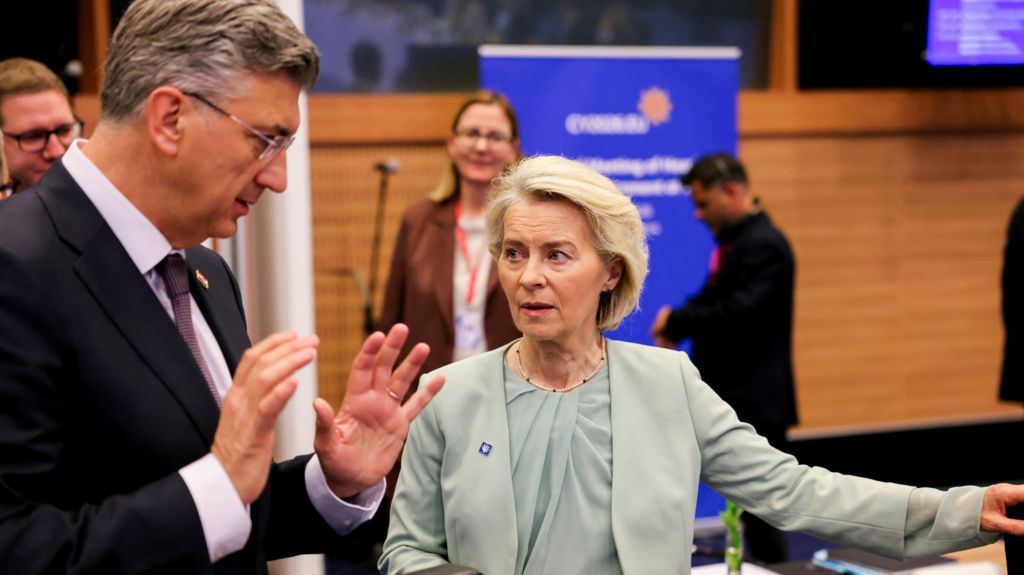
When European Union leaders gathered in Cyprus this week, they arrived intending to hash out pragmatic policy priorities, most notably the bloc’s next multiyear budget. Instead, they found themselves confronting yet another simmering transatlantic crisis that has laid bare deep fractures between the United States and its European allies – a rift that experts and leaders warn threatens the very foundation of the post-WWII collective defence order.
The catalyst for the latest standoff was a leaked internal Pentagon email, first reported by Reuters Friday, that outlined potential punitive measures against Nato allies who refused to back the U.S.-Israeli military campaign against Iran. Most alarmingly, the document floated the idea of suspending Spain from the 32-member defensive alliance over Madrid’s public opposition to the offensive.
Under Nato’s founding treaties, however, no mechanism exists to expel or suspend a member state. Any attempt to block Spain from occupying key civilian or military alliance roles, another potential penalty cited in the leak, would require unanimous approval from all Nato members – a step that all but guarantees rejection, given the swift, unified pushback from European leaders this week.
Spanish Prime Minister Pedro Sanchez, who has been one of the most vocal critics of the U.S.-Israeli strikes, struck a measured tone as he arrived at the summit, telling reporters simply: “We are fulfilling our obligations toward Nato.” Later, he dismissed the leaked email as an unauthorised document, noting Madrid conducts its diplomacy based on official U.S. government positions, not unsourced internal correspondence.
Sanchez’s defiance has long rankled the Trump administration: he was the only Nato leader to refuse Trump’s demand that members boost defence spending to 5% of GDP, and he immediately blocked U.S. forces from accessing shared U.S.-Spanish military bases for operations against Iran, earning earlier threats of U.S. trade sanctions.
Fellow European leaders were quick to rally to Spain’s side. Dutch Prime Minister Rob Jetten said he wanted to be “crystal clear” that Spain is and will remain a full Nato member, adding that European contributions to strengthening the alliance directly serve U.S. security interests. A senior German official echoed the sentiment, saying “Spain is a member of Nato. And I see no reason why that should change.”
Even Italian Prime Minister Giorgia Meloni, once widely viewed as a pro-Trump ally and a potential bridge between Europe and Washington, joined the criticism, describing the rising tensions between the U.S. and Madrid as “not at all positive.” Meloni has herself fallen out of favour with Trump in recent months: she denied U.S. forces permission to use the Sigonella airbase in Sicily for Iran operations, and called Trump’s derogatory remarks about the Pope “unacceptable.” Trump responded publicly by branding Meloni herself unacceptable, ending their once-close political alliance.
The leaked email also targeted another Nato ally, the United Kingdom, proposing a review of Washington’s position on the UK’s sovereignty over the Falkland Islands – a territory also claimed by Argentina. The move comes amid lingering tension between Trump and British Prime Keir Starmer, who initially denied Trump’s request to use British military bases for February strikes on Iran. Though the UK has since allowed limited base access and participated in drone interception missions, Starmer has refused to deepen UK involvement in the conflict or back the U.S. port blockade on Iran, drawing repeated verbal attacks from Trump.
Beyond the immediate threats against Spain and the UK, the leak has laid bare a growing crisis of confidence in the transatlantic alliance that experts say poses existential risk to Nato. Former Nato Assistant Secretary General for Defence Investment Camille Grande, now head of ASD Europe, said the leak reveals a fundamental misunderstanding of how the alliance works on the part of the Trump administration.
“The defence alliance is based on consensus; not run by the United States,” Grande explained. He compared Trump’s approach to that of a landlord seeking to evict tenants who do not pay what he deems sufficient rent, stressing that “Nato is not Trump’s building.”
French President Emmanuel Macron went even further, accusing Trump of deliberately “hollowing out” Nato through repeated public attacks on the alliance. Trump has repeatedly called Nato a “paper tiger” and a “one-way street” that benefits Europe at U.S. expense, writing on social media recently that “We will protect them, but they will do nothing for us.”
These public divisions have sparked deep anxiety among eastern European Nato members that have long relied on U.S. security guarantees to deter Russian expansionism. Russia’s full-scale invasion of Ukraine is now entering its fourth year, and the country’s war economy is growing, fueled by high global oil prices spurred by the current crisis around the Strait of Hormuz. Dutch military intelligence this week warned that once the conflict in Ukraine concludes, Moscow could be ready to launch a limited regional conflict against Nato within 12 months, aiming to divide the alliance politically through limited territorial gains and nuclear coercion.
That threat has left eastern allies questioning whether the U.S. would honour its Article 5 commitment to defend any attacked member. Polish Prime Minister Donald Tusk, a longstanding transatlanticist, openly raised that question this week. Even Estonia, a small Baltic state that spends heavily on defence and has long been courted by Trump, was left feeling vulnerable this week after the Pentagon delayed delivery of six contracted High Mobility Artillery Rocket System (HIMARS) to meet U.S. operational needs for the Iran war – a capability the U.S. itself called the most significant upgrade in Estonian military history.
The Trump administration has openly framed its approach as dividing allies into a tiered system of “good guys” and “bad guys.” In a December speech, U.S. Defence Secretary Pete Hegseth said model allies that fully back U.S. priorities would receive special favours, while those that do not would face consequences.
But former U.S. ambassador to Nato Julianne Smith, now president of Clarion Strategies, said punitive threats against European allies are entirely overreactive. “The President is obviously upset by Europeans that failed to fully support the US war in Iran. But punitive measures like removing force posture in Spain seem over-reactive in light of the fact that allies were never asked to assist the US and Trump has frequently denied that the US actually needed European support,” she noted. She added that new threats come as the transatlantic relationship is already reeling from Trump’s stated policy to seize Greenland from Nato member Denmark, and could deliver a devastating blow ahead of the alliance’s July summit.
Alarmed by the growing uncertainty over Nato’s reliability under the Trump administration, some EU leaders at the Cyprus summit floated the idea of activating the bloc’s own mutual defence clause, Article 42.7, as a potential backstop should Nato’s Article 5 prove unworkable. But European Commission President Ursula von der Leyen, the guardian of EU treaties, acknowledged the clause leaves critical details undefined: while it requires member states to come to each other’s aid, it offers no clarity on when activation is appropriate or what specific actions each member must take.
Caught between domestic public opposition to Trump’s Iran policy and the need to maintain working security and economic ties with Washington, many European nations are moving forward with independent plans to deploy international maritime patrols and mine-clearing operations in the Strait of Hormuz once hostilities end, in a bid to ease tensions with the U.S. France has pushed to exclude the U.S. from these discussions, though the UK has reportedly pushed for U.S. involvement.
Former Nato Secretary General Jens Stoltenberg warned this week that the mounting tensions put the alliance’s long-term survival in question, saying its existence cannot be guaranteed a decade from now. Still, he argued that Nato’s survival remains a core U.S. national interest: together, the U.S. and Nato allies account for 50% of global GDP and 50% of global military capability, giving the U.S. a network of global partners that rival powers Russia and China lack.
Stoltenberg pushed back on claims that Europe has broadly abandoned the U.S. over Iran, noting that most allies have provided quiet logistical support for operations, with only a handful of public dissenters. He also warned against Trump’s description of Nato as a paper tiger, stressing that alliances are rendered useless when they are undermined and attacked from within by their own members.
For European leaders, the core dispute with Washington is not whether Iran poses a threat to global security, but how to address that threat. European governments broadly favour diplomatic engagement and targeted sanctions over the unilateral military offensive launched by the U.S. and Israel, which they view as an unnecessary war of choice that has destabilized global energy markets and increased the risk of a broader regional conflict.