The ongoing Iran war has sent shockwaves through global energy markets, creating a severe fuel shortage across Europe and driving oil and gas prices to unprecedented heights. In response, the European Union has launched a serious evaluation of funding new alternative energy transport routes in the Middle East, designed to bypass conflict-prone chokepoints that have thrown global supply chains into chaos, most notably the Strait of Hormuz.
European Commission President Ursula von der Leyen announced the bloc’s new strategy Friday following an informal summit of EU leaders held in Nicosia, the capital of Cyprus, which currently holds the rotating EU presidency. Von der Leyen emphasized that the EU is prepared to partner with Persian Gulf nations to develop new energy export projects that will not be vulnerable to disruption from war or geopolitical tension. “The events of the past month have taught us a hard lesson,” she told reporters during a post-summit press conference. “Our security is not just related, it is intrinsically linked. A threat to a merchant vessel in the Strait of Hormuz is a threat to a factory, for example, in Belgium.”
While the EU executive highlighted plans to deepen defense cooperation and pointed to the bloc’s existing Red Sea maritime security mission as a potential model for Persian Gulf security, the core of von der Leyen’s public address focused on European backing for the repair and expansion of Middle Eastern energy infrastructure. “We are also ready to team up with the Gulf countries to diversify export infrastructure away from solely the bottleneck of the Hormuz Strait,” she said, adding that the bloc also stands ready to assist with repairing Gulf energy facilities damaged by the ongoing war.
Roughly 20% of the world’s total annual oil and gas trade transits the Strait of Hormuz, a narrow waterway between Oman and Iran that has been effectively closed to most commercial traffic since the outbreak of the Iran war. The disruption has triggered a sharp rally in global crude prices: as of Friday morning, Brent crude climbed 98 cents to settle at $100.33 per barrel, while U.S. West Texas Intermediate crude rose 81 cents to reach $96.66 per barrel. Von der Leyen confirmed that the price surge has added an extraordinary 25 billion euros ($29.3 billion) to the 27-nation bloc’s total energy bill over just 43 days.
Neither von der Leyen nor European Council President Antonio Costa released specific details about which potential infrastructure projects are under consideration or a clear timeline for moving proposals forward. However, von der Leyen did name the India-Middle East-Europe Economic Corridor, a previously announced connectivity partnership between the EU and India, as a relevant framework for future cooperation. She noted that a planned summit between the EU and the Gulf Cooperation Council, scheduled to take place later this year, will provide a formal opportunity for both sides to flesh out details of new energy infrastructure projects.
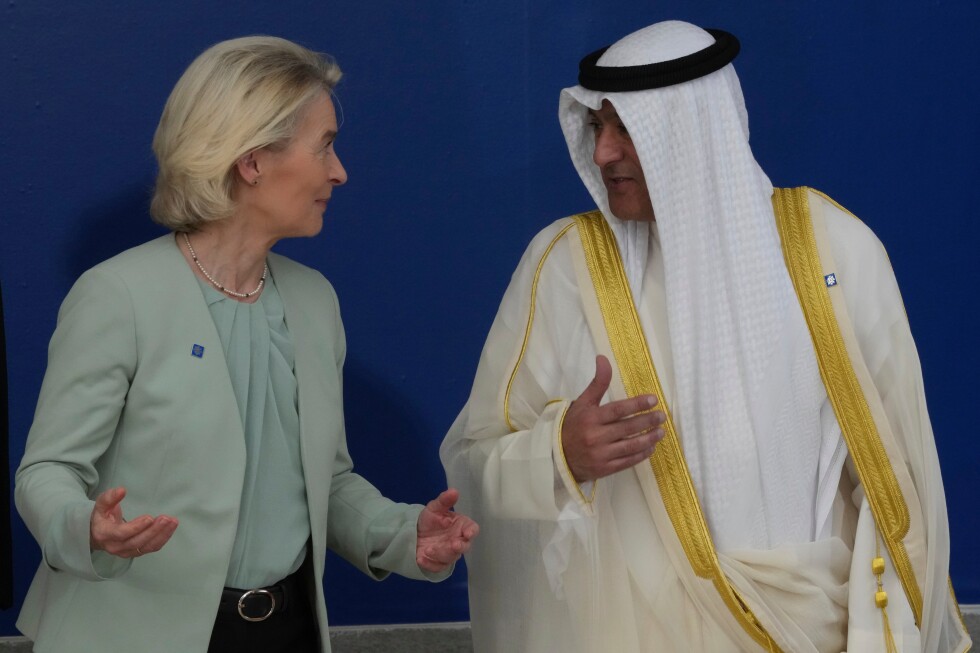
Cyprus, the current holder of the EU’s rotating presidency, is a small Eastern Mediterranean island nation located just off the coast of the Middle East, bordering Lebanon, Syria, Israel and Turkey. Cypriot President Nikos Christodoulides has made strengthening ties between the bloc and Middle Eastern nations a core priority of his country’s presidency, aiming to shore up regional economies and reinforce collective security across the Mediterranean and Middle East. This regional focus was clear in the guest list for the informal summit: attendees included Syrian President Ahmad al-Sharaa, Egyptian President Abdel-Fattah El Sissi, Lebanese President Joseph Aoun, Jordan’s Crown Prince Hussein, and GCC Secretary-General Jasem Mohamed AlBudaiwi.
During the summit, Syrian leader Ahmad al-Sharaa noted that “Europe needs Syria as much as Syria needs Europe,” while Lebanese President Aoun called on the EU to provide critical support for rebuilding his country, which has been heavily impacted by regional spillover from the war. Costa praised Aoun for his recent ban on unauthorized military activities by the militant group Hezbollah, which Costa described as “an existential threat” to Lebanon, and pledged EU support for the Lebanese government’s efforts to disarm the group. “The European Union is not part of the conflict, but we will be part of this solution,” Costa said.
The summit drew criticism from international human rights organizations, who condemned EU leaders for failing to increase diplomatic pressure on Israel over its ongoing military campaigns in the region. On the Iran policy front, multiple senior EU leaders including German Chancellor Friedrich Merz reaffirmed that the bloc will not roll back sanctions on Iran until a full range of outstanding issues are resolved, including ending Iran’s ballistic missile program and its support for regional militant proxies. Costa echoed that position, telling reporters “it’s too early to talk about relief of any kind of sanctions.”
Cyprus itself has already felt the direct impact of regional conflict, after a Shahed drone launched from Lebanon damaged an aircraft hangar at a British military base on the island’s southern coast on March 2. In response, several EU member states including Greece, France, Italy, Spain and the Netherlands deployed warships equipped with anti-drone capabilities to reinforce Cyprus’ air and maritime defense. The attack has reignited debate over a mutual assistance clause in the EU’s foundational treaties, which requires member states to provide support if one comes under armed attack. Following the summit, Christodoulides announced that EU leaders have agreed to develop a formal, institutional mechanism for activating mutual assistance, after concluding that the bloc’s current ad hoc response arrangements are unreliable.
This report was contributed to by McNeil reporting from Brussels, and Associated Press writer Baraa Anwer in Riyadh, Saudi Arabia.