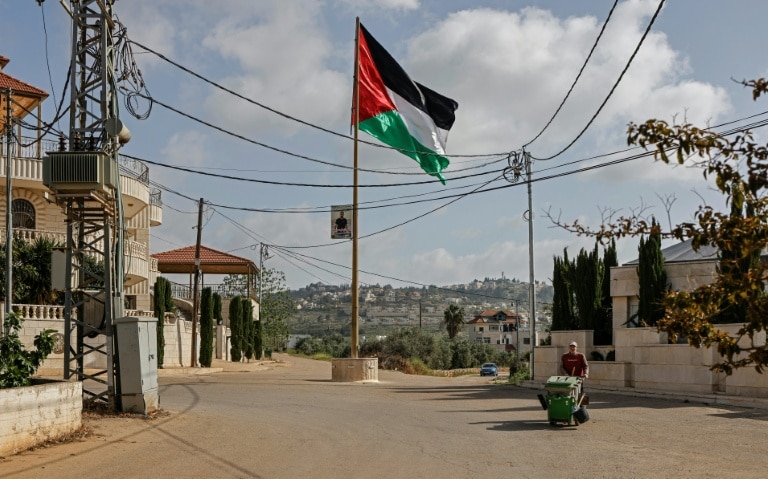
On Saturday, Palestinian residents across the Israeli-occupied West Bank and the central Gaza district of Deir el-Balah cast ballots in municipal elections, marking the first popular vote held by Palestinians since the outbreak of the latest Israel-Hamas war. This long-awaited electoral process unfolds against a backdrop of a restricted political field, widespread public apathy, and deep-seated challenges posed by ongoing conflict and occupation.
According to official figures from the Ramallah-based Central Elections Commission, approximately 1.5 million registered voters are eligible to participate in the West Bank, while another 70,000 residents in Deir el-Balah, one of the only areas of Gaza with a largely non-displaced population after more than two years of war, can also cast their ballots.
The structure of the electoral race reflects long-standing political divisions within Palestinian society. Nearly all competing candidate lists are either aligned with Palestinian Authority President Mahmoud Abbas’s secular-nationalist Fatah party or running as independent candidates. Notably, no candidate lists are affiliated with Hamas, Fatah’s long-time political rival which controls roughly half of the Gaza Strip. In most contested constituencies, Fatah-backed tickets face off against independent lists led by figures from smaller factions including the Popular Front for the Liberation of Palestine.
Widespread public disillusionment defines the lead-up to the vote, with many Palestinians questioning whether the election will deliver any tangible change to their daily lives under occupation. In Tulkarem, a northern West Bank city where two adjacent refugee camps have been under continuous Israeli military control for more than a year, local businessman Mahmud Bader said he would still cast a ballot, even as he saw little hope for improvement. “Whether candidates are independent or partisan, it has no effect and will have no effect or benefit for the city,” Bader told Agence France-Presse. “The Israeli occupation is the one that rules Tulkarem. It would only be an image shown to the international media — as if we have elections, a state or independence.”
In a sign of the limited political competition, multiple major population centers including Nablus and Ramallah, the administrative seat of the Palestinian Authority, only saw a single candidate list submitted for each local council. Those candidates will automatically claim their seats without any public vote.
Electoral officials have adjusted voting procedures to accommodate the extreme conditions in war-ravaged Gaza. Polling stations in the West Bank will operate from 7 a.m. local time to 7 p.m., while voting in Deir el-Balah will end two hours earlier at 5 p.m. This early closing is designed to allow vote counting to finish before dark, as widespread damage to infrastructure has left most of Gaza facing chronic electricity shortages.
International observers have framed the vote as an important milestone for Palestinian democratic process. UN Special Coordinator for the Middle East Peace Process Ramiz Alakbarov praised the Central Elections Commission for organizing a “credible process” amid extraordinary hardship. “Saturday’s elections represent an important opportunity for Palestinians to exercise their democratic rights during an exceptionally challenging period,” Alakbarov said in an official statement.
For Palestinian political analysts, the limited scope of the Gaza vote — restricted only to Deir el-Balah — carries clear strategic meaning for the Palestinian Authority. Deir el-Balah was selected for the pilot vote in large part because it is one of the only areas of Gaza where the majority of the original population has remained in place, rather than being displaced by the war, explained Jamal al-Fadi, a political scientist at Cairo’s Al-Azhar University. Al-Fadi added that the restricted election is an experiment for the Palestinian Authority to test public support after the war, when no formal opinion polling has been conducted.
The vote comes amid long-standing criticism of Abbas, who is 90 years old and has held the presidency for more than 20 years without winning a single re-election. Abbas has repeatedly promised to hold national legislative and presidential elections, but none have been held since 2006.
Despite widespread cynicism, some first-time voters in Gaza see the election as an act of political resilience. Twenty-five-year-old Farah Shaath, who is voting for the first time in her life, said she felt excited to participate even amid the chaos of war. “Although it is unlike any election in the world, it is a confirmation of our continued existence in the Gaza Strip despite everything,” Shaath said.
Logistical and security arrangements for the Gaza vote have already highlighted overlapping authority between the Palestinian Authority and Hamas. Election commission spokesman Fareed Taamallah said the body had recruited polling staff from local civil society groups and hired a private security firm to secure voting locations in Deir el-Balah. However, an anonymous source within the Gaza branch of the election commission told AFP that Hamas police have insisted on taking responsibility for securing the electoral process. The source added that Hamas will deploy unarmed personnel in civilian clothing around the 12 polling stations established in Deir el-Balah.