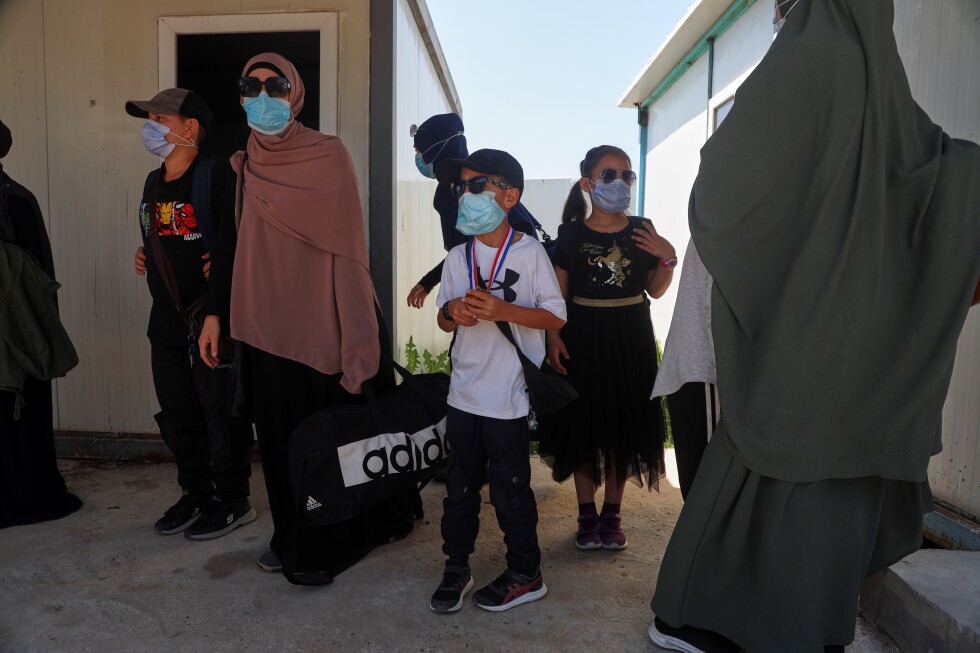
In a development that reignites debate over the repatriation of citizens linked to the Islamic State (IS) militant group, four Australian families departed the Roj Camp in northeast Syria on Friday, launching a fresh push to return to their home country, according to regional officials.
Correspondents from the Associated Press witnessed 13 Australian women and children board a bus guarded by a Syrian government delegation for the journey out of the remote camp, which sits just kilometers from the Iraq-Syria border and holds thousands of family members of people suspected of ties to IS.
Lana Hussein, a senior official with the Women’s Protection Units, an arm of the Kurdish-led Syrian Democratic Forces (SDF) that oversees security at Roj Camp, confirmed that the departure was coordinated jointly with the central Syrian government in Damascus. Per the agreed-upon arrangement, the Australian group will stay in the Syrian capital for approximately three days, after which they will be deported following standard security vetting procedures, Hussein explained.
As of Friday evening, neither the Syrian Ministry of Foreign Affairs nor the Australian federal government had issued any public statement in response to press requests for comment. It also remains unclear whether the Australian government was aware of or involved in planning this latest departure attempt.
This second effort to repatriate Australian citizens from the camp follows a failed attempt in February that saw a group of 34 women and children turned away by Syrian authorities before they could reach Damascus to depart for Australia. At the time, Australian officials explicitly stated they would not facilitate the group’s repatriation, and Canberra later issued a temporary exclusion barring one of the participating women from reentering the country.
The geographic context of the situation has shifted dramatically since that February attempt. Roj Camp is located in a region of northeast Syria that was long controlled by the SDF, but clashes between the SDF and Syrian government forces in early 2024 ended with Damascus seizing control of the majority of the territory the SDF previously held. The fighting also triggered a wave of prison breaks and mass escapes from the larger al-Hol camp, another major facility holding IS-linked detainees, which has since been formally closed. Following the collapse of IS’s self-declared caliphate in 2019, tens of thousands of former fighters, their spouses and children from dozens of countries were detained in a network of SDF-run camps and detention centers across northeast Syria. In the aftermath of the January clashes, the U.S. military transferred thousands of former IS detainees from Syria to Iraq to face legal proceedings.
Canberra has previously facilitated two repatriation operations for Australian women and children held in Syrian detention camps, and an unknown number of other Australian citizens have returned to the country without official government support. Even after the defeat of IS’s territorial rule, the group retains active sleeper cells that continue to launch lethal attacks across both Syria and Iraq.
This report includes contributing reporting from AP correspondent Abby Sewell based in Beirut.