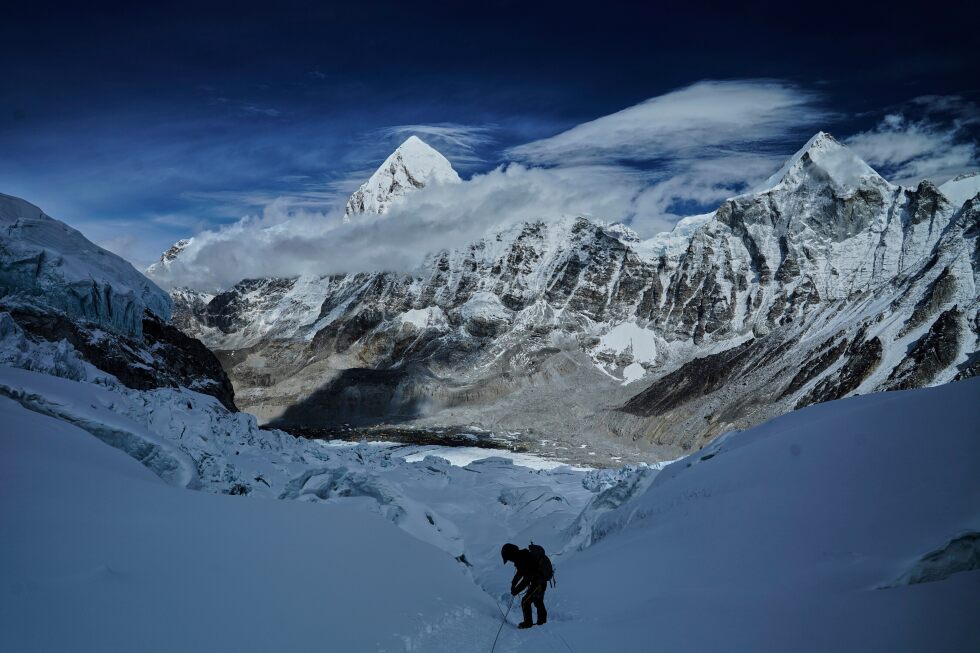
KATHMANDU, NEPAL – A dangerous unstable ice formation has thrown a wrench into the 2024 spring Mount Everest climbing season, forcing hundreds of climbers and their Nepalese support teams to pause their summit bids just as operations are set to ramp up, Nepalese mountaineering officials confirmed Friday.
The hazard is a massive hanging serac located along the standard climbing route between Everest’s base camp and Camp 1, a section of the iconic peak that already ranks among the most dangerous in the world. Himal Gautam, a representative from Nepal’s Department of Mountaineering, confirmed the ice block is shifting and poses an unacceptable level of risk for teams moving up the mountain. As of Friday, more than 800 total people – including permitted foreign climbers and their local guides – are stuck at base camp, waiting for officials to sign off on a safe passage forward, with expedition leaders and government teams working around the clock to re-evaluate conditions daily.
This year’s spring climbing window, the most popular period for summit attempts on Everest, runs through the end of May. Nepal’s tourism department has already issued 410 summit permits to foreign climbers for the season, a number that will double when counting the required Nepalese Sherpa guides, porters, and support staff that accompany every expedition.
The problematic serac sits within the Khumbu Icefall, a notoriously unpredictable glacial stretch that is universally regarded as one of the most treacherous sections of any Everest climb. The icefall is constantly shifting, dotted with gaping hidden crevasses and topped with overhanging ice blocks the size of 10-story buildings, any of which can collapse without warning.
Preparing a safe route through the Khumbu Icefall falls to the Icefall Doctors, an elite team of experienced Sherpa guides who annually fix climbing ropes and install aluminum ladders across deep crevasses to open the passage for expeditions. This work is typically completed by mid-April, but the unstable serac has halted progress. The Sagarmatha Pollution Control Committee, the organization that manages the Icefall Doctor team, is now planning to conduct an aerial survey to fully assess the serac’s stability. Committee chairman Lama Kazi Sherpa said the current avalanche risk is far too high for ground teams to work safely, so officials are adopting a wait-and-see approach, holding off on reopening the route until the ice block naturally melts to a safer size.
This is not the first time a massive ice collapse in the Khumbu Icefall has caused tragedy on Everest. In 2014, a large chunk of glacial ice broke loose and triggered a devastating avalanche that killed 16 Sherpa guides who were moving client equipment up the mountain. That disaster remains one of the deadliest accidents in the recorded history of Everest climbing.
Climbing teams typically time their summit bids for early to mid-May, when short, stable weather windows offer the best conditions for a push to the 8,848.86-meter (29,031.7-foot) peak. More than 4,000 climbers have successfully reached the summit since the first recorded ascent by New Zealander Edmund Hillary and Sherpa Tenzing Norgay on May 29, 1953.