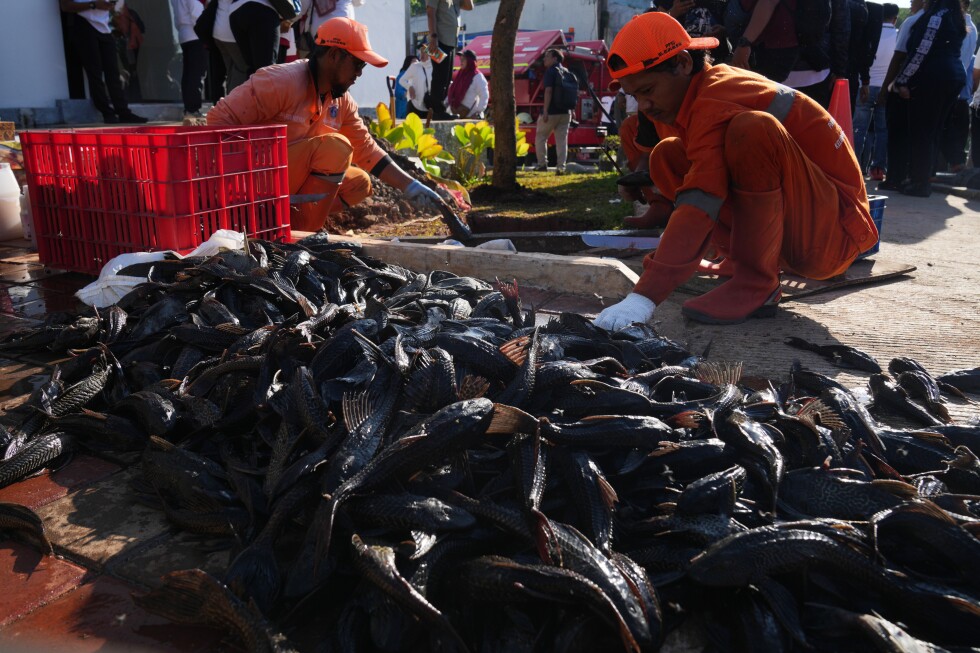
On a recent Friday in Jakarta’s East Jakarta Ciracas neighborhood, crowds erupted in cheers as hundreds of city workers, local residents and environmental volunteers pulled heavy nets teeming with armored, invasive suckermouth catfish from the depths of a 6-meter reservoir. This public effort marked the peak of a coordinated, city-wide campaign to cull at least 10 metric tons of non-native janitor fish, locally called sapu-sapu, from the capital’s overburdened waterways in a bid to rescue the ecologically fragile Ciliwung River.
Originally imported to Indonesia decades ago as a popular algae-eating addition to home aquariums, Pterygoplichthys, the scientific name for janitor fish, was accidentally or intentionally released into local rivers after outgrowing tank environments. The species quickly adapted to Jakarta’s heavily polluted water systems, thriving where most native freshwater fish cannot. Growing up to 50 centimeters long and living 10 to 15 years, the armored bottom-feeders have carved out an unchallenged niche in the Ciliwung, a waterway that once carried crystal-clear mountain runoff from West Java to Jakarta’s coast, but now carries a heavy load of untreated residential sewage and industrial pollution.
Ecologists warn that the unchecked growth of janitor fish populations has pushed the already strained Ciliwung ecosystem to the breaking point. Dian Rosleine, an ecologist at the Bandung Institute of Technology, explained that janitor fish are not just a symptom of poor water quality — they actively outcompete native species for food and habitat, feeding on the eggs and young of local fish to throw the entire freshwater food web off balance. Beyond ecological harm, East Jakarta Mayor Munjirin, who goes by a single name, noted that the fish’s habit of clinging to and burrowing into concrete river embankments has caused costly structural damage that increases flood risk for surrounding dense residential neighborhoods.
Ordered by Jakarta Governor Pramono Anung, the mass removal campaign launched last week across all five of the capital’s administrative districts, drawing hundreds of participants from firefighting teams, disaster management agencies, volunteer groups and local communities. Within the first seven days of the operation, crews had already netted and disposed of more than seven metric tons of janitor fish. Friday’s targeted reservoir cleanup alone removed 320 kilograms of the invasive fish, leaving piles of wriggling catfish stacked in red barrels along the shore — visible progress for residents who have long dealt with the river’s declining health.
The campaign has not proceeded without debate, however. Indonesia’s Indonesian Ulema Council (MUI), the country’s leading Islamic clerical body, raised ethical objections to the initial practice of burying caught janitor fish alive, arguing that the practice violates Islamic teachings on animal welfare. In response, Governor Anung announced a revised protocol requiring all fish to be humanely euthanized before burial at designated, sanitary sites, to prevent any accidental return of the fish to local waterways or unregulated commercial trade.
Officials are also exploring long-term, sustainable disposal methods that could turn the invasive catch into a useful resource. While janitor fish are consumed in other countries, high levels of heavy metal contamination in Jakarta’s polluted rivers rule out immediate approval for human consumption. Current proposals include processing the fish into livestock feed or organic fertilizer; buried fish can also act as natural compost, and Anung has floated the idea of adopting a Brazilian model that processes invasive suckermouth catfish into charcoal for economic benefit.
Despite the early progress of the removal campaign, ecologists emphasize that culling janitor fish alone will not solve the Ciliwung’s long-term problems. Rosleine and other experts warn that without systemic upgrades to Jakarta’s wastewater management infrastructure and dramatic reductions in pollution entering the river, the favorable warm, slow, nutrient-heavy conditions that allowed janitor fish to dominate will remain, leading to a rapid rebound of the invasive population. “Addressing the symptoms without tackling the root causes will not provide a lasting solution,” Rosleine said, noting that full rehabilitation of the Ciliwung River remains Jakarta’s greatest unaddressed environmental challenge.