In a landmark milestone for China-Pakistan aerospace cooperation and international space collaboration, two Pakistani astronauts arrived at the Astronaut Center of China in Beijing on Friday to kick off joint training with their Chinese counterparts, according to official confirmation from the China Manned Space Agency (CMSA).
In an official statement announcing the start of training, CMSA expressed its expectation that the Pakistani astronauts will soon turn their long-held national space ambition into reality, carrying the Pakistani public’s decades-old spaceflight dream and the enduring friendship between the two Asian nations to China’s Tiangong Space Station, nicknamed the “Heavenly Palace” in Chinese.
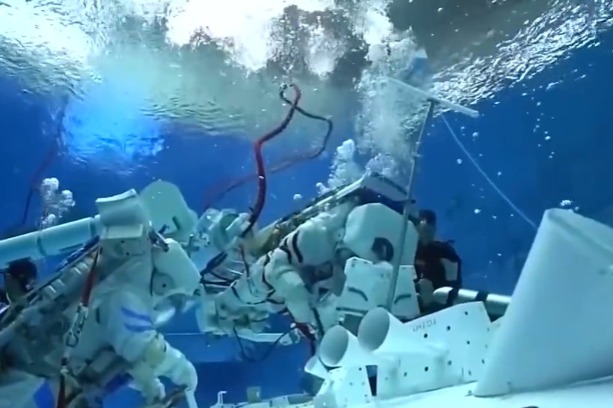
The two trainees, Muhammad Zeeshan Ali and Khurram Daud, are the first international astronaut candidates to receive training at China’s dedicated astronaut facility. Over the coming months, the pair will complete a structured program of specialized training modules before undergoing formal competency assessments. Following the evaluation process, one candidate will be selected to serve as a payload specialist on an upcoming Chinese crewed mission to Tiangong, making history as the first non-Chinese astronaut to visit the Chinese orbiting outpost.
For Pakistan, the mission carries extra national significance: if the collaboration proceeds successfully, the selected astronaut will become the first Pakistani national ever to reach Earth’s orbit, fulfilling a long-held national goal for the country’s space program.
The current training program is the outcome of a bilateral agreement signed 14 months prior, in February 2025, between CMSA and Pakistan’s Space and Upper Atmosphere Research Commission in Islamabad. That agreement laid the formal institutional and operational groundwork for joint cooperation in the selection and training of Pakistani astronauts for a mission to Tiangong.
Completed after more than a decade of development, Tiangong stands as one of the largest and most technologically advanced space structures ever placed in low Earth orbit. It is currently the only active space station in the world that is independently designed, constructed and operated by a single country. Since the station reached full operational capacity, it has hosted 10 consecutive crews of Chinese taikonauts, supporting hundreds of scientific experiments across a wide range of space research disciplines.