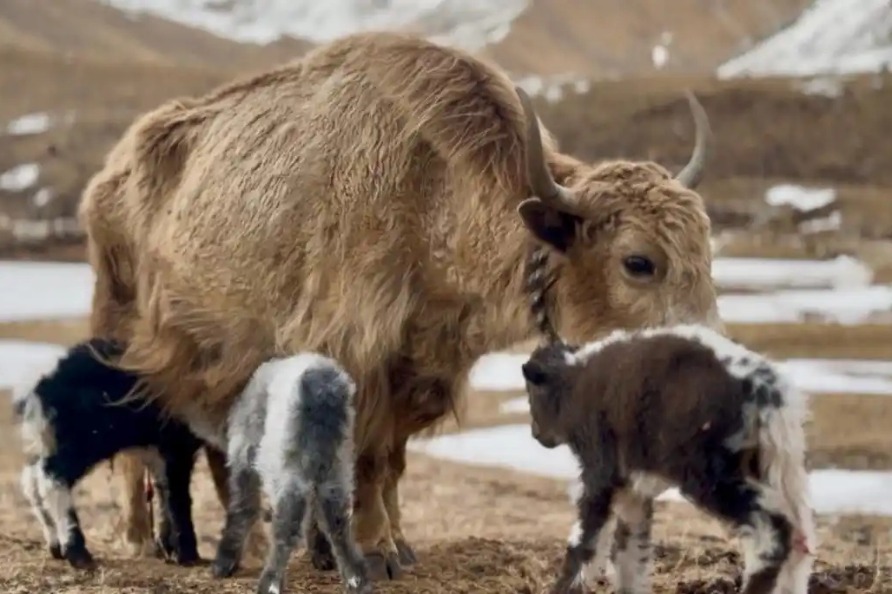
In a groundbreaking, never-before-documented event for the region, an 8-year-old female yak in Driru County, Xizang Autonomous Region, has given birth to three healthy, naturally conceived calves, marking the first officially recorded natural yak triplet birth in Xizang’s history.
As of the latest update, both the mother yak and her three newborns are in stable, good condition. The young calves are nursing normally and have already acclimated smoothly to Xizang’s harsh high-altitude, low-temperature environment, a testament to their hardiness.
Animal husbandry researchers explain that yaks are evolutionarily adapted to single-calve pregnancies, making a natural triplet birth an extraordinarily rare occurrence. This unprecedented birth is far more than a curious local oddity: it sheds new light on the outstanding genetic characteristics of Xizang’s indigenous yak breeds, and serves as tangible evidence of the region’s improving ecological environment and widespread adoption of standardized, science-based grazing management practices over recent years.
In response to this rare event, local agricultural and animal husbandry authorities have moved quickly to implement regular professional health checks and customized care plans to protect the mother and her triplets. Scientific teams will also conduct long-term follow-up genetic studies on the three calves, aiming to unpack the biological mechanisms behind this unusual reproductive outcome and inform advances in local yak breeding programs.
Researchers and industry analysts note that this milestone discovery carries substantial value for the future of Xizang’s yak industry. Insights gained from the triplets could help livestock scientists optimize yak breed lines, improve overall reproductive efficiency for the species, and drive the high-quality development of Xizang’s signature animal husbandry sector, a core source of income for many local herding communities.