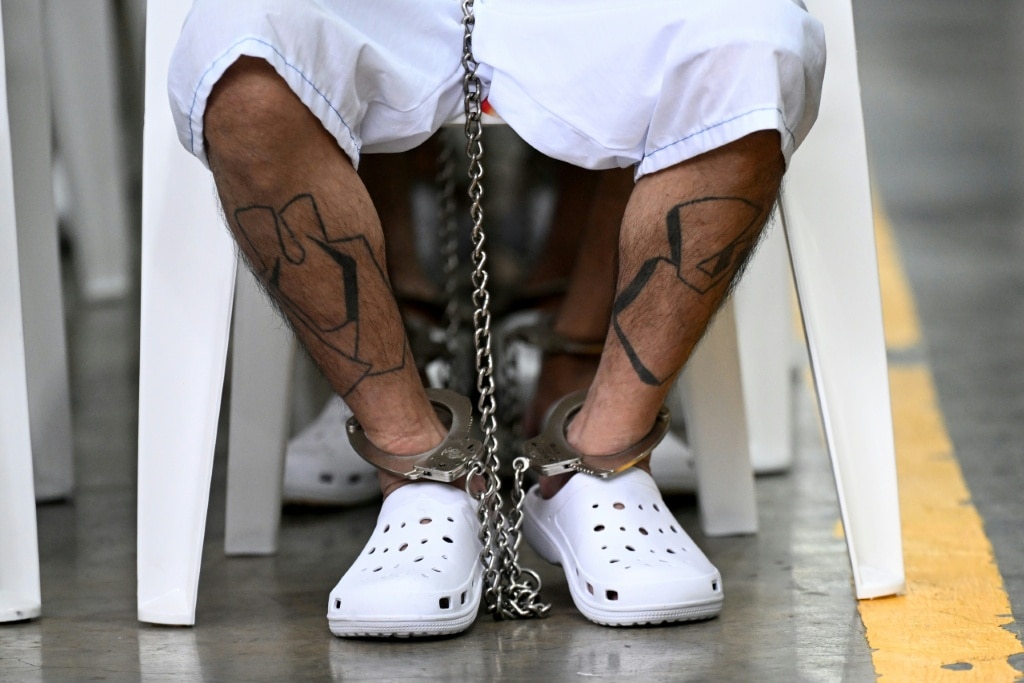
In a historic, high-security proceeding at El Salvador’s controversial Terrorism Confinement Center (CECOT) — the world’s largest mega-prison — hundreds of alleged members of the transnational criminal gang Mara Salvatrucha, better known as MS-13, appeared before the court this week to face charges of mass murder, torture and organized terror. On Thursday, Agence France-Presse reporters granted access to the restricted facility witnessed a stark scene: 220 defendants, all clad in matching white t-shirts and shorts, heads shaved, secured by chains, sat motionless and silent in orderly rows of plastic chairs arranged across CECOT’s main assembly hall. Hundreds of additional co-defendants joined the proceeding remotely from other blocks of the facility. Among those on trial are roughly 20 alleged high-ranking MS-13 leaders, including Borromeo Henriquez (known by the alias “The Little Devil of Hollywood”) and Carlos Tiberio Ramirez (“Snaider of Pasadena”), alongside dozens of mid-level gang lieutenants. Most defendants bore the gang’s signature tattoos across their faces, necks, hands and scalps, with some staring directly at visiting press as heavily armored security guards bearing riot shields formed a protective perimeter around the courtroom. Prosecutors allege the group collectively carried out more than 29,000 brutal killings across El Salvador over decades of gang rule. During Thursday’s testimony, graphic accounts of the gang’s violence played over the courtroom’s public address system. One witness recalled, “We burned her genitals and buttocks,” describing a targeted killing ordered by gang leadership. Additional testimony from two witnesses confirmed that MS-13 commanders continued to order murders from inside prison walls, even amid widespread state crackdowns. Prosecutors have directly linked the two top accused leaders to roughly 9,000 crimes, and the men showed no visible reaction as the chilling charges were read aloud. The mass trial is the centerpiece of Salvadoran President Nayib Bukele’s high-profile “war on gangs,” a sweeping security crackdown launched in 2022 that has seen more than 90,000 suspected gang members arrested under a prolonged state of emergency. Bukele, who has openly styled himself as the “world’s coolest dictator” in media appearances, has compared the CECOT mass trial to the Nuremberg Trials that prosecuted Nazi leadership after World War II. CECOT director Belarmino Garcia echoed the government’s framing, telling reporters, “These individuals caused mourning and pain to our society for many years.” A uniformed CECOT security agent, who spoke on condition of anonymity, added of the witness testimony: “It’s a horrifying account that makes your hair stand on end.” The Salvadoran government invited international journalists to observe the fourth day of proceedings, though access was tightly controlled under strict security protocols. For Bukele, the crackdown on gangs has proven politically transformative: supporters credit him with turning El Salvador from a nation once labeled the murder capital of the world into a safer country, and his hardline approach has become a template for right-wing political candidates across Latin America seeking to capitalize on widespread public anger over violent crime. Yet the mass trial and Bukele’s broader security campaign have faced sharp international criticism, particularly from human rights organizations that warn the sweeping dragnet of arrests has inevitably swept up thousands of innocent people, many of whom were detained for months before being cleared of any links to gangs. The process of mass trying hundreds of defendants at once has also raised alarms about due process violations. Controversy extends beyond El Salvador’s borders as well: Last year, former U.S. President Donald Trump authorized the transfer of 140 alleged Venezuelan gang members to be incarcerated at CECOT, a move that U.S. courts later ruled was unlawful. In 2021, U.S. authorities also leveled allegations that undermined Bukele’s carefully cultivated tough-on-crime image, claiming his administration held “covert negotiations” with MS-13 and other gangs, offering financial incentives in exchange for reduced gang violence and political support for Bukele’s ruling New Ideas party. The CECOT mega-prison, purpose-built to hold tens of thousands of suspected gang members, and the ongoing mass trial have become defining symbols of Bukele’s polarizing approach to public security, dividing supporters who hail his success in curbing violence from critics who warn the campaign is eroding democratic norms and civil liberties in the country.