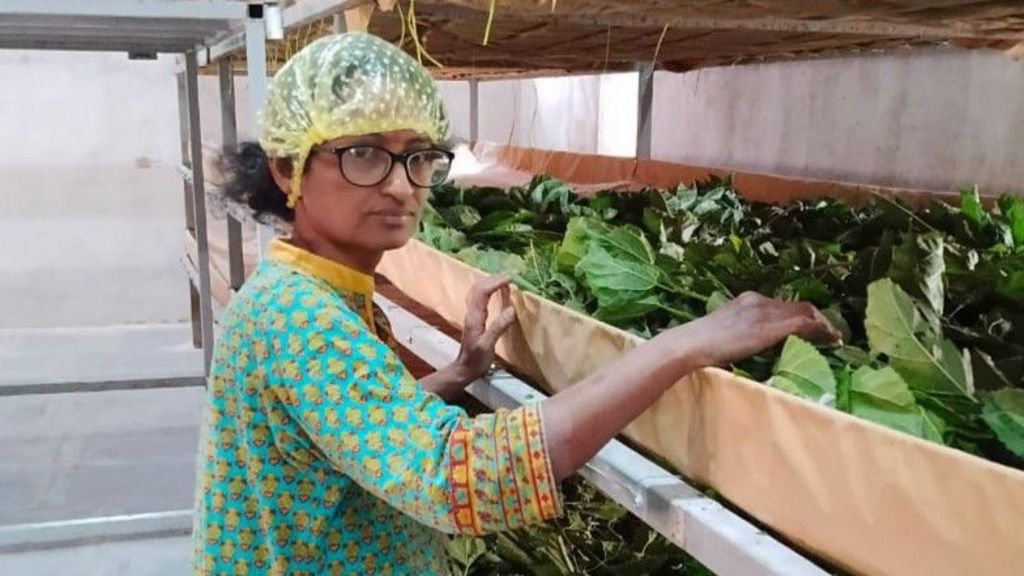
Six years ago, Dr. Jolapuram Umamaheswari made a life-altering career choice: she left her position as a research scientist in Singapore and returned to her home country of India, ready to forge an independent path as her own boss.
After months of exploring niche agricultural opportunities, she settled on sericulture — the centuries-old practice of raising silkworms to harvest raw silk from their cocoons. For Umamaheswari, the career shift was not a departure from her scientific roots, but a new application of them. “Silk farming sits at a rare intersection of biology, precision, and business,” she explained. “It didn’t feel like I was leaving science, it felt like I was applying it differently.”
The early days of operating her sericulture farm in Andhra Pradesh, India’s eastern coastal state, came with steep challenges. Frequent disease outbreaks wiped out entire batches of silkworms, crop yields fluctuated wildly, and managing the delicate living organisms required a complete re-learning of traditional practices. Drawing on her formal scientific training, Umamaheswari began testing incremental adjustments to farm operations: refining hygiene protocols, adjusting feeding schedules, and controlling growing environment conditions. Over time, these small changes compounded to deliver dramatic improvements, boosting silkworm survival rates and raising the overall quality of harvested cocoons.
Today, her hard work has paid off. Umamaheswari produces 10 annual crops of raw silk, with each 25 to 30-day growing cycle delivering a consistent, reliable income. She earns roughly $1,000 per month, a steady, salary-like return that sets sericulture apart from many seasonal agricultural ventures. “If managed well, it gives you regular returns, not just seasonal income,” she noted. Looking ahead, she plans to expand her farm with a small cow shed, adding a new revenue stream from milk sales while using cow manure to naturally fertilize her mulberry crops — the primary food source for her silkworms.
Umamaheswari’s data-driven approach to small-scale sericulture reflects a broader transformation sweeping through India’s silk industry, where traditional farming is merging with cutting-edge digital and biotechnological innovation. Krishna Tomala, founder of Asho Farms, is at the forefront of this tech-driven shift, integrating advanced automation and artificial intelligence across every stage of his silk production operation, from egg production to larval rearing and cocoon harvesting.
Tomala explains that silkworms experience nearly 1,000-fold growth in just 25 days, and their survival and quality depend entirely on strict control of temperature, humidity, and feed quality. Silkworms are extremely sensitive to even minor environmental fluctuations, and historically, growers relied on manual monitoring that often missed issues before it was too late. Today, connected sensors and automated systems adjust fans, heaters, and humidifiers in real time to maintain optimal growing conditions. At Asho Farms, artificial intelligence and computer vision detect early signs of silkworm disease with more than 99% accuracy, allowing workers to remove infected larvae before outbreaks can spread to entire batches.
As the second-largest silk producer in the world, trailing only market-dominating China, India holds a unique position in the global silk market. Unlike any other nation, India produces all four commercially relevant varieties of silk: Mulberry, Tasar, Eri, and Muga. Muga silk, in particular, is exclusive to India’s northeastern states of Assam and Meghalaya, giving the country an unrivaled product diversity that sets it apart from global competitors.
India’s national Central Silk Board is now driving next-generation innovation for the industry, focusing on genome editing to develop more resilient silkworm strains. Working in international collaboration with research partners in Japan, the board has already created new silkworm varieties that are resistant to common devastating diseases. Researchers are also unlocking new value from sericulture byproducts: for every kilogram of raw silk produced, approximately 2 kilograms of nutrient-dense dried silkworm pupae are left over, which are now being repurposed as high-protein feed for poultry and fish farming.
Further down the supply chain, technology is also transforming the final stage of silk production: reeling, the process of extracting silk fibers from cocoons and spinning them into strong raw yarn. Satheesh Kannur, who runs a reeling operation, says modern machinery has converted what was once a slow, labor-intensive craft into a fast, precision-focused industry. The adoption of solar power has also made reeling far more environmentally sustainable. Even with these advances, however, Kannur warns of a looming bottleneck: he fears that Indian sericulture farmers will not be able to produce enough cocoons to meet growing demand from reeling operations. Many second-generation farmers are leaving the industry for urban work, and most existing silk farms are made up of small, scattered land holdings that cannot support large-scale production. “Without cocoons, there is no silk. The entire industry depends on farmers,” Kannur said. “For this industry to grow we need huge lands.”
The Central Silk Board pushes back on this concern, noting that while the total number of sericulture farmers has declined, total national cocoon production continues to rise thanks to modern scientific farming techniques. “With advancements in rearing techniques, disease control, and scientific support to farmers, yield per acre has gone up significantly,” the board said in a statement.
For small-scale growers like Umamaheswari, the future of Indian sericulture is already clear. Even incremental, practical improvements to growing practices can boost both yield and quality, creating a rewarding, profitable venture for entrepreneurs willing to combine traditional farming with modern scientific knowledge.