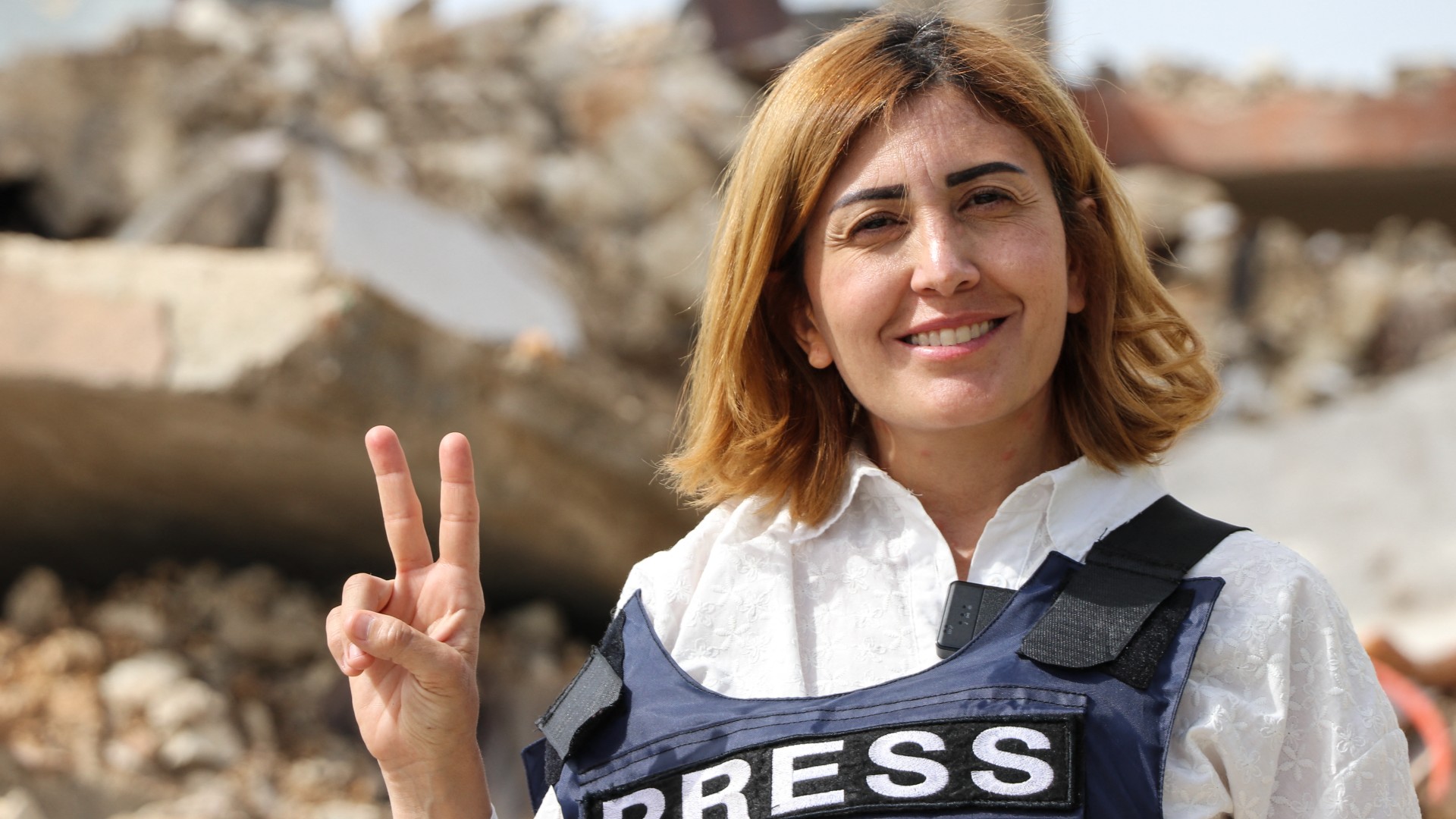
Forty years after she was born into the decades-long Israeli occupation of southern Lebanon, seasoned Lebanese journalist Amal Khalil was killed in that same region by invading Israeli forces while on assignment, leaving a deep gap in local journalism and a nation mourning a fearless storyteller who dedicated her life to amplifying marginalized voices.
Khalil, 42, was targeted and killed last Wednesday while traveling to al-Tayri to cover an earlier Israeli strike on the southern Lebanese town. According to Lebanon’s health ministry, an initial Israeli strike hit a vehicle ahead of Khalil and freelance photographer Zeinab Faraj, forcing the pair to seek shelter in a nearby residential building. A second Israeli strike then directly hit the structure. Rescuers managed to pull out Faraj, who suffered a severe head injury, but came under Israeli gunfire when they attempted to reach Khalil. Her body was recovered hours later, pulled from the rubble of the destroyed home.
Born in 1984 in al-Baisariyah, a village in Lebanon’s southern Saida district, Khalil grew up steeped in the realities of conflict and occupation. Her hometown had just been retaken from Israeli control shortly before her birth, and she spent her childhood looking out at nearby occupied villages while Lebanon was mired in civil war. Her early exposure to the struggles of southern Lebanese communities shaped her lifelong commitment to on-the-ground, people-centered reporting. As a young girl, she secretly read the now-defunct Lebanese newspaper As-Safir, where she first learned about ordinary people’s struggles, detained activists, forcibly disappeared citizens, and the human cost of Lebanon’s civil war. She went on to study Arabic literature in Saida, and without her parents’ knowledge, traveled to Beirut to become involved in communist activism — a step that launched her professional writing career, starting with early features for al-Hasnaa magazine. In one notable early piece, she profiled how queer people navigated and celebrated love in Lebanon’s conservative society for a Valentine’s Day special issue, she recalled in a January 2025 interview with Beirut-based outlet The Public Source.
In April 2006, just months before Al-Akhbar newspaper published its first issue, Khalil joined the newly launched outlet, where she would remain for nearly 20 years. Only weeks after she joined, Israel launched its 33-day 2006 war on Lebanon, a turning point that shifted her focus from planned coverage of women’s and cultural issues to documenting the experiences of people displaced and targeted by Israeli strikes. This focus on public interest storytelling, particularly for communities in southern Lebanon, became the throughline of her entire career. For most of her professional life, she was based in Tyre (known locally as Sour), where she investigated corruption and highlighted social injustices without sparing powerful figures — even when that put her own safety at risk. “Going after corruption cases and social issues in the area, sparing no one – not even my family – led to confrontations,” she once said. “I was threatened, assaulted, and intimidated. The pressure to break me was relentless, but I didn’t yield.” Though Al-Akhbar has a longstanding editorial alignment with Hezbollah and its resistance against Israeli occupation, Khalil repeatedly emphasized she reported without imposed limitations, pointing to the outlet’s 2011 decision to publish WikiLeaks documents referencing parliamentary speaker Nabih Berri, despite a request from then-Hezbollah leader Hassan Nasrallah to withhold the material. Over time, she became the newspaper’s lead field correspondent for all of southern Lebanon, covering areas including Sour, Bint Jbeil and Nabatieh.
Khalil was well aware of the risk Israeli forces posed to Lebanese journalists, having already mourned one of her own colleagues killed in Israeli shelling: in 2010, she wrote the obituary for Assaf Abu Rahhal, recalling the moment a Lebanese soldier handed her Abu Rahhal’s blood-stained identification, the only personal effect that remained of him. “It was all that remained of Assaf. I will never forget that day,” she wrote.
Throughout her career, Khalil remained unwavering in her commitment to left-wing politics and resistance against Israeli occupation. In recent years, she taught herself video editing to produce on-the-ground reporting, though she refused to appear on camera herself, saying: “For me, it was simple: I’m here to tell the stories of the people, not to become the story myself.” When the 2023-2024 Israel-Lebanon conflict broke out — after Hezbollah launched attacks on Israel in solidarity with Palestinians under assault in Gaza — Khalil spent months documenting evidence of Israeli targeting of civilians and civilian infrastructure across southern Lebanon. Following a February 2024 ceasefire, she continued to report on near-daily Israeli violations of the truce. She survived multiple close calls, the most recent in November 2024, when Israeli forces opened fire to force her and her colleagues to retreat from the border. Friends and colleagues said she never bowed to Israeli restrictions on her movement, refusing to stay out of areas Israeli forces sought to bar journalists from entering. After that 2024 close call, she said people had repeatedly urged her to limit her travel for safety, but her beliefs and upbringing taught her to stand “in the face of oppression.” “My alignment with the people of the south, my presence among them since the July 2006 war, has always been the right choice. They have always lived up to that faith placed in them,” she said. “They will grow stronger, more steadfast, and more committed to this unwavering compass, toward truth, and toward Palestine.”
In the days after her killing, tributes poured in from across Lebanon and the global journalistic community, with friends and colleagues remembering her generosity, courage and pioneering spirit. “Amal was present in every home. Every home in Lebanon has lost her,” her brother Ali Khalil said tearfully. “Amal resembles the south in all its details – its sweet breeze, its valleys, its mountains, and its old houses. She resembles all of that.” For younger Lebanese journalists, Khalil was a beloved mentor who freely shared her decades of knowledge and connections even with professional competitors. “She was so generous even if we were competitors. She never hesitated in sharing a contact, a key – and she had all the keys in the south. She knew it like the palm of her hand and she shared this love and dedication with everyone who needed it,” Hussein Chaabane, a Lebanese investigative and legal journalist, told Middle East Eye.
Lebanese filmmaker Bachir Abou Zeid framed Khalil as far more than a conventional journalist, saying her devotion to her people and her land guided all her work. “Amal was not a journalist in the conventional sense of the profession. Her love for the land and for her people outweighed everything,” he said, calling her “a journalist of resistance” who was targeted specifically for her unflinching reporting. “The killing of Amal was the killing of a woman of resistance. Israel killed her because she was a journalist of resistance, not simply because she was a journalist.” Lebanese Prime Minister Nawaf Salam has labeled her killing a war crime, saying Lebanon will use all available international channels to hold those responsible accountable. Chaabane said Khalil’s death leaves an enormous void in Lebanese journalism, one that surviving colleagues must work to fill. “Amal never accepted what the Israelis tried to impose as limitations; she pushed their limits,” he said. “Her death will leave a vacuum, a huge one, which we need to fill.”