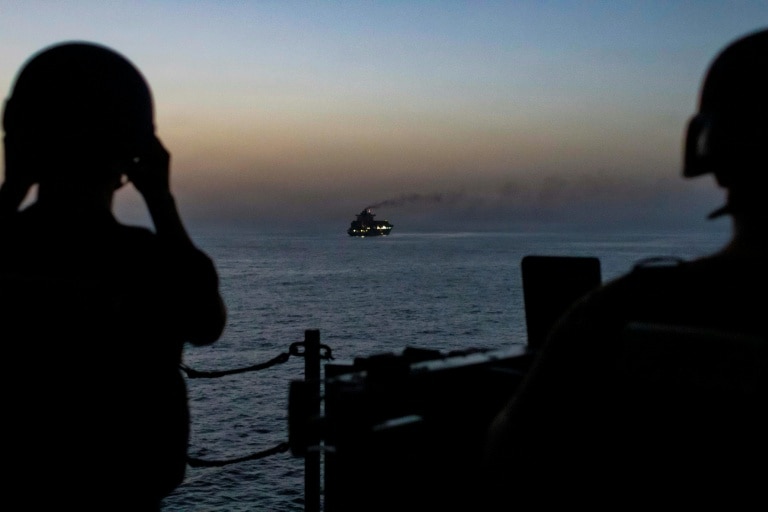
Fresh escalations and breaking developments continue to roil the Middle East this week, with a bitter standoff over the strategic Strait of Hormuz emerging as a flashpoint that threatens global energy supplies and economic stability. Multiple interconnected crises, from maritime blockades to diplomatic negotiations and violent attacks, have amplified instability across the region, sending shockwaves through global financial and commodity markets.
On the Hormuz front, Iranian officials announced Thursday that Tehran has collected its first batch of revenue from new tolls imposed on vessels passing through the waterway, a move implemented amid its ongoing standoff with the United States and Israel. Hamidreza Hajibabaei, deputy speaker of Iran’s parliament, confirmed the first toll payments have been deposited in an account held by Iran’s Central Bank, according to local Iranian news outlet Tasnim. This move marks a formal step forward in Iran’s effort to assert control over the chokepoint, through which roughly 20 percent of the world’s daily oil shipments pass.
Iran’s top leaders have doubled down on their refusal to reopen the Strait to full traffic, linking any reopening to an end to the U.S. naval blockade of Iranian ports. Parliament speaker Mohammad Bagher Ghalibaf, who led Iran’s delegation to preliminary talks in Islamabad, made clear that the ceasefire can only be considered legitimate if it ends the blockade. “Reopening the Strait of Hormuz is not possible amid a blatant violation of the ceasefire,” Ghalibaf stated, hardening Tehran’s position ahead of any further diplomatic negotiations.
U.S. military officials have responded with their own coercive measures, with U.S. Central Command (CENTCOM) announcing Wednesday evening it has ordered 31 vessels to divert from their routes or return to port as part of Washington’s blockade targeting Iran. In a post on X, CENTCOM confirmed the majority of the redirected vessels are oil tankers, and that most have complied with U.S. instructions. A separate U.S. Pentagon assessment, first reported by The Washington Post Wednesday, warns that clearing all mines laid by Iran in the Strait of Hormuz could take up to six months – a timeline that would keep global oil prices elevated for an extended period and continue dragging on the global economy. Iran has severely restricted access to the waterway since the outbreak of open hostilities with the U.S. and Israel, driving sharp increases in global oil and gas prices already strained by post-pandemic recovery and geopolitical uncertainty.
Beyond the Hormuz standoff, other developments have deepened regional unrest. Iran’s judiciary confirmed Thursday it executed a man identified as Sultan-Ali Shirzadi-Fakhr, who was convicted of membership in the banned opposition group People’s Mujahedin Organisation (MEK) and alleged collaboration with Israeli intelligence services. The execution, announced on the judiciary’s Mizan Online website, marks the latest in a series of high-profile convictions linked to alleged espionage against Tehran.
Along the Israel-Lebanon border, a new round of diplomatic negotiations got underway in Washington Thursday, aimed at extending a fragile ceasefire that is set to expire in days. Lebanese officials plan to request a one-month extension of the truce, while Israeli officials struck a conciliatory tone ahead of talks, saying they hold no major outstanding disagreements with the Lebanese government. Israel has called on Beirut to cooperate to disarm the pro-Iranian militant group Hezbollah, which has refused to participate in the negotiations and opposes any deal with Israel.
Tragedy struck southern Lebanon Wednesday, when an Israeli airstrike in an area officially covered by the ceasefire killed veteran journalist Amal Khalil, a correspondent for Lebanese newspaper Al-Akhbar. A second journalist, freelance reporter Zeinab Faraj, was wounded in the strike. Lebanese Red Cross officials confirmed to AFP that Khalil’s body was recovered from rubble after the attack, while Faraj was rescued and evacuated for medical care. Lebanese Information Minister Paul Morcos condemned the targeted attack on journalists as “a grave crime and a blatant violation of international humanitarian law.”
The rising tensions immediately rippled through global markets Thursday. Oil prices initially jumped more than 3.5 percent following Iran’s vow to keep the Strait of Hormuz closed, with benchmark U.S. West Texas Intermediate crude climbing 4.1 percent to hit $96.73 per barrel, and international benchmark Brent crude rising 3.6 percent to $105.63 a barrel before prices pared gains later in the session. Most major Asian stock markets fell in response to the geopolitical uncertainty, with indexes in Tokyo, Hong Kong, Shanghai, Sydney, Singapore and Wellington all closing lower.