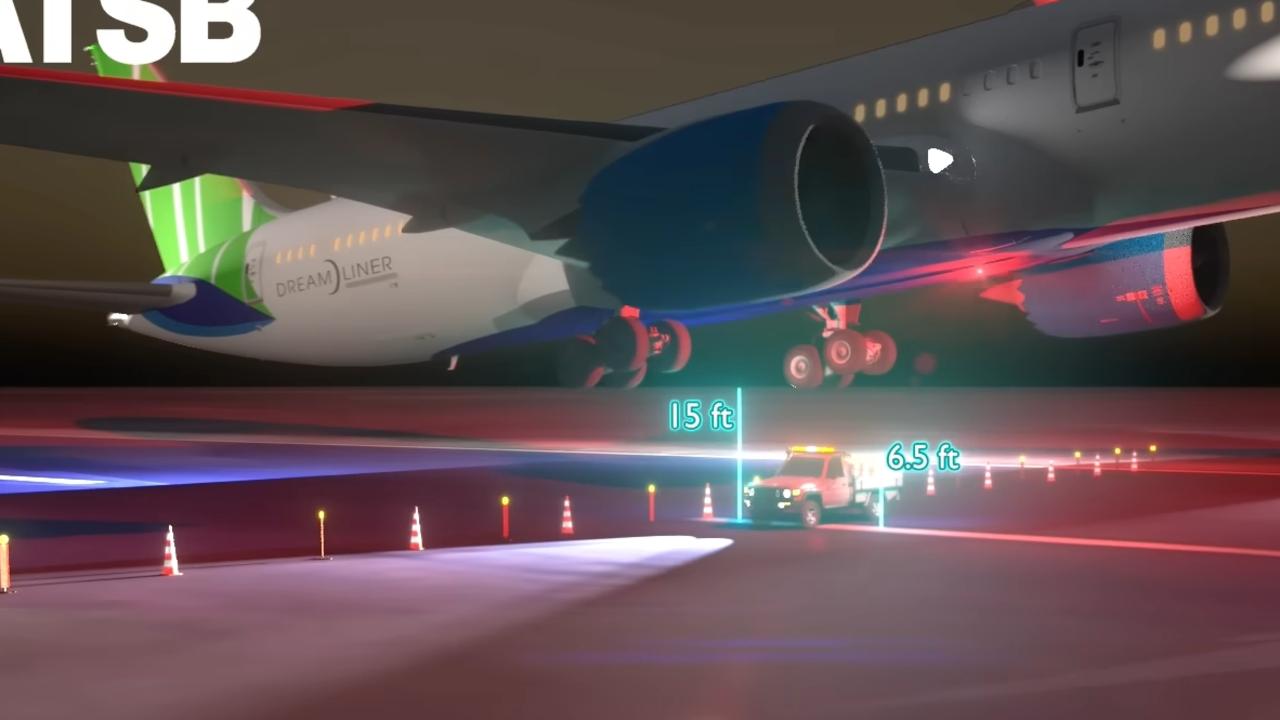
Australia’s aviation sector has been forced to confront critical gaps in safety protocols after a long-awaited official investigation concluded that two alarming near-collisions at one of the country’s busiest international hubs avoided catastrophe last year through nothing more than sheer good fortune. The Australian Transport Safety Bureau (ATSB) released its final public report on Thursday, detailing the two separate September 2023 incidents that unfolded at Melbourne Airport, Victoria’s primary international gateway, when runway construction work left a section of the takeoff strip drastically shortened.
The first incident occurred on September 7, when a Malaysia Airlines wide-body Airbus A330-300, bound for Kuala Lumpur with hundreds of passengers on board, exited the usable length of the temporary runway during its departure takeoff roll. After overshooting the marked end of the available runway, the large commercial jet climbed just 7 meters above an active construction worksite, where heavy machinery and ground personnel were working below.
In response to this first close call, Melbourne Airport leadership launched an internal risk review and implemented incremental safety adjustments, including updating internal communication protocols and issuing a general safety alert to all airlines operating at the facility. But just 11 days later, a second nearly identical incident unfolded: a Bamboo Airways Boeing 787-9 en route to Hanoi also overran the same shortened runway, clearing the construction site by an even slimmer margin of only 5 meters.
In its official statement accompanying the final report, the ATSB confirmed that on both occasions, powerful jet blast from the departing aircraft directly impacted the active work zone, where workers and heavy vehicles were present. While no ground personnel suffered physical injuries in either incident, one worker developed a stress-related injury following the second close call.
Investigators found that information about the reduced runway length had been correctly distributed to the aviation community, including being broadcast over radio frequency and included in routine Automatic Terminal Information Service (ATIS) updates received by both flight crews. However, ATSB Chief Commissioner Angus Mitchell explained that neither flight crew recognized just how drastically the runway’s usable length had been reduced. “While both crews accessed a version of the ATIS that mentioned the shortened runway, they only noted to air traffic control the weather information from the ATIS, and not the reduced runway length,” Mitchell said.
Further investigation revealed that while flight dispatchers at both airlines had adjusted their performance calculations to account for the shorter runway, the adjustment was not explicitly flagged in the pre-flight briefing materials provided to the operating crews. The ATSB noted this oversight was likely rooted in the fact that both aircraft were fully capable of departing safely from the shortened runway if correct power settings were applied. Nonetheless, the missed alert led both crews to plan their takeoffs using the original full runway length, and set reduced thrust settings for departure, resulting in the overruns.
Legal experts have sharply criticized the systemic gaps exposed by the investigation. Peter Carter, director of Australian law firm Carter Capner Law, emphasized that the incidents exposed basic failures in core aviation safety procedures. “These are basic requirements even for day one students,” Carter said, noting that pilots are obligated to review NOTAMs (notices to airmen) and cross-check all ATIS safety information before departure. He added that a catastrophic collision would have killed more than 350 passengers and crew, along with any workers on the ground, and left a permanent stain on Australia’s already-tarnished aviation safety record. “A catastrophic event was avoided only by good luck,” Carter said. “It could have resulted in a 350-person fireball.”
In the wake of the ATSB’s findings, both Malaysia Airlines and Bamboo Airways have committed to updating their internal flight dispatcher procedures and pre-flight briefing guidance to prevent similar oversights. Australia’s national air navigation provider Airservices Australia and the country’s civil aviation regulator Civil Aviation Safety Authority (CASA) have also proposed revisions to protocols for communicating safety-critical information related to runway construction projects.
Mitchell closed by outlining long-term safety changes that could prevent similar near-misses globally, arguing that prominent visual markings, such as the signage proposed for inclusion in ICAO Annex 14, the international body’s standards for airport design, can serve as a critical final safety net to alert crews to changed runway conditions when the altered layout would otherwise look normal from the air. “Flight dispatchers, aircraft operators, airport operators, individual air traffic controllers, air traffic services providers and others can all contribute to ensuring pilots are aware of safety‑critical information when they need it,” Mitchell said.