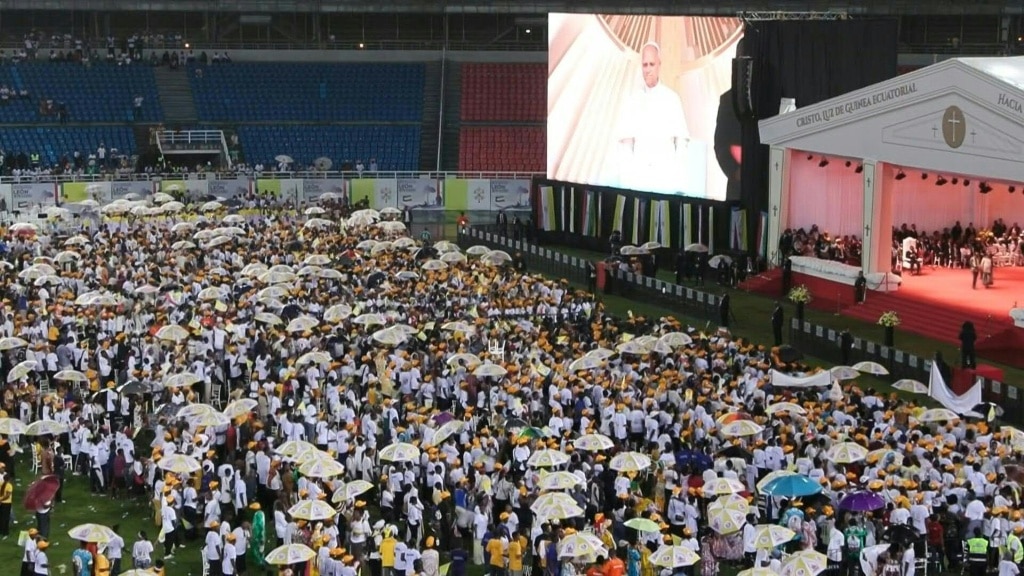
During a high-stakes stop on his 11-day pan-African tour, Pope Leo XIV delivered a rare, pointed rebuke of inadequate prison conditions in Equatorial Guinea, during a tightly choreographed visit to the Central African nation’s most infamous correctional facility this Wednesday.
The 70-year-old American-born pontiff, who leads the world’s 1.4 billion Catholics, traveled to Bata Prison in Equatorial Guinea’s largest city, where hundreds of detainees gathered in the facility’s freshly repainted courtyard to greet him. Minutes after the pope’s arrival, a heavy downpour soaked the crowd of inmates, who had lined the route and broke into song and dance to welcome the religious leader despite the rain. By the end of the meeting, the drenched prisoners chanted out the Spanish word “libertad” — freedom — for the pontiff to hear.
Speaking to the assembled group of roughly 600 detainees, including around 30 women, Pope Leo framed his remarks around the core purpose of justice systems. “The administration of justice aims to protect society,” he told the crowd. “To be effective, however, it must always promote the dignity of every person.” In an earlier open-air mass held in Mongomo, a city near the Gabon border that kicked off the day’s schedule, the pontiff made his call for reform public even with long-ruling President Teodoro Obiang Nguema Mbasogo in the congregation. He urged the country to carve out “greater room for freedom” and guarantee inherent human dignity for all, noting that prisoners are too often “forced to live in troubling hygienic and sanitary conditions.”
Equatorial Guinea’s prisons have faced decades of damning international scrutiny over systemic abuse. A 2023 U.S. State Department human rights report documented consistent cases of torture, extreme overcrowding, and unsanitary conditions across the country’s correctional facilities. A 2021 Amnesty International report labeled detainees in facilities like Bata Prison “forgotten people,” noting that most are jailed following flawed judicial processes and that family members are often left with no information about whether their incarcerated loved ones are alive or dead. President Obiang, who at 81 is the world’s longest-serving non-royal head of state after taking power in 1979, has faced consistent global accusations of widespread human rights violations and crackdowns on freedom of expression — making the pope’s public critique a notable break from the norm in the closed authoritarian state.
Local observers remain skeptical that the pontiff’s intervention will drive meaningful change. Mr. Ondo, a local teacher who spoke on the condition of partial anonymity, denounced the country’s justice system for its widespread “lack of independence” and pervasive corruption among judges and magistrates, questioning whether the pope’s visit would alter how the system operates.
Pope Leo’s visit to Equatorial Guinea is the fourth stop on his African tour, which has already included stops in Algeria, Cameroon, and Angola. The pontiff has walked a careful diplomatic line during his time in the country: seeking to support the nation’s large Catholic population without offering explicit backing to Obiang’s controversial government. On previous stops of the tour, the pope took far more aggressive stances, publicly denouncing global “tyrants” who exploit their populations and condemning the exploitation of vulnerable communities by wealthy and powerful actors. He even clashed with former U.S. President Donald Trump after the former president pushed back on his call for an immediate end to the ongoing conflict in the Middle East.
Following his prison visit, Pope Leo traveled to Bata’s main stadium, where he planned to honor the victims of a 2021 tragedy that killed more than 100 people and meet with affected families and local youth. The pontiff was greeted in Mongomo earlier this week with a raucous welcome, including fireworks, a balloon release, and cheering crowds that lined his route as he traveled through the city in the popemobile.
Equatorial Guinea, a small coastal nation with a population of just 2 million, inherited its large Catholic majority from decades of Spanish colonial rule, with roughly 80% of the population identifying as Catholic. While the country is rich in fossil fuel reserves — oil and gas account for 46% of national GDP and more than 90% of exports, per African Development Bank data — Human Rights Watch reports that the vast majority of oil revenue has been captured by a small elite circle surrounding Obiang, leaving most of the population stuck in entrenched poverty.
The pontiff is set to conclude his 11-day, 11,200-mile African tour Thursday with an open-air mass in the national capital of Malabo, before returning to Vatican City in Rome.