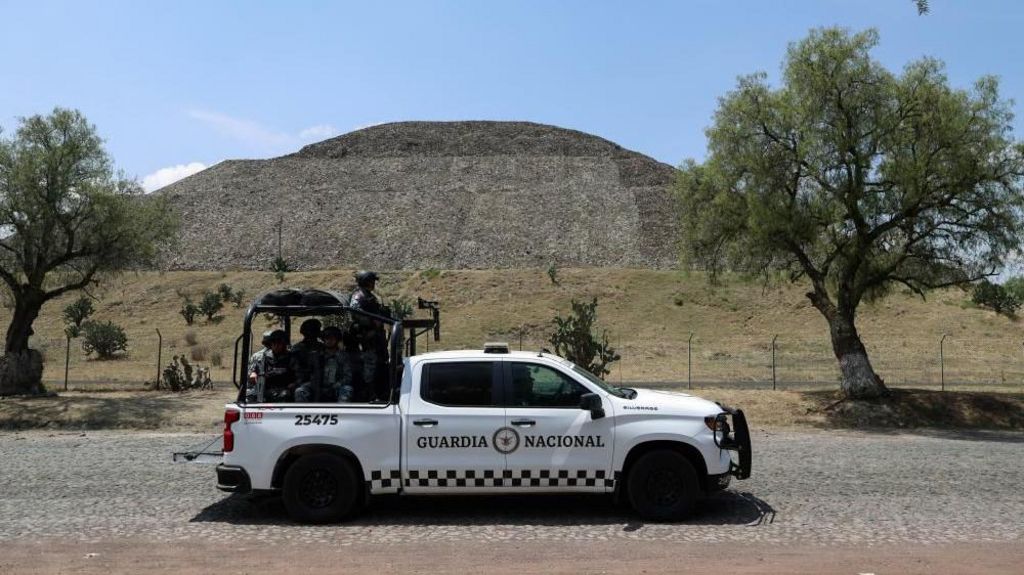
On a seemingly ordinary Monday morning at Teotihuacán, Mexico’s most iconic pre-Hispanic archaeological site and top international tourist destination, a routine day of exploration collapsed into sudden, horrifying gun violence that authorities are still working to fully unpack.
Disturbing eyewitness footage captured the attacker, 27-year-old Mexico City native Julio César Jasso Ramírez, opening fire on unsuspecting visitors from the upper terrace of the site’s famous Pyramid of the Moon. Panicked tourists scrambled for shelter behind ancient stone structures as shots rang out, beginning the attack around 11:00 a.m. local time.
When the violence ended, a 32-year-old Canadian woman was dead, and the gunman had taken his own life via a self-inflicted gunshot wound. Multiple injured tourists from countries including Russia, Colombia, and Brazil were admitted to local hospitals for treatment of their wounds. Security forces, including the National Guard, were rapidly deployed to secure the historic site.
Initial investigations have drawn a clear line between this attack and the cartel-linked violence that has plagued Mexico for decades. Just two months prior, the killing of Jalisco New Generation Cartel leader “El Mencho” sparked a wave of coordinated violence across the country that left widespread fear in its wake. But Mexican officials confirm Jasso Ramírez acted entirely alone, with no connections to organized criminal groups.
Searching the attacker’s belongings, investigators recovered a handgun, a supply of ammunition, and a tactical knife. They also found written materials, images, and manuscripts referencing a notorious 1999 mass shooting in the United States: the Columbine High School attack that left 13 dead. One witness told Reuters the gunman explicitly referenced Columbine, which took place 27 years to the day before the Teotihuacán attack.
Mexico State Attorney-General José Luis Cervantes Martínez confirmed that no evidence of co-conspirators has emerged, noting, “The aggressor planned and carried out the attack on his own and there is absolutely no indication at this point that he had any external help or that any other individuals were involved in this incident.” He described the attacker as fitting a psychopathic profile driven by copycat behavior, saying “the evidence collected so far pointed to a tendency to imitate situations that occurred in other places, at other times, and involving other individuals.”
The attack marks the second high-profile lone mass shooting in Mexico in less than a month, following a school shooting in Michoacán where a teen killed two teachers with an assault rifle. Both incidents mark a disturbing shift for Mexico, where nearly all large-scale violence has historically been tied to cartel turf wars. Mexican family therapist Valeria Villa, who has worked in mental health for decades, called the trend “a moment of transition, a very unfortunate, lamentable and worrying one, towards imitation of the phenomenon of mass killings we see every day in the United States.”
Experts note the trend does not stem solely from the importation of U.S. societal violence, however. Long-standing cartel violence in Mexico has desensitized segments of the population, particularly young people, to bloodshed. While Mexico does not have the same widespread legal access to guns as the United States, illegal firearms are easily obtainable on the black market, with most smuggled across the border from the U.S.
The shooting comes at a politically and socially sensitive moment for the Mexican government, just three weeks before Mexico co-hosts the 2026 men’s FIFA World Cup, set to kick off in Mexico City on June 11. President Claudia Sheinbaum, who has recently touted her administration’s security progress, claiming the daily homicide rate in February 2026 was 44% lower than at the end of her predecessor’s term in September 2024, was quick to offer condolences and solidarity to the victims’ families.
Sheinbaum’s critics argue that falling homicide rates mask ongoing security crises, most notably the tens of thousands of unresolved missing person cases that disproportionately affect young Mexicans. The administration has moved quickly to reassure visiting football fans that security will be guaranteed during the tournament, but viral footage of a gunman opening fire on foreign tourists at one of the country’s most famous landmarks has done little to ease pre-tournament anxiety.