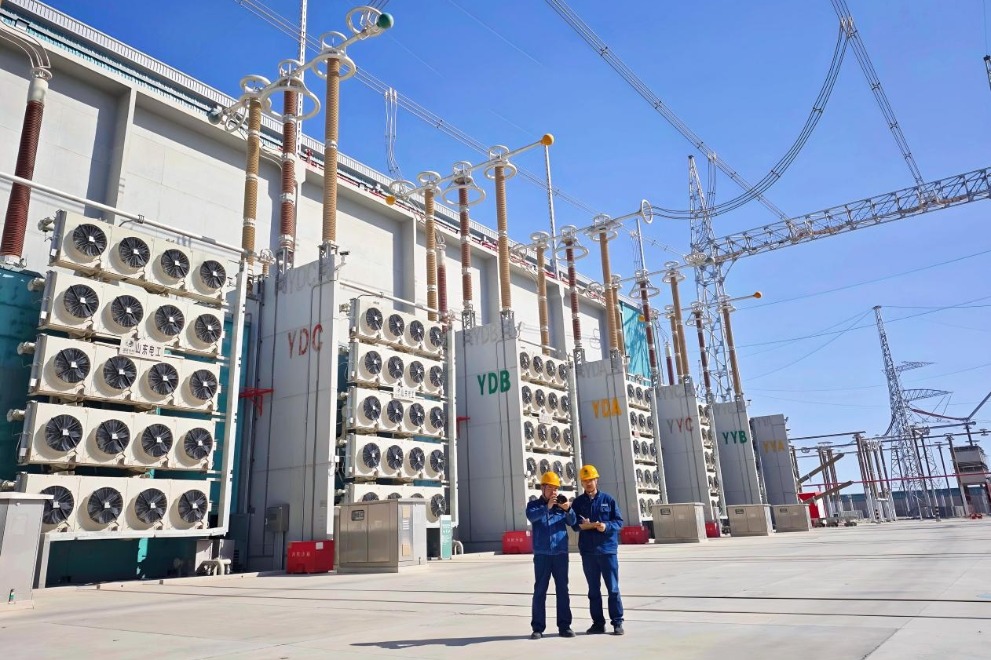
China’s flagship West-to-East power transmission infrastructure has notched a major milestone in the first quarter of 2026, with the ±800 kilovolt Gansu-to-Hunan ultra-high voltage direct current (UHVDC) transmission line delivering more than 10 billion kilowatt-hours (kWh) of electricity, operator State Grid Gansu Electric Power Company has announced. To put this output in context, the volume is enough to meet the full annual electricity demand of roughly 2.95 million average three-member households across China.
A core component of China’s national West-to-East power transmission strategy, the 2,383-kilometer transmission corridor stretches from the Qilian converter station in northwestern China’s Gansu province, across Shaanxi, Chongqing and Hubei, all the way to its final terminal at the Shaoshan converter station in central southern Hunan. Since the project entered commercial operation in June 2017, it has cumulatively transmitted more than 200 billion kWh of electricity across regional boundaries, marking it as one of the country’s most productive cross-regional energy arteries.
What sets this 2026 milestone apart is the growing share of low-carbon energy in the transmission mix: more than 40 percent of the electricity moved via the line so far this year comes from renewable sources. The infrastructure has been instrumental in unlocking large-scale development of Gansu’s abundant wind and solar energy resources, enabling bundled transmission of wind, solar and thermal power from the resource-rich northwest to high power-demand regions in central China. Beyond supporting economic growth in Hunan and surrounding regions, the optimized cross-regional energy allocation brought by the UHV project directly advances China’s national carbon peaking and neutrality goals by increasing the share of renewables in the national energy mix.
To maintain reliable output amid growing demand, the line has sustained extended high-load operation through the first three months of 2026, with daily transmission volume exceeding 100 million kWh on 41 days this year. As the operating entity responsible for the project, State Grid Gansu Ultra-High Voltage Company has made power supply security its top organizational priority, rolling out a series of enhanced monitoring and maintenance measures to avoid service disruptions.
The company has upgraded its full-lifecycle safety management framework and integrated a suite of advanced inspection technologies into its operations, including automated routine inspections, drone-based remote monitoring, and infrared and ultraviolet defect detection. These tools have enabled the construction of an all-weather, multi-dimensional monitoring system covering every segment of the line and all core converter station equipment, boosting overall equipment reliability and guaranteeing consistent, stable delivery of clean energy across regions.