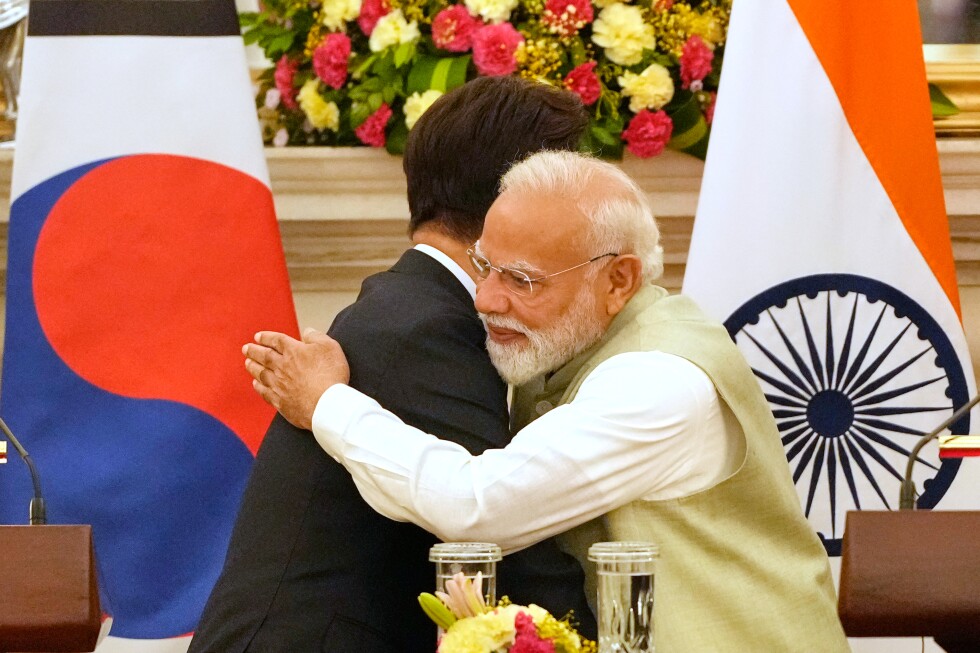
NEW DELHI – In a high-stakes diplomatic meeting held in the Indian capital on Monday, South Korean President Lee Jae Myung and Indian Prime Minister Narendra Modi have announced a bold new commitment to expand bilateral economic and strategic cooperation, setting an ambitious target to nearly double two-way trade by the end of the decade.
Against a backdrop of growing global economic volatility and widespread supply chain disruptions stoked by ongoing conflict in Iran, the two leaders framed the expanded partnership as a mutually beneficial step to shore up economic stability for both nations. Modi outlined that the current annual trade volume between the two countries sits at roughly $27 billion, with the new goal to push that figure to $50 billion by 2030. To hit this target, the countries will focus on reinforcing interconnected supply chains, easing barriers to improve market access for businesses on both sides, and creating more favorable conditions for increased cross-border investment.
“India and South Korea are going to transform their trusted ties into a futuristic partnership,” Modi stated during the meeting, emphasizing the long-term strategic vision guiding the new agreement.
President Lee echoed this sentiment, confirming that the two sides had reached a consensus to substantially upgrade their economic cooperation framework, with targeted focus on high-growth, strategically important sectors including shipbuilding, national defense, and artificial intelligence. Beyond these areas, Lee added that the partnership will also broaden industrial collaboration, ramp up trade and investment flows in advanced manufacturing, and deepen cooperation in sensitive, critical sectors ranging from essential critical minerals to civilian nuclear energy.
To directly address growing risks of supply chain disruptions from Middle East tensions, President Lee revealed that South Korea is proactively moving to increase imports of naphtha, a key crude oil derivative used in petrochemical manufacturing, from India. This strategic shift is designed to cushion South Korean markets against potential supply shocks linked to regional instability. Last year, India already supplied roughly 8% of South Korea’s total naphtha imports, a share that is set to rise in the coming months under the new agreement.
Following the conclusion of his official visit to India, Lee is scheduled to travel next to Vietnam for the next stop of his regional diplomatic tour.