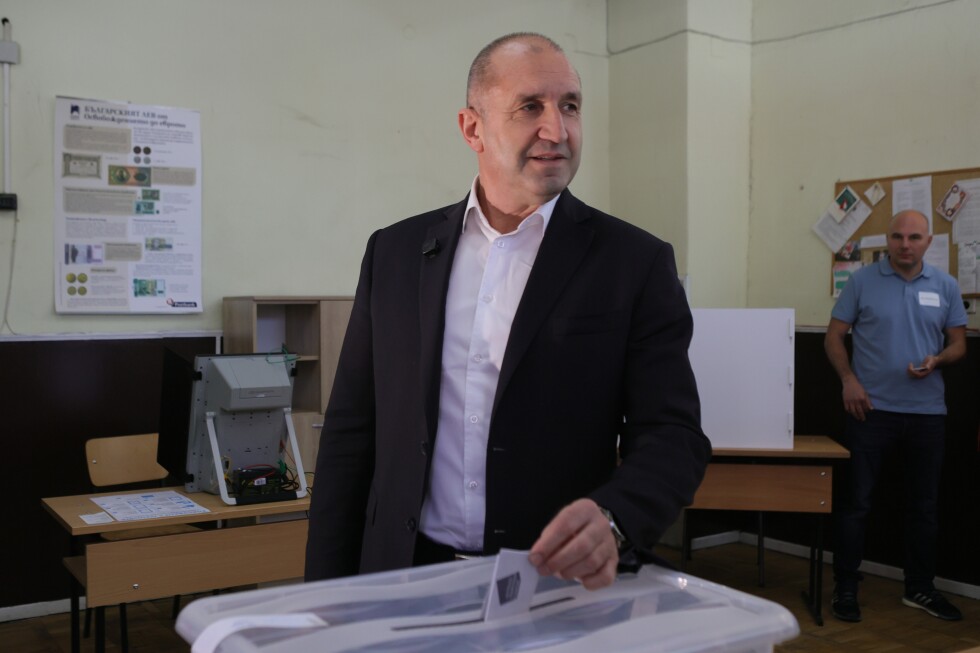
SOFIA, Bulgaria — In a result that reshapes Bulgaria’s turbulent political landscape, the nation’s central electoral commission confirmed Monday that former president Rumen Radev’s center-left Progressive Bulgaria coalition has won a decisive majority in the country’s latest parliamentary election, bringing a close to five years of fragmented governance and unstable short-lived governments.
With 96% of all ballots processed by Monday morning, early official data put the Radev-led coalition at 44.7% of the popular vote — a lead of more than 20 percentage points over its nearest competitors. Former prime minister Boyko Borissov’s long-dominant center-right GERB party captured 13.4% of the vote, while the pro-Western We Continue the Change-led reformist bloc followed closely at 12.9%, with the two rival groups running nearly neck-and-neck for second place. Latest projections indicate only two additional political parties will cross the electoral threshold to claim seats in the 240-seat national legislature, streamlining the chamber after years of splintered representation.
Shortly after results were published, Borissov publicly conceded defeat and extended formal congratulations to the winning coalition. Radev, for his part, framed his coalition’s victory as a defining turning point for the Balkan nation. Addressing reporters, he called the outcome “unequivocal,” describing it as “a victory of hope over distrust, a victory of freedom over fear.” He reaffirmed that Bulgaria will remain committed to its integration trajectory with the European Union, while adding a note of pragmatic critique: “But believe me, a strong Bulgaria and a strong Europe need critical thinking and pragmatism. Europe has fallen victim to its own ambition to be a moral leader in a world without rules.”
The 62-year-old former fighter pilot, who holds a master’s degree in Strategic Studies from the U.S. Air War College and previously served as commander of the Bulgarian Air Force, resigned from his largely ceremonial presidential post in January, several months ahead of the end of his second term, to launch a bid for the far more powerful position of prime minister.
Throughout his two terms as president, Radev gained widespread recognition for his open sympathy toward Moscow, repeatedly opposing European Union-led initiatives to supply military aid to Ukraine following Russia’s full-scale invasion. He has long argued that military support for Kyiv risks dragging Bulgaria directly into the conflict, and has repeatedly called for the resumption of diplomatic negotiations with Russia to end the war. His coalition of supporters draws two distinct camps: one faction that backs him as an anti-corruption outsider committed to rooting out entrenched graft, and another that aligns closely with his Euroskeptic, Russia-leaning policy stances.
Bulgaria, a NATO and EU member state of 6.5 million people, has faced long-standing international criticism for its failure to tackle systemic corruption and address persistent gaps in the rule of law. Since 2021, repeated elections have produced only fragmented parliaments and weak coalition governments, none of which have lasted longer than 12 months before collapsing amid street protests or parliamentary power struggles. The previous conservative administration fell in December after mass nationwide anti-corruption protests drew hundreds of thousands of predominantly young Bulgarians to the capital’s streets. Radev capitalized on this public anger, positioning himself as a staunch opponent of the entrenched oligarchic networks that have long been accused of colluding with top political figures. During his campaign, he made a core promise to “remove the corrupt, oligarchic model of governance from political power.”
After years of repeated election cycles and constant political upheaval, ordinary Sofia residents expressed mixed reactions to the landslide result. Nikoleta Dimitrova, a 37-year-old shop assistant working in the capital, said she welcomed the shift and hoped for lasting institutional reform. “Above all, we expect a more stable judicial system, and for trust in institutions to truly be restored. Until now, they have been heavily influenced by various figures, many of whom, as we can see from the current results, have now left the government,” she explained. Others remained more skeptical, however. Cveta Gerogieva, a 55-year-old accountant, cautioned that long-term stability remains far from guaranteed. “I hope that we will really live a better life, but I am not sure that there will be stability for a long period. Probably we will vote again,” she said.