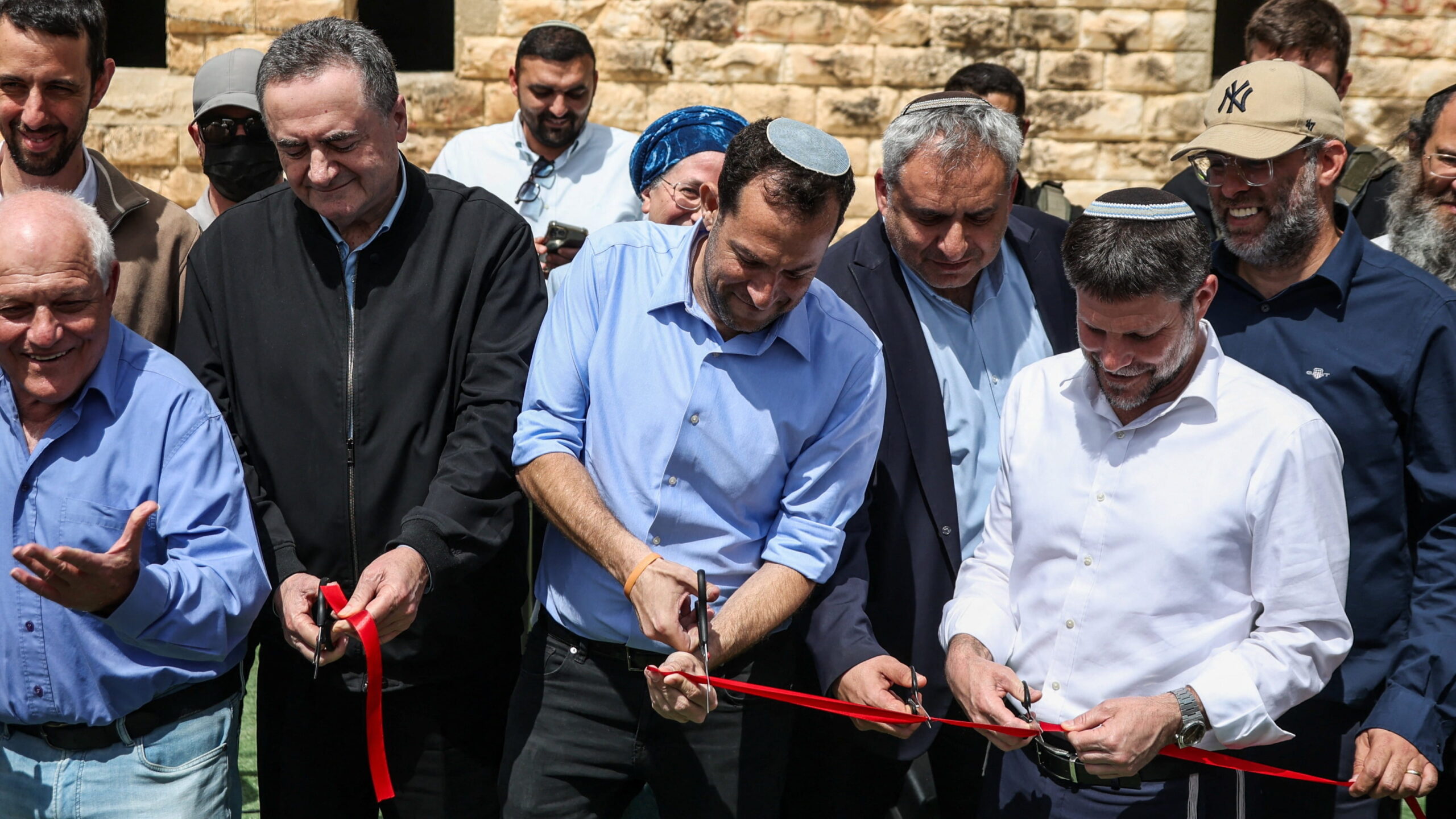
Two decades after Israel’s 2005 unilateral withdrawal from the Gaza Strip that dismantled a handful of settlements in both Gaza and the West Bank, the Israeli government has formally re-established a Jewish settlement at the site of Sanur, a Palestinian village located southwest of Jenin in the occupied West Bank. The move is the most high-profile step in a dramatic acceleration of Israeli settlement construction that has unfolded since the start of the 2023 Israel-Hamas war in Gaza, a trend that has put the international legal order governing occupied territories under unprecedented strain.
The inauguration ceremony held Sunday drew senior members of Israel’s ruling coalition, including Defense Minister Israel Katz and far-right Finance Minister Bezalel Smotrich, a prominent advocate for annexation who resides in an Israeli settlement in the West Bank himself. In remarks at the event, Smotrich framed the re-establishment of Sanur as a momentous turning point for Israel, calling it a “national holiday” and a “historic correction” of what he termed the “sinful expulsion” carried out during the 2000 withdrawal. He went further, declaring that the step “abolishes the disgrace of expulsion, kills the idea of a Palestinian state, and returns to the settlement of Sa-Nur.” Smotrich also used the occasion to call for the re-establishment of Israeli settlements inside the Gaza Strip to create what he described as a “security belt for Israel.”
Alongside the Sanur project, the Israeli government has already committed to rebuilding three additional West Bank settlements that were dismantled as part of the 2005 withdrawal. All Israeli settlements constructed on land seized by Israel during the 1967 Six-Day War, including those across the occupied West Bank and East Jerusalem, are explicitly deemed illegal under international law, a standing position held by the United Nations and most of the global community.
Palestinian groups have immediately decried the move as a deliberate escalation targeting Palestinian claims to statehood and territorial sovereignty. Mahmoud Mardawi, a senior official with Hamas, described the re-establishment of Sanur as a “dangerous escalation” aimed at erasing Palestinian presence in the West Bank. In an official statement, Hamas emphasized that the step opens an “unprecedented stage of settlement expansion, which falls within the so-called annexation plan and the complete control of the West Bank and Palestinian land.”
Today, an estimated 700,000 Israeli settlers currently reside in roughly 300 illegal settlements spread across the occupied West Bank and East Jerusalem. Data from Israeli and peace monitoring groups confirms that settlement expansion has surged to unprecedented levels under the current Israeli government, which took office in 2022.
Earlier in April, Israeli news outlet i24NEWS reported that the Israeli cabinet secretly approved a record-breaking batch of new settlement units during a period aligned with escalating U.S.-Israeli tensions with Iran. In a single decision, the government authorized 34 new settlements — a figure equal to more than half of all settlements approved in 2025, which itself was a record-setting year for expansion. Since 2022, the current government has greenlit a total of 68 new formal settlements, while nearly 200 unauthorised settler outposts have been established across the West Bank in the same period.
Israeli peace advocacy group Peace Now’s annual data underscores the scale of the expansion: in 2025, the government approved 54 new settlements, shattering the previous record of nine approvals set in 2023. Twenty-six of these were unauthorised outposts that the government retroactively legalised. The group also recorded a 40 percent jump in new unauthorised outposts last year, with 86 new outposts established — an average of one to two new outposts per week.
The re-opening of the Sanur settlement coincides with a dramatic spike in settler violence targeting Palestinian communities in the West Bank. Over recent weeks, dozens of Israeli settlers have carried out coordinated attacks against Palestinian civilians and property, including torching and vandalising Palestinian infrastructure, shooting at residents, and destroying agricultural and residential property.
A United Nations report released on March 17 documented the devastating human impact of this surge in violence: between November 2024 and October 2025, more than 36,000 Palestinians were displaced from their homes in the West Bank amid rising settler attacks. The UN recorded 1,732 incidents of settler violence resulting in casualties or property damage during that 12-month period, a 25 percent increase from the previous year. A tally compiled by Agence France-Presse based on data from the Palestinian Ministry of Health found that more than 1,151 Palestinians have been killed in the West Bank by Israeli forces or settlers since the start of the Gaza war in October 2023.