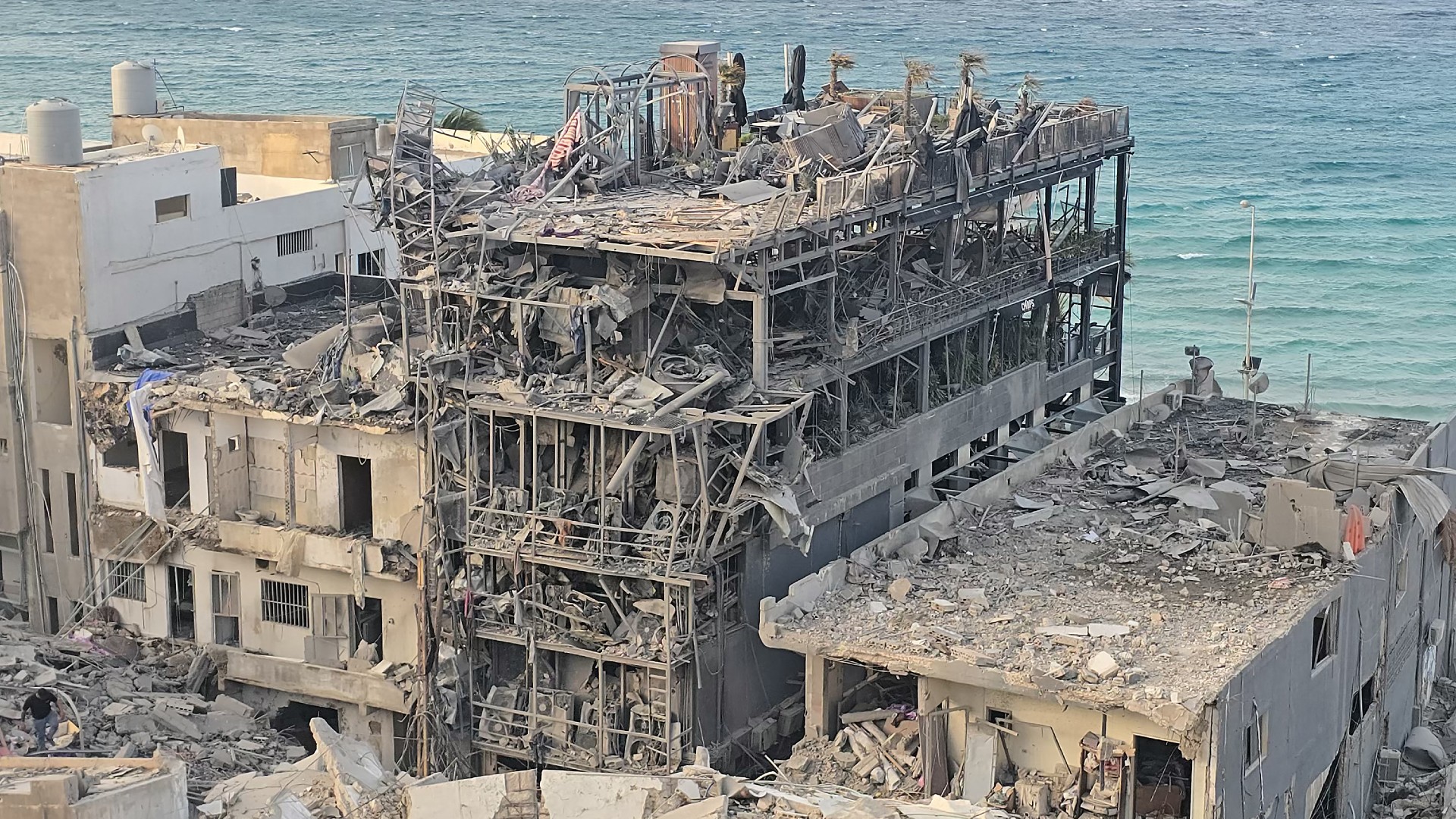
A fresh expose published in Israeli newspaper Haaretz on Sunday has revealed that the Israeli military has continued the systematic demolition of civilian buildings across southern Lebanon, even after a 10-day ceasefire agreement halted formal open hostilities last Thursday. The ceasefire, which brought a temporary end to months of deadly large-scale conflict, has not put a stop to state-backed destruction of residential and public infrastructure in border-area villages, according to senior Israeli army commanders who spoke to the outlet on condition of anonymity.
Per the sources, the demolition operation is being carried out by paid Israeli civilian contractors deployed with heavy civilian engineering equipment, including dozens of excavators. Contractors are compensated either through a fixed daily wage or via performance-based payments tied to the number of structures destroyed and the total scope of the work. Multiple sources confirm that some of these contractors have prior experience carrying out similar demolition work in the Gaza Strip, with one witness noting that roughly 20 excavators were operating simultaneously in a single southern Lebanese village alone.
The operation targets schools, residential homes and other civilian sites as part of an official Israeli policy framed as “cleaning up the area,” a tactic directly modeled after widespread destruction campaigns Israel carried out in Gaza starting in October 2023. All destruction is occurring south of the so-called “yellow line” — a boundary unilaterally drawn by Israel roughly 20 kilometers south of the Litani River — which Israeli forces are barred from crossing under the terms of the current ceasefire agreement.
Haaretz’s sources confirmed that one of the core strategic goals of the demolition campaign is to prevent displaced Lebanese residents from returning to their homes in border communities adjacent to Israel. The Israeli military is even using advanced digital tracking tools, including specialized statistical systems, to monitor and quantify the number of buildings destroyed across different operational sectors to measure progress on the campaign.
The policy of widespread demolition was explicitly announced by Israeli Defense Minister Israel Katz last month, who confirmed that “All houses in villages near the border in Lebanon will be demolished in accordance with the Rafah and Beit Hanoun models in Gaza.” At the time, Katz also stated that after the conclusion of Israel’s offensive in Lebanon, the Israeli military would retain full security control over the entire territory extending north to the Litani River.
The current conflict between Israel and Hezbollah erupted after US-Israeli airstrikes targeting Iran killed Iranian Supreme Leader Ali Khamenei in early March, prompting a retaliatory cross-border rocket barrage from the Iran-backed militant group. Since that escalation, the Lebanese Ministry of Health reports that Israeli attacks have killed at least 2,294 people across Lebanon — including 100 rescue workers and healthcare employees — and wounded more than 7,500 others. The violence has also displaced roughly 1.2 million Lebanese people nationwide, destroying all bridges crossing the Litani River, including the critical Qasmiyeh bridge that formed the last major transport link between southern Lebanon and the rest of the country. In the immediate aftermath of the new ceasefire taking effect, workers hastily constructed a makeshift crossing to accommodate tens of thousands of displaced residents seeking to return to their homes.
Even before the current ceasefire, there have been repeated violations of prior truce agreements. A United Nations assessment found that Israel violated the 2024 ceasefire brokered by the Biden administration more than 10,000 times over the course of one year, and has maintained five permanent military outposts inside Lebanese territory since that agreement was reached. Last week, Haaretz also reported that the Israeli military has been constructing additional new outposts inside southern Lebanon despite the terms of the current truce. Just hours before the latest ceasefire went into effect, an Israeli airstrike on a residential complex in the southern Lebanese city of Sour killed 11 people and wounded 35 more.