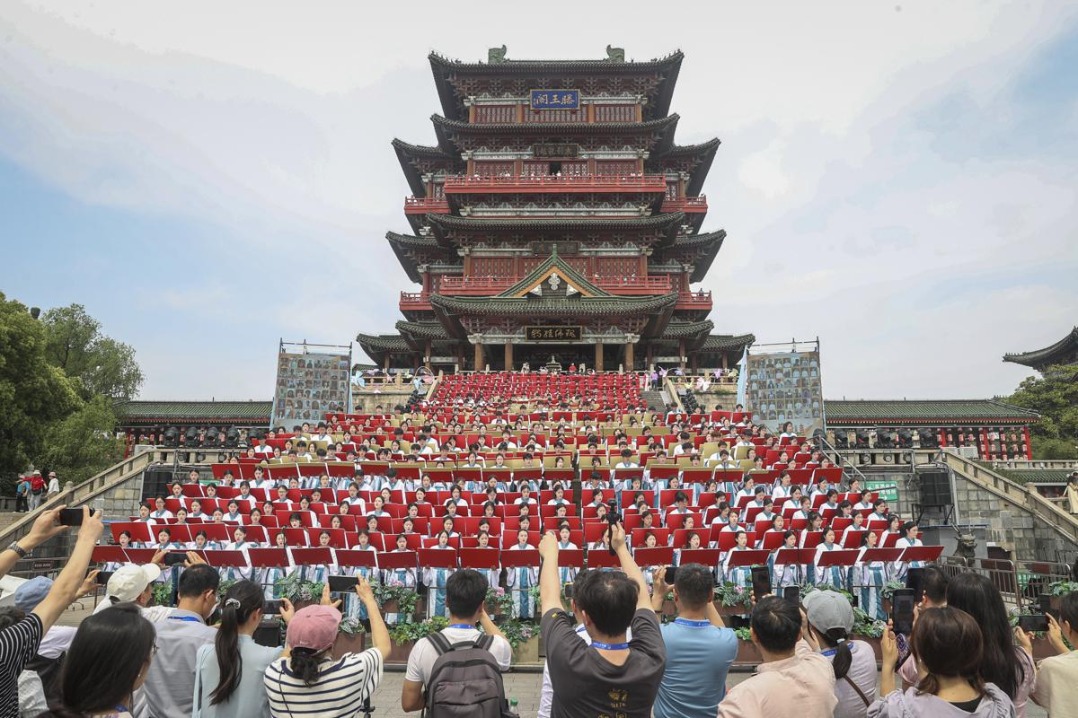
China’s journey to cultivate a national reading culture reached a new milestone this week, as the fifth National Conference on Reading opened in Nanchang, the capital of east China’s Jiangxi Province, on Monday. The three-day gathering also formally inaugurates the country’s first-ever National Reading Week, a nationwide initiative designed to embed regular reading into public life and strengthen cultural development across the nation.
Attendees of the conference emphasized that reading forms the foundational bedrock of cultural advancement, and called for scaled-up efforts to popularize reading and build a society that values literary engagement. They underlined that expanding nationwide reading programs is a critical component of China’s broader push to build itself into a leading cultural power. Li Shulei, member of the Political Bureau of the Communist Party of China Central Committee and head of the Publicity Department of the CPC Central Committee, attended the opening ceremony and delivered a keynote address.
The establishment of National Reading Week follows a national regulation released by the State Council that entered into force on February 1 this year, which formalized the designation of the fourth week of April annually as the national event. The regulation’s core goals are to lift the intellectual, moral, scientific, and cultural standards of the Chinese public, and to boost overall social civility. The inaugural week will feature hundreds of localized events across the country aimed at sparking public enthusiasm for reading.
To align with the launch of National Reading Week, the Nanchang conference has organized a diverse lineup of targeted forums tailored to different demographic groups and sectors, covering topics including youth reading, family and parent-child reading, public library services, rural reading expansion, reading for senior citizens, reading rights protection, and the fast-growing digital reading sector.
One of the standout attractions of this year’s conference is a comprehensive showcase of Jiangxi’s deep-rooted traditional cultural heritage. A major exhibition focused on ancient Chinese academy culture offers visitors an immersive experience, recreating the lively scholarly atmosphere of iconic Jiangxi institutions such as the centuries-old Bailudong Academy, one of the most famous centers of learning in imperial China. Other special cultural activities include an exhibition of classical works from the Jiangxi School of Poetry and the Tengwang Pavilion Book Fair, held at the city’s iconic historic landmark. Ahead of the conference, students dressed in traditional Chinese costumes gathered in front of Tengwang Pavilion to recite *Preface to the Pavilion of Prince Teng*, the celebrated 7th-century literary classic by Tang Dynasty poet Wang Bo.
Two key industry reports released at the conference reveal encouraging trends in Chinese reading habits. The 23rd National Reading Survey found that 82.3 percent of Chinese adults reported reading regularly in 2025. On average, each adult read 8.39 combined paper and digital books last year, representing a steady increase from 2024 figures. Among minors aged 0 to 17, 86.7 percent engaged in book reading, and 75.9 percent participated in digital reading — both metrics also saw year-on-year growth.
The separate National Digital Reading Report added further context to the sector’s rapid expansion. By the end of 2025, the total number of digital reading works available in China hit 70.5592 million, an 11.87 percent increase from 2024, pointing to a robust and growing supply of digital content. Exports of Chinese digital content also saw strong growth, with the total number of digital works released overseas — including translated Chinese works, original foreign-language content from Chinese creators, and exported e-books — reaching 949,200, a 17.42 percent rise year-on-year. The total number of digital reading users in China reached 689 million in 2025, marking a 2.95 percent annual increase.
The conference also brought together prominent figures from across the cultural and literary sectors to share their perspectives on reading. At a special event focused on “red classic” literature organized by the China Federation of Literary and Art Circles, veteran pingshu (Chinese traditional storytelling) performing artist Liu Lanfang, who has 67 years of experience in the art form, shared her lifelong love of reading. Even now, Liu spends several hours daily reading on her mobile device, and noted, “One should always read. Reading expands knowledge, and that’s how people can keep improving.”
At a separate children’s book sharing event held alongside the conference, popular children’s storyteller Wang Kai, widely known as Uncle Kai, highlighted the unique importance of reading for young people growing up in the age of artificial intelligence. “In the AI era, we need a broader perspective on reading,” Wang said. “Children need a solid foundation of common knowledge, and the best way to gain that is through reading.”