Nestled in Maisons-Alfort, a southeastern suburb of Paris, France, a one-of-a-kind wildlife hospital operates under a simple but strict rule: no affectionate cuddling, but unwavering, expert care for every wild patient that passes through its doors. Every year, the facility takes in thousands of injured, ill, and orphaned wild animals, most of whom have been harmed directly or indirectly by human activity and the relentless spread of urbanization. Its ultimate mission is to heal these creatures and return them to their natural wild habitats.
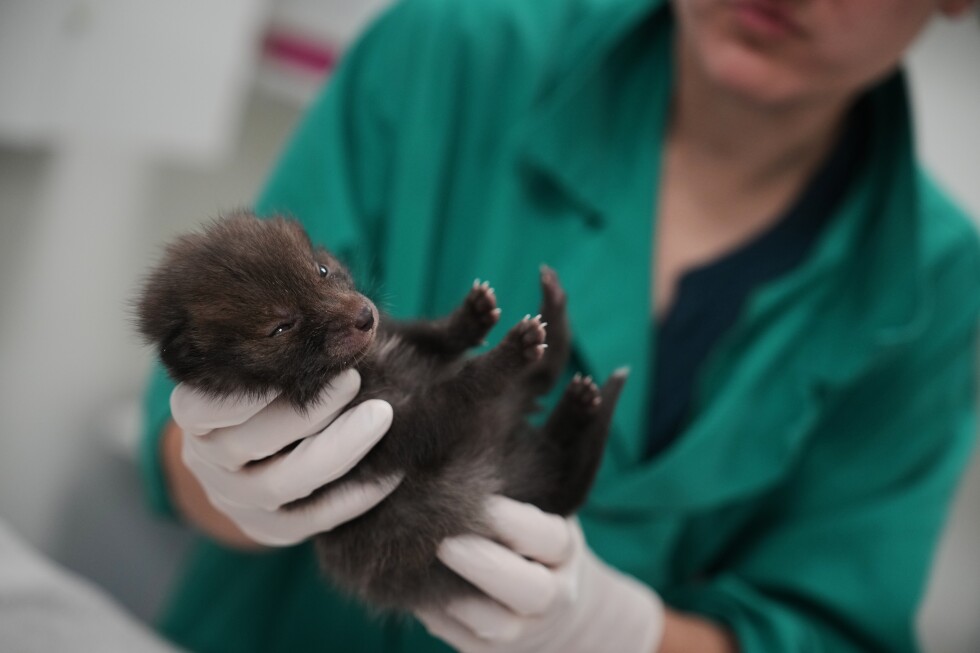
Last week, local residents who keep hunting dogs discovered a tiny female fox cub alone in an outskirt garden, with no sign of her mother anywhere nearby. Estimated to be just two weeks old — far too young to fend for herself in the wild — the cub was quickly transported to the hospital for care. After a thorough examination by veterinarian Julie Piazza, the cub was found to be in generally good condition, with only a small wound likely caused by a bite from either another wild animal or one of the residents’ hunting dogs. Currently, a team of dedicated volunteers provides 24-hour care for the cub, feeding her specially formulated artificial milk that matches the nutrient composition of a wild fox mother’s milk. Piazza noted that the cub currently has a slightly swollen abdomen after adjusting to her new diet, a common condition for very young animals that have experienced a disruption to their regular feeding routine.
Animal caretaker Valentin Delon explained that the facility’s no-cuddling policy is not a lack of compassion, but a critical measure to protect the animals’ future. “Any kind of imprinting that makes animals dependent on human caregivers long-term has to be completely avoided,” Delon said. “So we don’t hold them, we don’t interact with them more than necessary, and we maintain a careful distance for their own good. If they become attached to humans, they’ll never be able to survive once released back into the wild.”
Once the cub gains enough weight and matures, she will not be released directly into the wild. Instead, she will first move to a specialized outdoor rehabilitation enclosure, where she will socialize with other young foxes. Staff will use a gradual release process: the enclosure door will be left open so the fox can come and go freely while still having access to food, before portions are slowly reduced to encourage her to hunt and forage on her own.
Over the 12 months prior to this report, the Wildlife Veterinary Hospital of Maisons-Alfort admitted more than 10,400 wild animals, covering a huge range of native species: from songbirds and waterfowl to European mammals including foxes, roe deer, and hedgehogs. Run by the nonprofit organization Faune Alfort, it is the only facility in the greater Paris region that provides medical care and rehabilitation for a full spectrum of wild species, with approximately 86% of its patients being birds. From swans with broken wings and injured hedgehogs to orphaned ducklings often found abandoned on urban balconies and injured city pigeons, every animal receives the same level of skilled care, regardless of how common or rare it is.
Elisa Mora, head of communications for Faune Alfort, told reporters that the facility saw a record 200 admissions in a single day last summer. Between April and September, wild animals enter their breeding season, bringing a surge of orphaned or injured juvenile animals to the hospital. “All wild animals face growing pressure from human activity, but juveniles are far more vulnerable than adults,” Mora explained. For animals whose injuries are too severe to heal, or who can never adapt to survival in the wild, humane euthanasia is the only option.
Funded almost entirely by individual donations and charitable grants, the hospital depends heavily on its network of volunteers to handle daily feeding, cleaning, and basic care. The organization traces its roots back to 1987, when veterinarian Jean-François Courreau founded Faune Alfort after seeing veterinary students eager to develop better care protocols for wild animals. Six years later, the organization opened its dedicated hospital on the campus of the National Veterinary School of Alfort, an institution founded in the 18th century.
“It’s impossible to stand by and watch an animal in distress when you have the training to help,” Courreau said. “Before this center existed, people who found an injured wild animal would think ‘there’s nothing I can do, this animal will die.’ When they know they can bring it here to get care, it’s a huge relief for them too.”
Data from the hospital confirms that 60% to 80% of all admitted animals are harmed by human activity: common causes include vehicle collisions, entanglement in barbed wire fencing, and accidental injury from gardening or agricultural machinery. As urbanization continues to encroach on native wildlife habitats across France, the role of this unique wildlife hospital has grown more critical than ever.