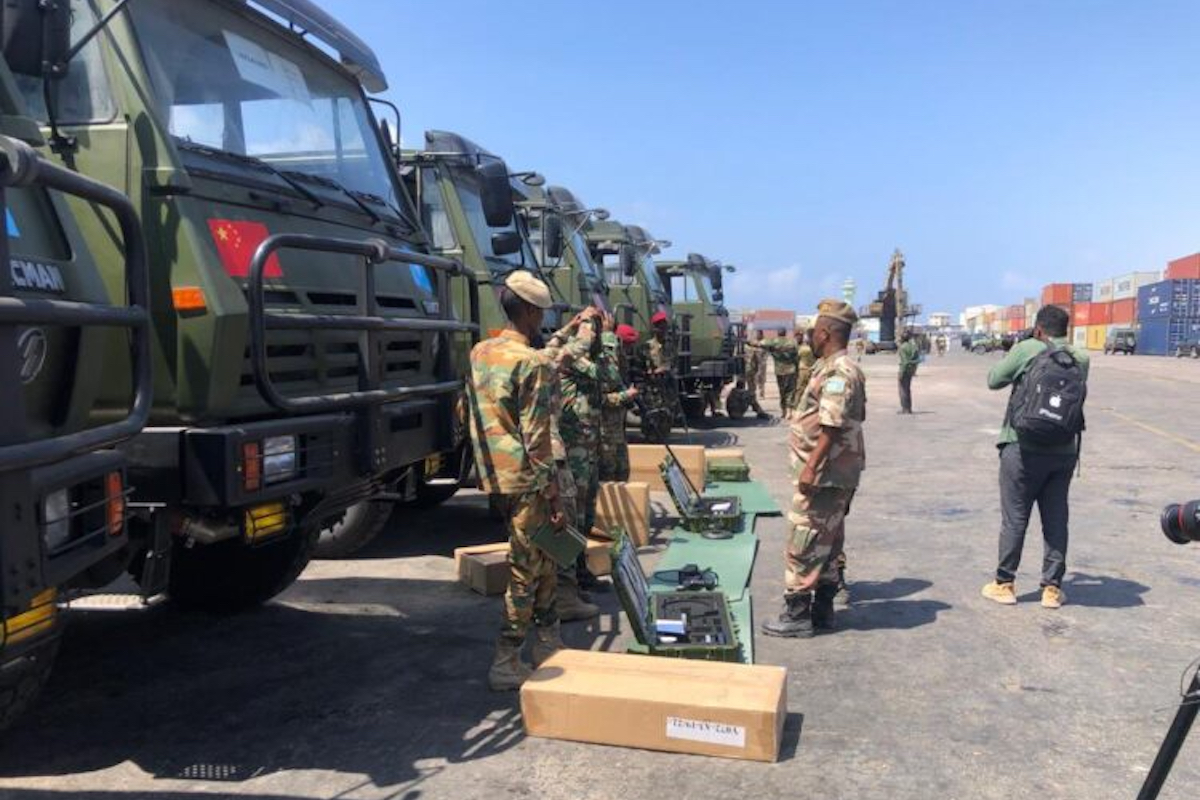
In a notable departure from its longstanding low-profile, cautious engagement in Somalia, China has recently announced a significant expansion of military backing for Mogadishu’s ongoing counterterrorism campaign against al-Shabaab militants. The new commitment includes provision of military equipment, specialized training for Somali security forces, and deeper bilateral security collaboration, a shift analyzed in depth by Brendon J. Cannon, an associate professor at Khalifa University whose research focuses on external power engagement in sub-Saharan Africa.
Cannon breaks down China’s interests in Somalia and the broader Horn of Africa into two interconnected core strands, the first rooted in broad geopolitical strategy and the second tied specifically to Beijing’s priorities around Somalia and Somaliland. Geopolitically, the Horn of Africa has long held massive strategic value for China as a critical crossroads connecting the Indian Ocean, Red Sea, and Mediterranean. This strategic importance has already driven China to establish a permanent military base in Djibouti and roll out extensive infrastructure investments across neighboring regional states including Ethiopia, Kenya, Uganda, and South Sudan, all aimed at expanding Beijing’s political influence and embedding it within existing regional security frameworks.
The second, Somalia-specific driver of China’s growing engagement centers on its long-running diplomatic campaign over Taiwan. Beijing claims the self-governing island of Taiwan as an inalienable part of its territory, and has viewed with deep concern the formal diplomatic ties established between de facto independent Somaliland and Taipei in 2020. Somaliland withdrew from its voluntary union with Somalia in 1991 and has since pursued international recognition, making its diplomatic alignment with Taiwan a direct challenge to Beijing’s “One China” policy. Today, Somaliland and the southern African kingdom of Eswatini are the only two African entities that maintain formal diplomatic relations with Taiwan, putting them squarely in Beijing’s diplomatic crosshairs.
To counter Somaliland’s recognition of Taiwan, China has aligned itself closely with the federal government in Mogadishu, which also rejects Somaliland’s independence claim and asserts territorial control over the entire region. Beyond diplomatic backing and development aid, China has now added counterterrorism-focused security and military cooperation to its support package for Mogadishu. Even with this expanded security engagement, however, China’s overall economic footprint in Somalia remains modest: unlike neighboring Ethiopia, which has received billions in Belt and Road Initiative funding for railways, ports, and airports, Somalia has not attracted large-scale Chinese infrastructure investment. This makes Chinese engagement in Somalia a fundamentally selective, strategic project rather than a transformative economic undertaking, Cannon argues.
Tensions escalated further in late 2025, when Israel became the first UN member state to formally recognize Somaliland’s independence, with U.S. policymakers also signaling growing support for Somaliland’s bid for international standing. In response, Beijing doubled down on its public affirmation of Somalia’s sovereignty and territorial integrity. This alignment has created a natural convergence of interests between China and the Mogadishu government: both have publicly reaffirmed their commitments to “One China” and “One Somalia” respectively, uniting their opposition to the self-determination claims of Taiwan and Somaliland. Unlike Somalia’s federal government, which has failed to establish effective sovereign control over large swathes of its territory and struggles to field a capable national military against al-Shabaab, Somaliland has built a relatively functional security apparatus and enjoys broad domestic political legitimacy for its independent government.
Cannon draws a clear distinction between China’s approach to the region and that of other external actors. Western powers have historically prioritized direct counterterrorism operations, governance overhauls, and security sector training in Somalia. Meanwhile, regional actors such as Turkey and the United Arab Emirates have combined military engagement with large-scale infrastructure investment and commercial activity, often becoming deeply entangled in Somalia’s internal clan and political dynamics. China, by contrast, has centered its engagement on propping up the Mogadishu regime to reinforce Somalia’s claimed territorial integrity, with its assistance tied closely to diplomatic objectives rather than overt military expansion or commercial gain. Across much of Africa, China has prioritized building technological and institutional dependency in sectors ranging from telecommunications to surveillance, a pattern it is now replicating in Somalia.
Looking ahead, Cannon warns that deeper Chinese involvement carries significant risks for the already fragile Horn of Africa region, adding a new layer of great power geopolitical competition to existing local conflicts. Rather than acting as a stabilizing force, Beijing is likely to find itself pulled into the same complex local political dynamics that have derailed the engagement of past external powers. There is little evidence to suggest China’s military assistance will deliver better results than the decades of support provided by other external actors, with most of its impact expected to be political rather than operational on counterterrorism.
One of the most visible flashpoints of this new geopolitical dynamic is Las Anod, a contested city in eastern Somaliland that has become the base for the SSC Khatumo political entity, which is backed by Mogadishu and labeled illegitimate by Somaliland. Multiple reports indicate SSC Khatumo has received arms from external actors including China. In January 2026, Abdikhadir Firdhiye was inaugurated as the first president of the Northeast State recognized by Mogadishu, with Las Anod designated as its capital. Diplomats from China, Turkey, Saudi Arabia, Djibouti, and Sudan all attended the inauguration, a clear signal that the contest over Las Anod has become intertwined with broader regional and global geopolitical rivalries. For Somaliland, the development makes clear that its decades-long bid for independence is now fully entangled in a much larger geopolitical struggle centered on China’s diplomatic campaign over Taiwan.