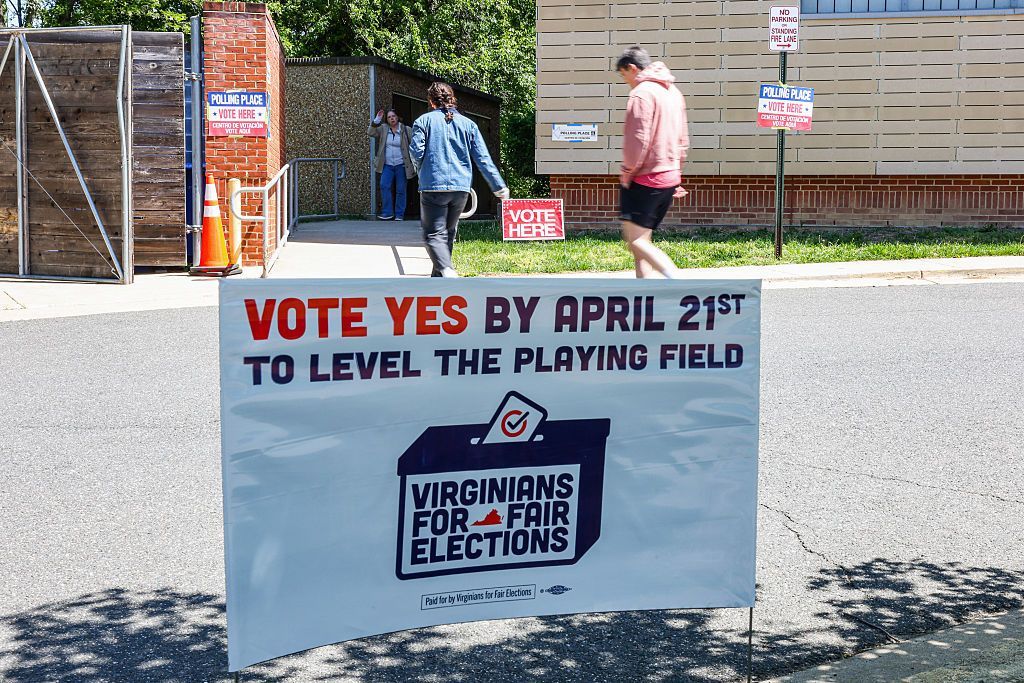
The national partisan fight over congressional redistricting reached a pivotal turning point in Virginia, where voters have greenlit a Democratic-backed ballot amendment that threatens to upend the fragile balance of power in the U.S. House of Representatives ahead of November’s midterm elections.
The vote comes in the wake of a years-long nationwide push by former President Donald Trump and national Republicans to aggressively redraw district lines across the country, a strategic move designed to lock in conservative control of the chamber through partisan gerrymandering. The first major shake-up of this effort came when Texas became the first state to implement a mid-decade redistricting shift under pressure from Trump, a change that projected to hand Republicans a structural advantage in five additional congressional seats.
In response to the Republican power grab, Democratic leaders in blue states launched countermeasures to adjust their own maps to balance out the partisan skew. Last year, California voters backed a campaign led by Governor Gavin Newsom to abandon the state’s previously independent district lines in what Newsom framed as a necessary “fight fire with fire” move. That referendum, approved by California voters in November, delivered Democrats a competitive edge in five new districts, directly countering the gains Republicans secured in Texas.
Now, Virginia’s approval of its own redistricting amendment has the potential to flip the partisan balance of congressional power on a national scale. Currently, Democrats hold 6 of the state’s 11 House seats, and the new redrawn map is projected to flip as many as four currently Republican-held seats, potentially pushing the state’s Democratic delegation to as many as 10 out of 11 total seats.
Notably, the referendum has made history in Virginia: according to data from the nonpartisan Virginia Public Access Project, it is by far the most expensive ballot measure in the state’s history, with both proponents and opponents raising a combined total of more than $80 million (£59 million) as of earlier this month, reflecting how high the stakes of the national redistricting battle have become.
In his first public remarks on the outcome of Virginia’s vote, Trump sounded the alarm on Monday, arguing that a Democratic takeover of the House majority in the midterms would “be a disaster” for the country. In a striking reversal of his own party’s aggressive gerrymandering efforts across the country, Trump added, “I don’t know if you know what gerrymandering is, but it’s not good.”
Under standard U.S. redistricting rules, states redraw their congressional maps once every 10 years following the release of updated decennial U.S. Census population data. However, Trump’s push for mid-decade adjustments upended this longstanding norm, triggering a tit-for-tat cycle of map changes from both major parties as they fight to gain every possible advantage ahead of the 2024 midterms. Republicans currently hold a narrow, razor-thin majority in the House, and historical trends consistently favor the opposition party — in this case, Democrats — during midterm election cycles, making every competitive district a critical prize for both sides.
Under current U.S. law, partisan gerrymandering — the practice of shaping district boundaries to intentionally favor one political party — is only illegal when it is drawn along discriminatory racial lines, leaving the current tit-for-tat partisan map changes largely unchallenged in courts.