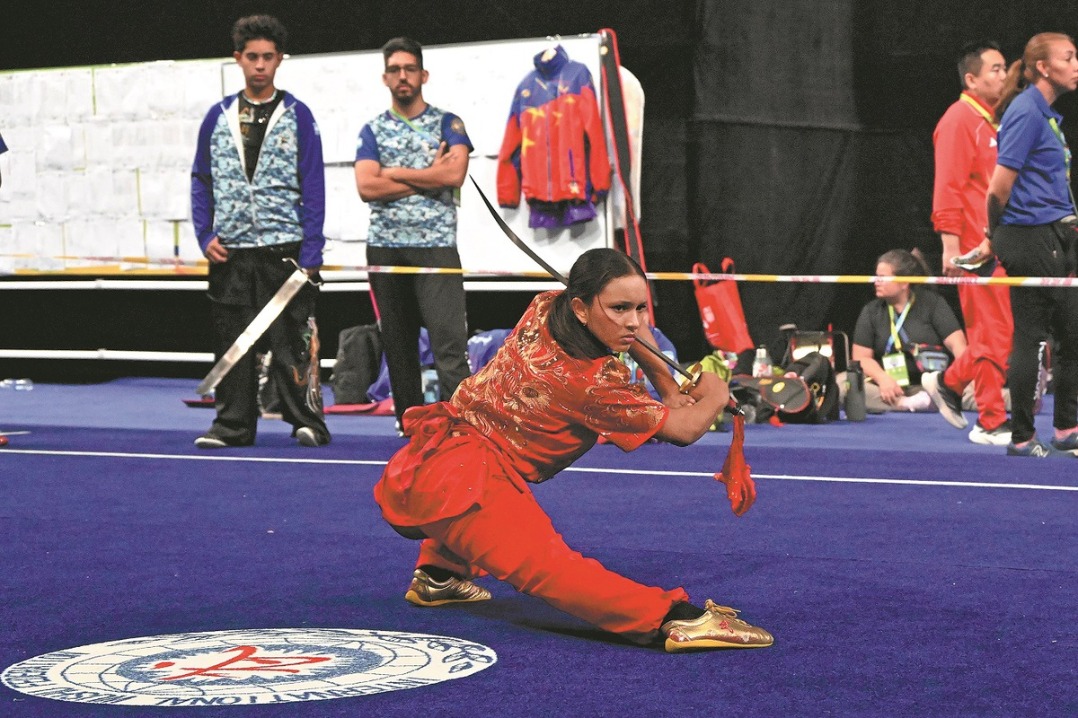
Fresh off the closing ceremony of the 10th World Youth Wushu Championships in Tianjin, an impromptu, unplanned game unfolded on a nearby outdoor basketball court. With no official equipment to hand, a ragtag group of teenage athletes drawn from four continents chased after nothing more than an empty plastic water bottle, laughing and competing with none of the formality of the tournament they had just exited.
Just hours before, these same young competitors had stood opposite one another on the competition mat, locked in focused, disciplined combat for championship placement. Now, all tournament rivalry had melted away. This casual, joyful scene perfectly encapsulated the core philosophical paradox at the heart of wushu: it is a martial art that teaches practitioners how to strike, first and foremost to build the self-discipline to avoid unnecessary conflict.
For 20-something Swiss competitor Leandro Gia-Hy Luong, who inherited his love of wushu from his father, the most valuable lesson the sport has taught him is not a powerful high kick or a lightning-quick palm strike. It is a simple two-word rule drilled into him by his coach: “Don’t fight.” For Luong, wushu is first and foremost an exercise in intentional self-restraint. It is defined as the art of “stopping conflict” — a philosophy that is even written into the etymology of the Chinese character for “martial” (wu), which combines the character radicals for “stop” and “spear”.
Anthony Sims, a veteran American referee with more than two decades of experience officiating wushu competitions, echoed this perspective. “In almost every sanda match I officiate, I see the exact same pattern,” he shared. “After an intensely competitive bout on the platform, competitors walk off the mat and immediately embrace, or exchange warm shoulder pats to encourage one another.”
When asked to sum up wushu in just three words, Sims did not select common descriptors of martial skill like “strength”, “speed” or “agility”. Instead, he chose “perseverance”, “humility” and “growth”. After 20 years on the job, Sims says he has seen firsthand that wushu delivers far more than physical fitness. It builds mental fortitude and instills core values such as self-restraint, regular self-reflection, and lifelong personal growth — and that mental development, he says, matters far more than any competition medal. For the hundreds of young international athletes who gathered in Tianjin for this year’s youth championships, the event proved less a fight for placement and more a gathering that built cross-cultural connections and life-changing personal lessons that will outlast any tournament result.