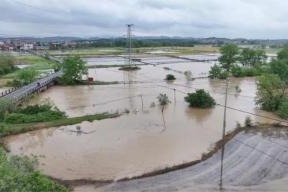
BEIJING – As consecutive rounds of extreme rainfall continue to batter southern China, national emergency management authorities have formally deployed comprehensive flood prevention, emergency response, and disaster relief operations across high-risk key regions, the Ministry of Emergency Management announced Tuesday.
Preliminary meteorological data shows recent downpours across parts of Hunan, Guizhou, and Jiangxi provinces have already shattered historical rainfall records for this time of year. Following the first widespread intense rainfall event that swept through the region starting April 20, a second wave of heavy precipitation is projected to hit southern China beginning April 26, according to the joint meeting co-hosted by the Ministry of Emergency Management and the State Flood Control and Drought Relief Headquarters.
Meeting participants highlighted that prolonged continuous rainfall has left soil in multiple affected areas completely saturated, drastically increasing the likelihood of flash floods and catastrophic geological disasters including landslides and mudslides.
To mitigate emerging risks, the joint meeting outlined a series of priority action items for local and regional authorities. First, officials are directed to strengthen real-time monitoring, meteorological forecasting, and early warning systems, leveraging multi-source data to boost the accuracy of short-term rainfall and hazard projections, expand the reach of early alert networks, and guarantee that warnings reach individual households, villages, and grassroots townships without delay.
Second, the meeting stressed that special attention must be paid to flood safety at high-risk populated sites, ordering authorities to prioritize flood prevention and contingency planning at elderly care centers, active construction sites, and popular tourist attractions where large groups of people may gather.
Finally, the meeting called for systematic full inspections of critical water infrastructure, including reservoirs, river dikes, and major hydropower and water conservancy projects, with targeted reinforcement measures to address existing structural vulnerabilities. It also ordered the pre-positioning of disaster relief supplies and emergency response equipment in high-risk zones to enable rapid deployment when disasters strike.