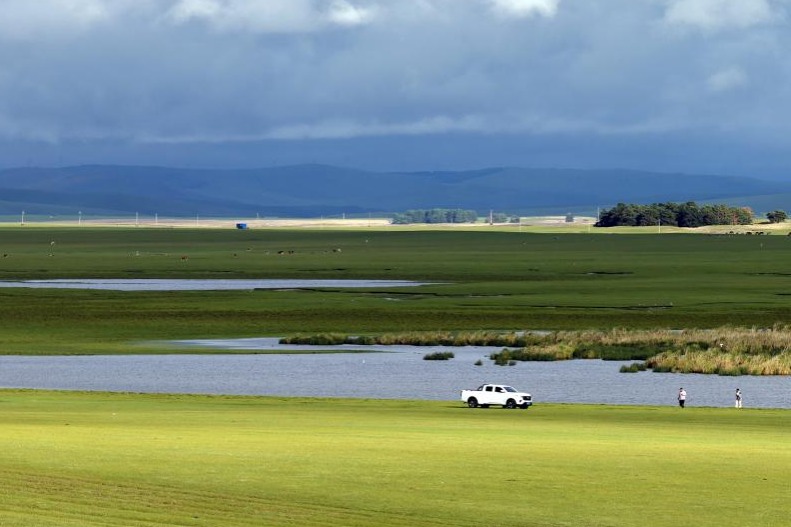
BEIJING — To strengthen long-term grassland ecological conservation across the country, China has established 167 national-level field observation and research stations dedicated to monitoring grassland ecosystems, a leading grassland science expert announced Tuesday at a Beijing press conference hosted by the State Council Information Office.
Xin Xiaoping, director of the National Observation and Research Station for Grassland Ecosystems located in China’s northern Inner Mongolia Autonomous Region’s Hulun Buir, outlined that these specialized stations serve as core infrastructure supporting both China’s national ecological civilization initiative and large-scale ecological disaster prevention and mitigation work.
Describing the unique function of these field sites, Xin compared them to the human body’s sensory receptors, saying: “Just as hands can sense warmth and cold, the stations act as permanent outposts that let us detect and track subtle changes in grassland ecosystems in real time.”
At Xin’s own Hulun Buir station, researchers have collected 30 years of uninterrupted observational data, amassing more than 20 million structured records. This massive long-term dataset has fundamentally reshaped scientific and public understanding of grassland biodiversity in the ecologically critical Hulun Buir region, one of China’s largest temperate grasslands. Beyond data collection, the station has conducted dozens of targeted research projects to pinpoint the root causes of grassland degradation and develop evidence-based, locally tailored restoration strategies.
The national observation network also functions as a real-world testbed and demonstration zone for cutting-edge ecological technologies. Last year, for example, the world’s first integrated grazing robot and unmanned aerial vehicle (UAV) monitoring system was deployed and tested at the Hulun Buir station. “These stations are exactly where we can test how new scientific and technological advances can deliver tangible benefits to local herdsmen,” Xin explained.
Xin’s research team has already scaled up proven grassland restoration technologies across a 100,000 mu (equivalent to roughly 6,667 hectares) demonstration area in Hulun Buir. Initial results from the project show a dramatic 200 to 600 percent increase in grass yield within the restored zone, marking a major success for both ecological recovery and local pastoral productivity.
In addition to their core research and ecological functions, the network of stations serves as a collaborative bridge between the scientific community and public stakeholders. They operate as open research platforms supporting hundreds of domestic universities and research institutions, have trained generations of early-career ecologists focused on grassland conservation, and provide evidence-based policy recommendations to guide national and regional grassland management decision-making.