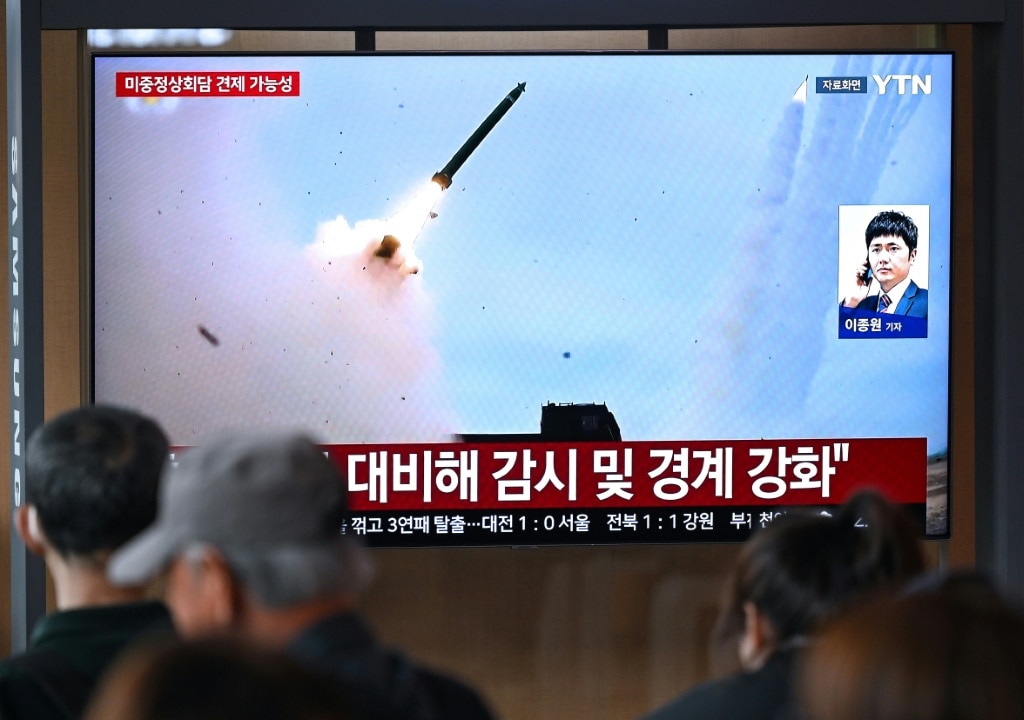
In a recent series of provocative military moves that have stoked regional tensions, North Korea has officially confirmed it carried out a test of short-range ballistic missiles fitted with cluster munition warheads over the weekend, with leader Kim Jong Un personally overseeing the exercise. The Korean Central News Agency (KCNA), Pyongyang’s official state mouthpiece, released details of the Sunday test on Monday, marking the latest in a steady stream of weapons trials conducted by the nuclear-armed East Asian nation in recent months. According to KCNA’s official statement, the drill was designed to evaluate the performance and destructive power of both cluster bomb warheads and fragmentation mine warheads integrated into the country’s domestically developed tactical ballistic missile system. This test follows just weeks after a string of other weapons assessments, including launches of longer-range ballistic missiles, anti-ship cruise missiles, and additional trials of cluster munition technology.
The weekend test focused specifically on the Hwasongpho-11 Ra, a surface-to-surface tactical short-range ballistic missile developed by Pyongyang. KCNA reported that five missile projectiles were launched toward a target zone surrounding an island located roughly 136 kilometers (85 miles) from the original launch site. The warheads successfully covered an impact area ranging from 12.5 to 13 hectares with what the agency described as “very high density,” fully demonstrating the system’s operational combat capacity. Kim Jong Un expressed high satisfaction with the outcome of the test, noting that the advancement of cluster bomb warhead technology will dramatically strengthen North Korea’s military capabilities both for high-precision strikes and large-scale high-density attacks against designated enemy target zones.
Regional security analysts point out that the 136-kilometer confirmed range of the tested missile system places both South Korea’s capital Seoul and major United States military installations across the Korean Peninsula well within Pyongyang’s striking range. Hong Min, a senior research fellow at the Seoul-based Korea Institute for National Unification, explained that this new weapons platform is intended to fill a critical capability gap between North Korea’s existing multiple rocket launcher systems and its longer-range short-range ballistic missile arsenal. Yang Moo-jin, a professor of Korean studies at Seoul’s University of North Korean Studies, highlighted a notable shift from previous weapons tests: frontline corps commanders, rather than just weapons development researchers, were invited to observe the latest trial. Yang said this shift strongly indicates the system is approaching full operational deployment, and would be capable of being launched directly from forward-deployed positions against targets in South Korea and at U.S. military bases across the region.
The United States maintains roughly 28,000 active-duty troops in South Korea as part of its long-standing security commitment to defend the South against potential Northern aggression. South Korea’s military first detected the launches on Sunday from the Sinpo area along North Korea’s eastern coast, and quickly issued a formal condemnation of the test. In an official statement, South Korea’s Ministry of National Defense said the country is maintaining a “firm combined defense posture” alongside the United States, and pledged an “overwhelming response” to any future provocation from the North. The statement called on Pyongyang to immediately end its series of successive missile tests that have sharply escalated regional tensions, and urged North Korea to engage constructively with the South Korean government’s ongoing diplomatic efforts to build lasting peace on the peninsula.
Security analysts widely interpret the latest test as a clear signal that Pyongyang has rejected recent overtures from Seoul to repair long-strained inter-Korean relations. Earlier this year, Seoul issued an expression of regret over unauthorized civilian drone incursions into North Korean airspace in January, a gesture Pyongyang initially appeared open to before reversing course and once again labeling South Korea as its “most hostile” enemy. North Korea has long been subject to sweeping United Nations sanctions that ban all development of nuclear weapons and prohibit any work on ballistic missile technology, restrictions Pyongyang has openly and repeatedly violated in recent years as it expands its military arsenal.
The latest missile test comes just weeks after another high-profile military exercise in April, when Kim Jong Un oversaw tests of strategic cruise missiles launched from a North Korean navy warship. Official photos from that April trial showed Kim observing the launches surrounded by top military officials. The cruise missile tests were conducted from the Choe Hyon, one of North Korea’s two newly commissioned 5,000-ton destroyers, both of which entered service last year. According to South Korean military sources, Pyongyang is currently constructing two additional 5,000-ton destroyers to expand its naval fleet. This month, a South Korean lawmaker cited recent satellite imagery collected by a U.S.-based private intelligence firm, claiming North Korea is “accelerating the modernization of its naval forces with support from Russian military assistance.” Observers widely believe North Korea has supplied thousands of artillery shells and ground troop support to Russia for its full-scale invasion of Ukraine, and in return is receiving advanced military technology and expertise from Moscow to advance its own weapons development programs. Notably, neither North nor South Korea has signed the 2008 Oslo Convention on Cluster Munitions, an international treaty that bans the use, production, transfer, and stockpiling of the controversial weapons, which scatter submunitions across wide areas and often leave unexploded ordnance that poses long-term risks to civilian populations.