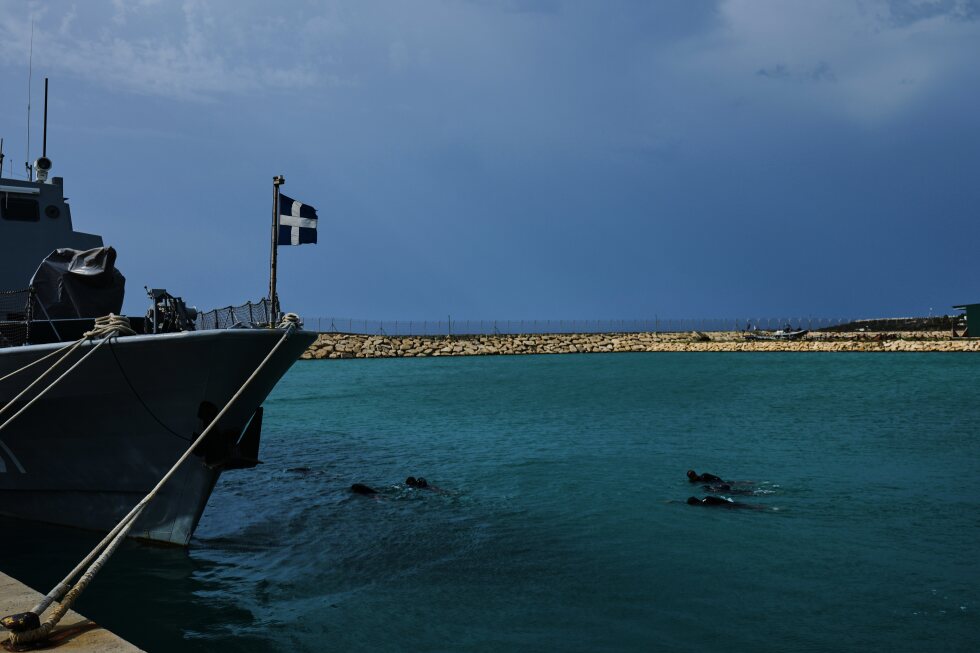
In the strategically vital eastern Mediterranean, the island nation of Cyprus is undertaking a major upgrade of its core military infrastructure, backed by U.S. taxpayer funding, to solidify its growing role as a secure evacuation hub and humanitarian logistics center for conflict-plagued regions of the Middle East.
The Associated Press secured rare exclusive access to the restricted military sites, where National Guard spokesperson Lieutenant Colonel Paris Samoutis outlined the scope of the improvements. Located just 229 kilometers off the coast of Lebanon, Cyprus’ primary Evangelos Florakis Naval Base will gain a new heliport financed by U.S. European Command. The facility is engineered to accommodate large heavy-lift rotorcraft such as Chinook transport helicopters, designed to streamline the evacuation of civilians and displaced people out of active conflict zones. Beyond the heliport, the naval base will also see extensive renovations to its port infrastructure, allowing it to berth larger vessels including frigates that bring advanced radar and missile-based air defense capabilities to protect incoming and outgoing humanitarian missions.
On the island’s southwestern coast, the Andreas Papandreou Air Base will undergo expansion to add a new aircraft apron. This dedicated space will cut turnaround times for refueling and maintenance of dozens of heavy-lift military transport aircraft, which ferry personnel and emergency equipment to support regional humanitarian response operations. A regional wildfire coordination center, designed to assist neighboring Middle Eastern nations in combating large-scale seasonal blazes, is also set to open at the air base next month.
While exact total project costs have not been publicly released as final cost assessments are still ongoing, the U.S. has already committed 500,000 euros ($588,000) to develop the detailed expansion plan for the air base. Construction on both projects is scheduled to break ground next year, as part of a broader multi-site infrastructure upgrade initiative across Cyprus’ military facilities. The U.S. funding is explicitly earmarked to help Cyprus scale up its capacity to handle large-scale humanitarian crisis response operations.
This deepened security cooperation between Washington and Nicosia would have been unthinkable a decade ago. For decades, Cyprus maintained a strict policy of non-alignment in global geopolitics, but it has gradually shifted its diplomatic orientation firmly toward the West. That shift accelerated after President Nikos Christodoulides, an American-educated leader, took office in 2023. Under his administration, diplomatic outreach to the U.S. reached unprecedented levels, resulting in the end of a decades-long U.S. arms embargo on Cyprus and opening new doors for bilateral economic opportunity.
Christodoulides has consistently leveraged Cyprus’ unique geographic location to make the case to European Union and U.S. leaders that the island is the ideal hub for Western diplomatic, economic, and humanitarian engagement with the volatile Middle East. “As a conscientious and responsible partner, Cyprus remains a credible and safe harbor,” Christodoulides stated in a December address.
For years, the U.S. military relied on the two British sovereign base areas that the U.K. retained on Cyprus after the island gained independence from colonial rule in 1960. However, that arrangement was upended in early March, when a Shahed drone—confirmed by Cypriot officials to have been launched from Lebanon—struck an aircraft hangar at RAF Akrotiri, the first drone attack on EU territory tied to the wider Iran-Israel regional conflict. The upgrades to Cyprus’ own national military installations now provide Washington and other Western partners with alternative, sovereign infrastructure to support regional operations.
Cyprus has already built a proven track record of facilitating humanitarian and evacuation operations in recent years. In April 2023, it served as a primary transit point for the repatriation of third-country nationals fleeing the conflict in Sudan. When regional tensions escalated following U.S. and Israeli strikes on Iranian nuclear facilities in June 2025, Cyprus again acted as a safe way station for foreign nationals leaving Israel and for Israelis stranded abroad to return home. In 2024, the island launched the Amalthea maritime corridor, which delivered thousands of tons of emergency humanitarian aid to war-torn Gaza—first directly, then via the Israeli port of Ashdod.
Dozens of EU member states and other nations have already pre-positioned civilian personnel, military units, helicopters, and fixed-wing aircraft in Cyprus to support potential future evacuation operations for their citizens. In 2024, the U.S. deployed a marine contingent and a fleet of V-22 Osprey tiltrotor aircraft to Cyprus’ Paphos Air Base specifically to assist with evacuation operations out of Lebanon.
A core red line has remained clear from the Cypriot government: all use of the upgraded military installations will be restricted exclusively to humanitarian operations, and will never be used for offensive military action. Echoing President Christodoulides’ core governing mantra for the island’s regional role, Samoutis emphasized: “Cyprus remains part of the solution, not the problem.”