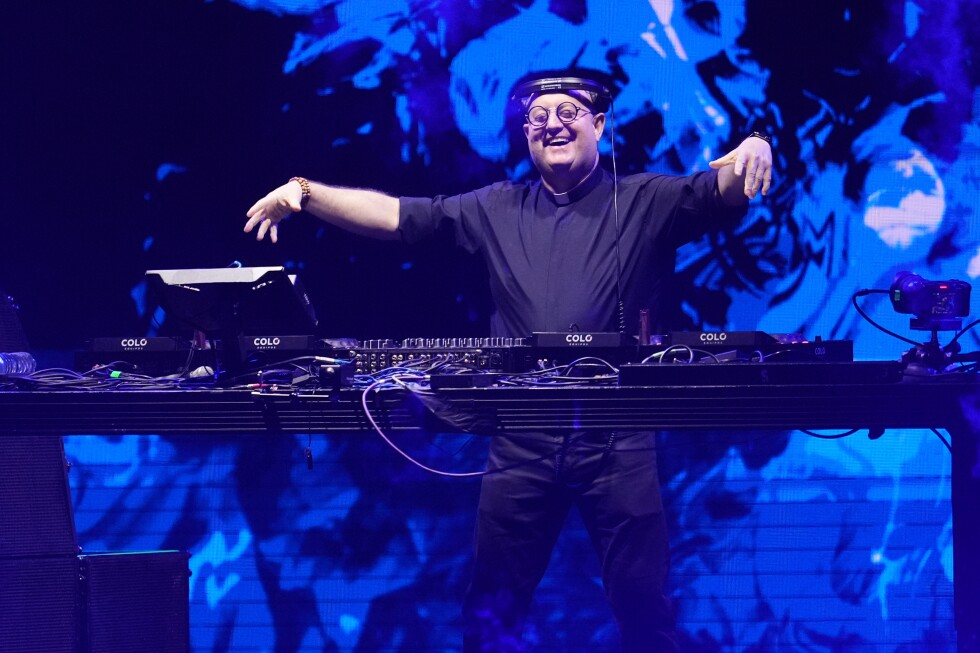
One year after the passing of Argentine-born Pope Francis, his image and legacy returned to the heart of Argentina’s capital Buenos Aires — not through divine miracle, but through the pulsing beats of a unique Portuguese priest who has turned DJing into a tool for modern evangelization.
Guilherme Peixoto, a 50-something Catholic priest better known to his global fanbase as Padre Guilherme, headlined a public tribute rave Saturday at Buenos Aires’ iconic Plaza de Mayo to honor the former head of the Catholic Church, who died in April 2025. As attendees ranging from lifelong Catholics to religious agnostics danced to the mixed tracks flowing from Peixoto’s booth, three massive screens overhead projected images of Pope Francis, former Pope John Paul II, and symbolic white doves.
Before Peixoto stepped into view, clad in his priestly vestments and wearing a professional pair of DJ headphones, a voice-over welcomed the crowd: “God bless you, and let’s dance.” For the following two hours, the priest blended pulsing techno beats with traditional religious melodies, delivering a one-of-a-kind experience that cost attendees nothing. “This is a unique opportunity to see him, and it’s free,” noted Jesús Martín, a 54-year-old Spanish electronic music fan who attended the event. “Compare that to Ibiza, where you’d pay 150 euros just for entry, and up to 2,000 euros for a VIP pass.”
Today, Padre Guilherme is a global cultural sensation, with a following of 2.8 million Instagram followers and more than 220,000 monthly streams of his work on Spotify. But his dual journey as a priest and electronic artist began decades ago, rooted in a family promise. Ordained in 1999, his entry to the priesthood was driven both by personal religious vocation and a promise his mother made to God when he survived a life-threatening childhood illness.
Electronic music started as a casual hobby parallel to his pastoral work. In the 2000s, he began spinning tracks at university events and organizing community dance parties to raise funds for his parish. Back then, he hid his hobby from church leadership, asking no one to publish photos of his DJ sets out of fear of disciplinary retaliation from superiors. Those fears vanished completely in 2013, when Cardinal Jorge Bergoglio — an Argentine prelate — was elected Pope Francis, bringing a new open, outreach-focused leadership style to the global church.
Peixoto recalled how Pope Francis’ messages gave him the courage to embrace his dual calling openly. “He often said, ‘Don’t be afraid,’ that we had to go out to the peripheries and that ‘We shouldn’t be afraid to use our hands,’” Peixoto told the Associated Press ahead of the Buenos Aires tribute. “These messages were an inspiration.”
With that newfound confidence, Peixoto enrolled in formal DJ training, reached out to established electronic music producers, and began writing his own original tracks. Soon after, invitations to play at festivals and clubs across Portugal and beyond began rolling in. He broke into the global spotlight after a well-received set at 2023 World Youth Day, performed just before Pope Francis celebrated the event’s open-air Mass.
“I will never lose this connection with Pope Francis,” Peixoto said. “He was the one who touched my heart with this facet of music.”
Many attendees at the Plaza de Mayo tribute had not followed Peixoto’s career before the event. Silvia Garaggiola, a 60-year-old local attendee, said she first learned of the priest-DJ when the tribute was announced. “I came to remember the Pope, but I think what he does is very original, as long as it’s done respectfully,” she explained. Saturday’s setlist included Peixoto’s popular original track “El Grano de Mostaza” alongside upbeat remixes of hits from Bad Bunny and Queen.
From Spain’s massive Medusa Festival to Mexico’s Dreamfields and the famous Hï Ibiza club — located in the Spanish resort island often called the electronic music “Vatican” — Peixoto has brought his message of peace and coexistence to thousands of young people, most of whom do not actively practice Catholicism. At the Buenos Aires rave, the atmosphere matched any mainstream electronic music event: haze from tobacco and cannabis hung over the crowd, teenage attendees danced and imitated Peixoto’s signature hand movements behind the booth, and swirling laser lights transformed the historic public square into a pulsing open-air nightclub.
“It sounds really good,” commented 17-year-old attendee Ileana González. “I have zero religion, but I’m having fun.”
In recent decades, the Catholic Church has struggled to connect with younger generations, pushed away by institutional resistance to modernization, opposition to sexual diversity, and ongoing clergy abuse scandals. Pope Francis made breaking down these barriers a central goal of his revolutionary papacy, and Peixoto — an admirer of iconic electronic artists Carl Cox and Anyma — sees his DJ work as carrying that legacy forward.
“I believe it is incredibly important to make young people smile, to help them feel happy with themselves, rather than associating happiness with merely possessing this or that material thing,” he said.