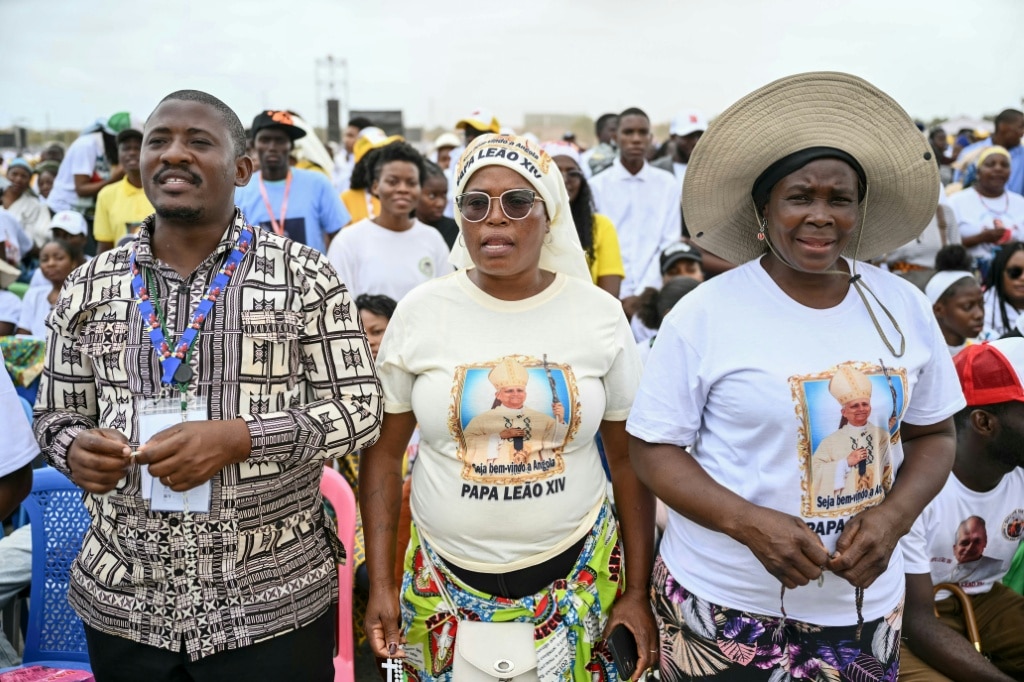
On the second day of his high-stakes visit to Angola, a resource-rich southern African nation grappling with systemic widespread poverty, Pope Leo XIV led a massive open-air Holy Mass on Sunday that drew tens of thousands of pilgrims and hopeful attendees to the Kilamba district on the outskirts of the capital, Luanda.
The pontiff arrived in the Portuguese-speaking country Saturday to kick off the third leg of his 11-day, four-nation tour across the African continent. Immediately after landing, he held a formal meeting with Angolan President Joao Lourenco and top government officials, where he delivered sharp criticism of systemic oppression, the deep human suffering driven by extreme poverty, and the unregulated exploitation of Angola’s abundant natural resources. These remarks aligned with the core theme of his entire tour, which has centered on repeated warnings about the scourge of transnational corruption and the continued plunder of African natural wealth by foreign and domestic elites.
For many in the crowd, the Pope’s visit represented a rare opportunity to appeal for global attention to Angola’s paradox of plenty: a nation sitting on some of the continent’s largest reserves of crude oil and diamonds, yet marked by crippling income inequality. Thirty-two-year-old attendee Patricio Musanga, who wore a branded cap and T-shirt emblazoned with the Pope’s image, told reporters he had come seeking a message of encouragement for Angola’s struggling youth. Facing persistent mass unemployment, thousands of young Angolans flee every year to Western countries in search of better economic prospects. Musanga noted, “We are very rich in natural resources but … there is a glaring inequality between those who live well and the others,” adding that he hoped the Pope would reinforce that Angolans can build prosperous lives at home without leaving for opportunities abroad.
World Bank data underscores this gap: despite its status as one of Africa’s top crude oil producers, roughly one-third of Angola’s 36.6 million residents live below the international poverty line. Father Pedro Chingandu, who traveled from Angola’s eastern Moxico Province to attend the mass, pointed to decades of conflict as a key driver of persistent inequality. “There’s a concentration of wealth in the hands of very few, and of course the war just aggravated the situation,” he told Agence France-Presse, calling for “real democracy and the redistribution of wealth and justice” across the country. Angola has yet to fully heal from the 27-year civil war that broke out immediately after the nation gained independence from Portugal in 1975, only ending in 2002.
Following the Kilamba mass, Pope Leo is scheduled to travel 110 kilometers by helicopter to Muxima, Angola’s most sacred Catholic pilgrimage site. The small river town is home to a 300-year-old church that overlooks the Kwanza River, once a major transit route for enslaved Africans trafficked to the Americas. Built by Portuguese colonial settlers to baptize enslaved people before they were shipped across the Atlantic, the church houses the beloved statue of the Virgin Mary known locally as “Mama Muxima,” which draws two million pilgrims annually. Large crowds are expected to greet the pontiff during his stop at the historic slave-route shrine.
The Angolan government has drawn criticism for its multi-million-euro infrastructure project to build a new basilica, residential housing, and expanded public services in Muxima ahead of the Pope’s visit, with opponents questioning the government’s spending priorities at a time when widespread poverty persists across the country. Economic frustration already boiled over into public unrest last July, when a three-day looting spree across Luanda and other urban centers left roughly 30 people dead, many killed during what critics called a heavy-handed police crackdown. Political analysts have framed the unrest as a clear signal of widespread public dissatisfaction with the ruling socialist MPLA party, which has held uninterrupted control of the Angolan government since independence in 1975.
In comments to reporters on his flight to Angola, the Pope, who was elected to the papacy one year ago, opened up about a recent public dispute that has overshadowed much of his African tour. He expressed regret over his public war of words with U.S. President Donald Trump, who has attacked the Pope as “weak” after Leo called for an immediate ceasefire to end the ongoing war in the Middle East. “It is not in my interest at all” to publicly debate the U.S. leader, the Pope affirmed.
After wrapping up his engagements in Angola, Pope Leo will travel to Equatorial Guinea for the final stop of the 18,000-kilometer cross-continental tour, concluding a journey that has centered the needs of African nations and the urgent need for equitable global development.