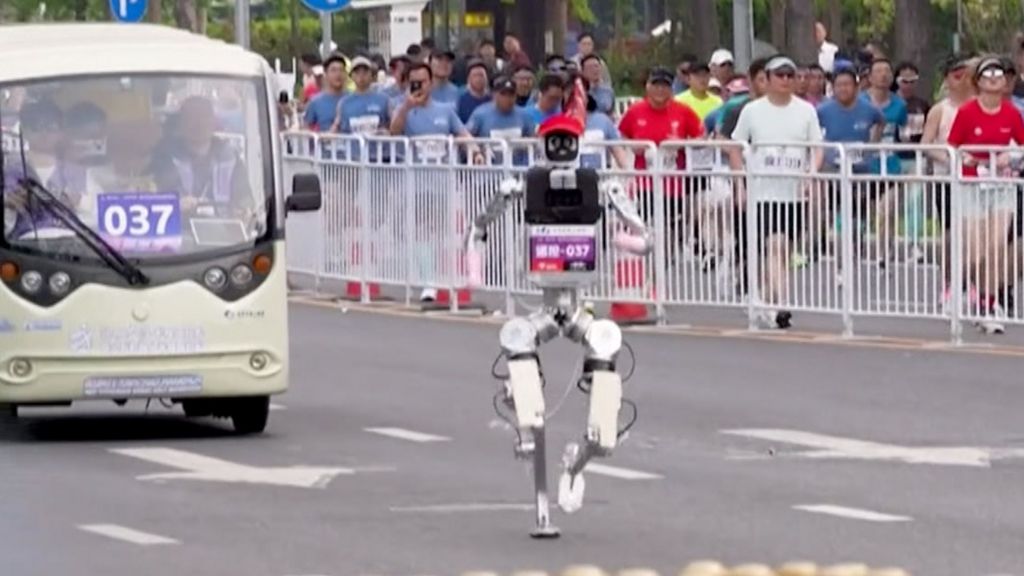
In a groundbreaking clash between human athleticism and artificial engineering, Sunday’s half marathon in Beijing delivered a stunning result that turned heads across the global sports and technology communities: a robotic competitor outperformed all its human runners, finishing far ahead of the pack to claim a historic victory.
The unusual race, which pitted elite and amateur human runners against a fleet of advanced robotic entrants, marked one of the first public head-to-head competitions between man and machine in a mainstream long-distance running event. The event organizers designed the matchup to showcase advancements in robotics and mobility technology, while also creating a one-of-a-kind spectacle for spectators gathered along the race route.
By the final kilometer of the 21.1-kilometer course, the top-performing robot had already opened an insurmountable lead over the nearest human contender. Crossing the finish line well ahead of the entire human field, the winning machine cemented its place as the unlikely champion of the day, leaving even the fastest human rivals trailing far in its wake.
The event has sparked new conversations about the rapid progress of robotic engineering, and how automated systems are increasingly crossing into domains long dominated by human physical performance. While many in attendance viewed the matchup as a lighthearted exhibition, the outcome also highlights just how far mobility technology has advanced in recent years, opening new questions about future intersections of sports, technology and human competition.