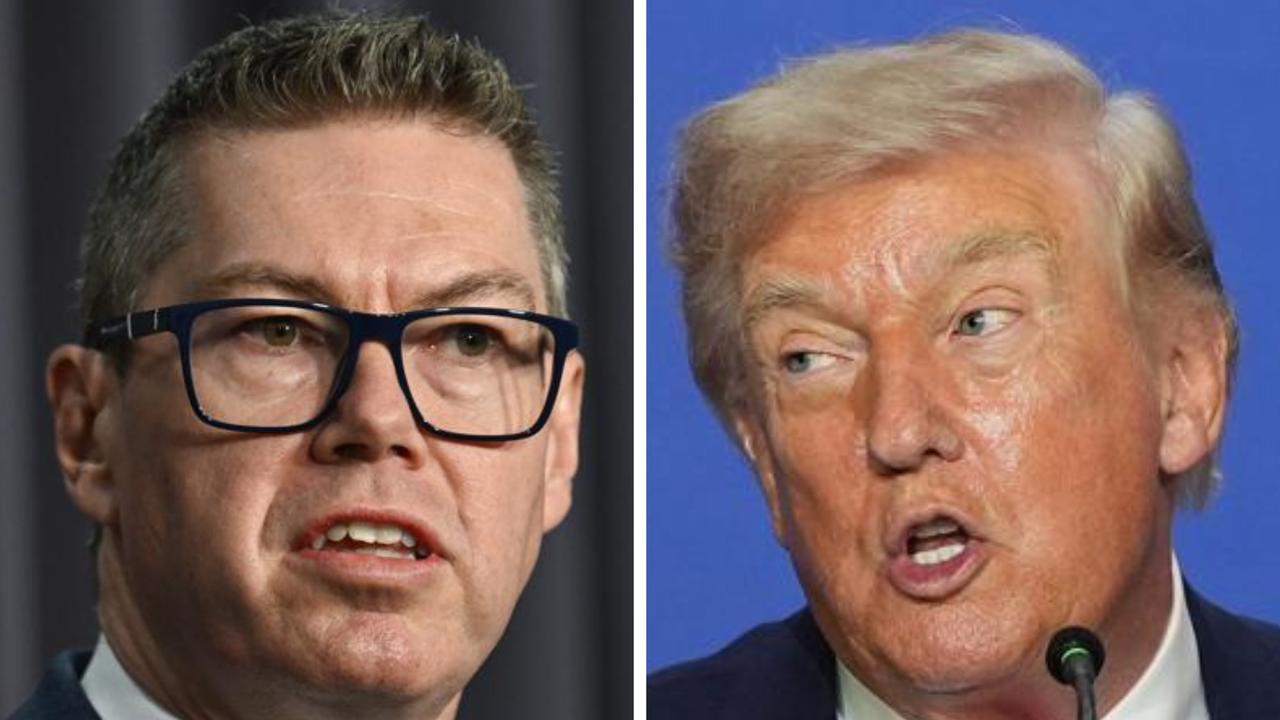
A sharp public disagreement has erupted between former U.S. President Donald Trump and Australia’s federal government over claims of an unmet request for military support in the strategically critical Strait of Hormuz, a dispute unfolding against a backdrop of renewed regional tension after Iran reimposed shipping restrictions on the key global energy waterway.
Trump has repeatedly targeted Australia in public criticism since recent joint U.S.-Israeli strikes on Iran, launching his fourth public rebuke of the country this week during a press briefing. The former president told reporters he was deeply dissatisfied with Australia’s refusal to join a U.S.-led naval coalition in the Strait of Hormuz, saying, “I’m not happy with Australia because they were not there when we asked them to be there. They were not there, having to do with Hormuz. So I’m not happy, I’m not happy with them.”
This public callout follows an earlier inconsistent outburst on Truth Social, where Trump first claimed the U.S. had achieved such overwhelming military success that it no longer needed or wanted assistance from allied nations, even writing “WE NEVER DID!” before singling out Australia, South Korea, and Japan for their reluctance to back U.S. military actions. He had previously told reporters he was caught off guard by Australia’s unwillingness to join the effort.
But top Australian government officials have pushed back forcefully against Trump’s claims, uniformly denying that any request for naval support in the Strait of Hormuz — either formal or informal — has ever been received from Washington. Defence Industry Minister Pat Conroy reiterated this position during an appearance on Sky News’ *Sunday Agenda*, declining to engage further with Trump’s personal criticism but confirming that no ask for naval assets has been made. “What I can say to you and your viewers is we’ve had no formal request to provide naval assets to the Strait of Hormuz,” Conroy stated Sunday.
According to Conroy, the only recent military assistance request from the U.S. was for Australia to deploy an E7A Wedgetail airborne early warning and control aircraft to provide defensive support to the United Arab Emirates, a request that was also made directly by the UAE government itself. When pressed to confirm whether any informal request for Strait of Hormuz support had been extended by U.S. officials, Conroy responded, “Not to my knowledge.”
Prime Minister Anthony Albanese has previously echoed this denial, noting that the Australian government maintains regular, open communication with U.S. counterparts and that no request for coalition participation has been raised.
The political dispute comes as regional tensions flared again overnight, when Iran announced it would reimpose shipping restrictions on the Strait of Hormuz — just less than 24 hours after the waterway was reopened to commercial traffic. Iranian officials cited “repeated breaches of trust” by the U.S. during a recent temporary ceasefire, and demanded that Washington lift its ongoing blockade of Iranian ports and its coastline. The closure of the strait, which handles roughly a fifth of global oil supplies, has already triggered disruption to international energy markets.
Australian Defence Minister Richard Marles described Iran’s decision to reclose the strait as a “disappointing development” in comments to ABC’s *Insiders*. “Clearly, this is a situation which is in flux … I think what we need to see now is every diplomatic avenue being pursued to turn this temporary ceasefire into one that is permanent, open the Strait of Hormuz to return the global fuel supply chain to normality, and to put events on a pathway to peace,” Marles said. He added that de-escalation and reopening the strait aligns with both Australia’s national interests and the broader interests of the global community.
Marles declined to comment on Australia’s position regarding the U.S. blockade of Iran, saying only that “Iran blocked the Strait of Hormuz, and America has reacted. I’m not about to second guess America’s reaction in the context of that.”
The story remains developing as diplomatic efforts continue to address the regional crisis.