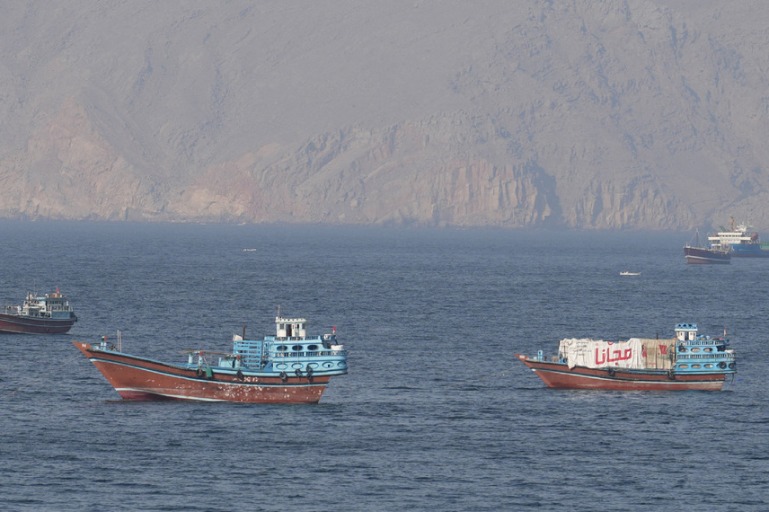
Just 24 hours after the Strait of Hormuz, one of the world’s most critical energy shipping chokepoints, was reopened to global traffic, Iran’s military announced Saturday it is reimposing sweeping strict controls over the waterway. The move directly responds to the ongoing US blockade of Iranian maritime ports, with Tehran stating the enhanced military oversight will remain in place until Washington fully lifts the restrictive measure.
Iran has labeled the US blockade as nothing less than state-backed piracy and illegal maritime plunder, drawing a sharp rebuke from US President Donald Trump, who dismissed Iran’s actions as unacceptable blackmail while claiming negotiations between the two nations are still progressing smoothly. Multiple on-the-ground reports confirm escalating incidents in the strait over the past 24 hours: The Washington Post documented Iranian forces opening fire on a tanker attempting to transit the lane early Saturday, while the UK Maritime Trade Operations (UKMTO) confirmed an unidentified vessel was struck by unknown munitions, damaging several cargo containers but leaving no crew members injured. Iran’s Islamic Revolutionary Guard Corps also fired on and turned away two supertankers registered under the flag of India, according to regional maritime sources.
Following the escalation, Trump convened an emergency high-level strategy session in the White House Situation Room, bringing together top national security and economic officials including Vice President JD Vance, Secretary of State Marco Rubio, Defense Secretary Pete Hegseth, and Treasury Secretary Scott Bessent to map out the US response. The president told reporters he expected clarity on whether a comprehensive deal could be reached by the end of Saturday, but as of 8 pm Eastern Time that day, no official progress on negotiations had been announced. Iranian state media, however, confirmed the country’s Supreme National Security Council is currently reviewing new diplomatic proposals put forward by the US. Trump downplayed the renewed tensions, noting Iran “got a little cute” by reimposing controls, but maintained bilateral talks with Tehran remain productive.
Real-time shipping data captured by global maritime trackers showed dozens of commercial vessels executing U-turns in waters adjacent to the strait Saturday afternoon, diverting away from the restricted lane to avoid potential conflict. Amid growing market uncertainty over the disruption to global energy supplies, global oil prices ticked upward in early trading Saturday. The Strait of Hormuz, which connects the Persian Gulf to the Gulf of Oman, carries roughly 20 percent of all globally traded oil, making even minor disruptions a major risk to international energy markets.
The waterway has remained a persistent flashpoint for conflict since US-Israeli joint military strikes against Iranian targets began on February 28. Iran has officially confirmed that more than 3,300 Iranian citizens have been killed in the ongoing strikes, and recent satellite imagery shows persistent fires still burning at damaged Iranian refineries, with large plumes of crude oil leaking into the Persian Gulf from damaged infrastructure.
Iranian Foreign Ministry spokesman Esmaeil Baghaei reiterated Saturday that war reparations for damage from the US-Israeli strikes will be a non-negotiable top priority in any peace talks with Washington. In a small sign of de-escalation, Iran also announced that six major domestic airports, including Tehran’s flagship Imam Khomeini International Airport, have reopened for preparation, though no commercial or passenger flights have yet been authorized to operate.
The sudden re-escalation in the Strait of Hormuz has thrown already fragile peace negotiations into further jeopardy. Just one day before Iran’s announcement, a 10-day ceasefire between Israel and Lebanon went into effect, raising cautious hopes for broader regional de-escalation. But renewed tensions in the Hormuz region now threaten to unravel that fragile progress, pushing the Middle East back toward the brink of wider conflict.