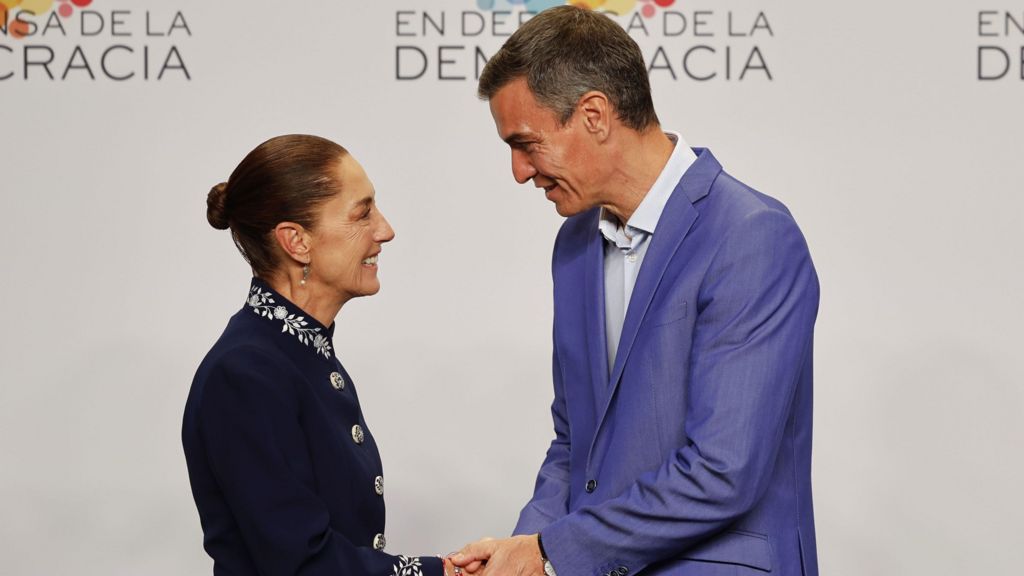
On a Saturday gathering of progressive leaders in Barcelona, Mexican President Claudia Sheinbaum moved to ease longstanding tensions over colonial history, stating publicly that there is “no diplomatic crisis” between Mexico and Spain after years of strained bilateral relations. Her remarks, delivered ahead of a meeting with Spanish Prime Minister Pedro Sánchez, came amid a carefully orchestrated rapprochement that ends an eight-year gap in visits by sitting Mexican presidents to the European nation.
The friction between the two countries stretches back to 2019, when Sheinbaum’s predecessor Andrés Manuel López Obrador publicly demanded a formal apology from Spain for systemic human rights violations committed during the 16th-century conquest of Mexico, a campaign that saw Spanish conquistadors topple the Aztec Empire and leave hundreds of thousands dead from violence and imported disease. When no official apology was forthcoming, Sheinbaum made a sharp diplomatic gesture in 2024 by uninviting Spain’s King Felipe VI from her inauguration, prompting Madrid to recall all official representatives from the event.
In recent months, however, a series of incremental steps have signaled a gradual warming of ties. During a March visit to a Madrid exhibition highlighting Indigenous Mexican women, King Felipe became the first Spanish monarch to openly acknowledge the harm of colonial rule, admitting that “a lot of abuse” occurred during the conquest, and that events judged by modern values cannot be a source of national pride. A month before that public acknowledgment, Sheinbaum had extended an invitation to the king to attend the 2026 FIFA World Cup, which Mexico will co-host alongside the United States and Canada. The Spanish royal palace confirmed Sheinbaum framed the tournament as a chance to highlight the deep, unique bonds between the two nations. This diplomatic shift follows a 2024 statement from Spanish Foreign Minister José Manuel Albares, who recognized the “pain and injustice” of shared colonial history and won praise from Sheinbaum for his candor.
Following Sheinbaum’s comments in Barcelona, Spanish Economy Minister cast the Mexican president’s attendance at the summit as a “very important and positive sign of rapprochement” between the two nations, while Sánchez himself declined to comment on the current state of bilateral relations.
The Barcelona gathering, formally the fourth edition of the “In Defence of Democracy” summit, brought together left-leaning global leaders to push back against a global surge in illiberal politics and extremist ideology. The event was deliberately convened to counter a parallel far-right rally held the same weekend in Milan, Italy, where leaders of Europe’s most prominent nationalist parties gathered to denounce immigration and European Union bureaucracy.
Opening the summit, co-host Pedro Sánchez warned that democratic norms can no longer be taken for granted. “We are witnessing attacks on the multilateral system, one attempt after another to challenge the rules of international law, and a dangerous normalisation of the use of force,” he told attendees. His co-chair, Brazilian President Luiz Inácio Lula da Silva, launched a scathing critique of the United Nations Security Council, arguing the body has become dysfunctional under the influence of its five veto-wielding permanent members – the United States, China, Russia, France, and the United Kingdom – whom he labeled “lords of war.” “No president of any country in the world, however powerful, has the right to keep imposing rules on other countries,” Lula added.
Across the Italian peninsula in Milan, thousands of supporters assembled for a rally organized by Patriots for Europe, the right-wing European Parliamentary grouping. The event featured major far-right figures from across the continent: Jordan Bardella, leader of France’s Rassemblement National and head of Patriots for Europe; Italian Deputy Prime Minister Matteo Salvini, the rally’s organizer; and Geert Wilders, leader of the Dutch far-right Party for Freedom. Among the absentees was Hungary’s outgoing Prime Minister Viktor Orbán, whose Fidesz party is part of the Patriots for Europe alliance. Orbán was ousted from power last weekend in Hungary’s general election by Péter Magyar, a former close ally turned political rival.
In his address to the crowd, Bardella said attendees would focus on two core grievances: uncontrolled immigration and the mounting regulatory burden imposed by the European Commission and EU institutions on eurozone industry and national economies. Salvini doubled down on this anti-establishment rhetoric, framing the Patriots for Europe alliance as the only genuine opposition to “Brussels bureaucrats who serve a few businessmen and warmongers.”