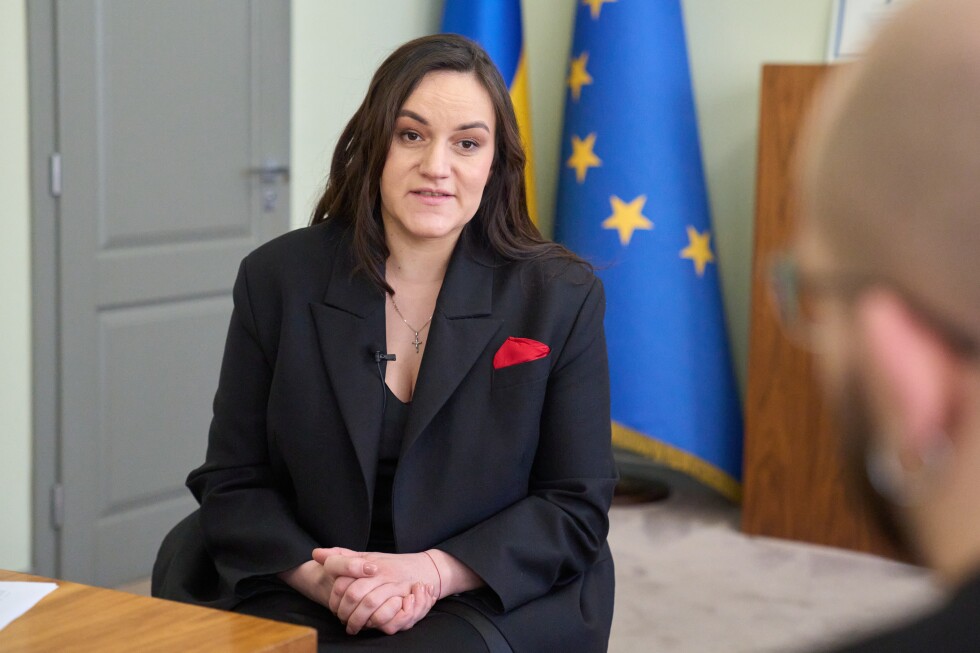
When Russian troops withdrew from Kherson in late 2022 after Ukraine reclaimed the strategic southern Ukrainian city, Alina Dotsenko, director of the Kherson Art Museum, returned to her workplace to a devastating scene: nearly all of the institution’s collections had been stripped and carted away.
“ I stepped inside to find every storage unit gutted, every shelf bare. My legs couldn’t hold me, and I just slid down the wall, crying like a child,” Dotsenko recalled in an interview with the Associated Press.
Before Russia launched its full-scale invasion in February 2022, the Kherson Art Museum housed more than 14,000 artworks spanning global creative traditions from North American pieces to Japanese art. Multiple sources, including Dotsenko and citizen footage captured after the liberation, confirm that retreating Russian forces loaded the majority of the collection onto military trucks and transported it to Crimea, the Ukrainian peninsula illegally annexed by Moscow in 2014. To date, the whereabouts of nearly 10,000 missing artifacts remain unknown.
Today, this act of cultural plunder is back in the international spotlight as Russia pushes to rejoin global cultural circles, just months ahead of the 2024 Venice Biennale — one of the world’s most prestigious contemporary art events. For the first time since 2022, event organizers have cleared Russian representatives to participate, a move Ukraine has sharply condemned. Kyiv argues the biennale “must not become a platform to whitewash the war crimes Russia commits daily against the Ukrainian people and our cultural heritage.”
Unlike most cases of cultural looting across Ukraine, the Kherson Art Museum theft is uniquely well-documented, thanks to pre-war preparation by Dotsenko herself. Years before the invasion, the director launched a full-scale project to photograph every item in the museum’s collection, building a comprehensive digital archive. When Russian forces occupied Kherson, Dotsenko hid the archive’s hard drives in secret, and retrieved them intact after liberation.
This detailed record has turned the Kherson case into a top priority for Ukrainian prosecutors and Interpol, who are using the catalog to trace missing works and build legal cases against those responsible for the looting. Unfortunately, this level of documentation is extremely rare across the country.
Across Ukraine’s occupied and war-torn regions, most pre-war cultural collections lack complete, accessible digital records. Russian occupying forces have deliberately seized or destroyed original inventory logs and collection documentation, making it nearly impossible to meet the strict evidentiary requirements for international legal claims to recover lost artifacts.
The experience of the Donetsk Regional Art Museum reflects this widespread challenge. Halyna Chumak, the museum’s former director, fled Russian-controlled Donetsk in 2014, shortly after Moscow first seized parts of eastern Ukraine. She was only able to smuggle out a fraction of the museum’s collection catalogs, documenting just over 1,000 of the institution’s 15,000 total works. Over the course of a year, Chumak carried the fragile documents through multiple armed checkpoints, leaving most behind to avoid attracting suspicion from pro-Russian search teams.
A decade later, a team led by Ukrainian entrepreneur Oleksandr Velychko is working to digitize these surviving catalogs, a painstaking process that took more than three months to process just 400 works. Once complete, the digitized database will be turned over to Ukrainian authorities to serve as partial legal evidence for future ownership claims.
Ukraine’s Prosecutor General Office currently has 23 open criminal cases focused on cultural heritage crimes, covering 174 separate incidents of looting, destruction, and damage to cultural sites. Anna Sosonska, deputy head of the office’s war crimes unit, explained that the Kherson case stands out from the rest almost entirely because of Dotsenko’s surviving archive.
“Russian forces almost always take inventory books and all original collection documentation from museums they occupy,” Sosonska explained in an interview. Without these records, prosecutors must rely on open-source intelligence, tracing looted artifacts through social media posts, auction house listings, and other online traces — a slow, labor-intensive process that can rarely reconstruct entire stolen collections. Still, Sosonska emphasized that cultural heritage crimes fall under international humanitarian law and carry no statute of limitations, meaning investigations will continue long after active fighting ends.
The full scale of Ukraine’s cultural losses remains impossible to calculate accurately. As of March 2024, Ukraine’s Culture Ministry confirms Russia has destroyed or damaged more than 1,700 designated cultural heritage sites and 2,503 cultural infrastructure facilities, including high-profile targets like the Mariupol Drama Theatre. More than 2.1 million museum objects are still held in Russian-occupied Ukrainian territory, and more than 35,000 items have been confirmed looted from territories Kyiv has retaken since 2022.
Moscow has moved to formalize its control over stolen cultural property. In 2023, the Russian government amended national legislation to add 77 Ukrainian museums from occupied Donetsk, Luhansk, Kherson, and Zaporizhzhia regions to Russia’s official national cultural catalog. Critics call this move a deliberate attempt to cement illegal ownership and block the eventual return of looted works to Ukraine.
Tetiana Berezhna, appointed Ukraine’s Culture Minister in October 2023, has made widespread digitization of all Ukrainian cultural collections a core priority for her ministry. “If we had fully digitalized all collections before the invasion, we would know exactly how many objects were stolen and exactly what they look like,” she noted.
There are small signs of progress on accountability for these crimes. In March 2024, a Polish court approved the extradition of Russian national Oleksandr Butiahin to Ukraine, where he faces charges for conducting illegal archaeological excavations in occupied Crimea and smuggling ancient artifacts out of the site that Ukraine recognizes as its sovereign cultural heritage. Butiahin was arrested in Poland in 2023 at Ukraine’s request, and the ruling is still subject to appeal. If extradited and convicted, this would mark the first time a Russian national faces prosecution in Ukraine for crimes against Ukrainian cultural heritage in occupied territory.
For Dotsenko, who has dedicated 50 years of her life to the Kherson Art Museum, the fight to recover the collection is deeply personal. She recently spoke to the AP at a Kyiv exhibition featuring high-quality reproductions of the stolen paintings, many of which have not been seen by the public since 2022. “While these works remain in captivity, all of us hold out hope that this will be resolved in favor of the Kherson Art Museum,” she said. “I did not spend 50 years of my life building this collection for nothing.”
The Russian Culture Ministry did not respond to repeated requests for comment from the Associated Press on the allegations of looted Ukrainian art. In past statements, Russian-installed officials in occupied Ukrainian territories have described the removal of cultural artifacts as “protective measures” to save works from damage during fighting. Kirill Stremousov, the former Russian-installed deputy administrator of occupied Kherson who died shortly before the city’s liberation, claimed looted statues would “definitely return” to Kherson once active fighting ended.